

4.2.5 Computer Simulated Particles
Mie theory remains a useful tool in cometary research because, despite there being
cometary dust particles in Earth laboratories, the scattering properties of the ensemble of cometary particles (including size distribution, shape, composition and porosity) are relatively poorly known. On the other hand, this situation is beginning to
change as spacecraft missions acquire more information and, as more knowledge is
acquired, the deficiencies in Mie theory for modelling work are becoming more
apparent.
Mie theory is restricted to spherical particles of constant refractive index throughout. There are techniques for determining the scattering of spherical particles with
radially dependent refractive indices but in general it is the spherical approximation
that is most questionable when discussing cometary dust particles. Evidence for the
fluffy, porous nature of cometary dust particles has been presented on numerous
occasions (Dollfus 1989; Hadamcik et al. 2007) although various shapes and degrees
of porosity might be expected when studying particles in detail. Simplified
approaches such as using equivalent spheres (i.e. using Mie theory for particles
with the same cross-sectional area) are becoming obsolete as computing power has
increased.
The determination of the scattering properties of irregular-shaped particles has
been the subject of a lot of research over the past 20 years because of applications in
Earth atmosphere remote sensing and the literature in that field is a rich source of
information. An important element is the computational construction of particles.
There are two commonly used approaches that result in significantly different
particle structures.
The Ballistic Particle-Cluster Aggregation (BPCA) procedure randomly shoots
monomers of a given size at a particle. The monomer hits a cluster of monomers and
sticks where it hits. The dust agglomerate then grows until a given number of
monomers have been accumulated. In the Ballistic Cluster-Cluster Agglomeration
(BCCA) process, hit-and-stick collisions occur between dust agglomerates of
equal size.
These two mechanisms lead to remarkably different particle structures. BPCA
particles are more compact with BCCA particles being more fluffy (Fig. 4.12) and
this results in differences in the scattering properties. The degree of fluffiness can be
described in terms of a fractal mass dimension such that
m f ~ a
D f
ð4:37Þ
where m f is the particle mass and a is the radius of a single dust particle. BCCA is
characterized by a fractal mass dimension, D f , of 2 whereas BPCA, being more
compact have D f ~ 3 (Wurm and Blum 1998; Mukai et al. 1992). Long chain type
structures with very low values of D f are also possible and have been observed to
form in microgravity experiments (Krause and Blum 2004).
296
4 Dust Emission from the Surface
Mie theory remains a useful tool in cometary research because, despite there being
cometary dust particles in Earth laboratories, the scattering properties of the ensemble of cometary particles (including size distribution, shape, composition and porosity) are relatively poorly known. On the other hand, this situation is beginning to
change as spacecraft missions acquire more information and, as more knowledge is
acquired, the deficiencies in Mie theory for modelling work are becoming more
apparent.
Mie theory is restricted to spherical particles of constant refractive index throughout. There are techniques for determining the scattering of spherical particles with
radially dependent refractive indices but in general it is the spherical approximation
that is most questionable when discussing cometary dust particles. Evidence for the
fluffy, porous nature of cometary dust particles has been presented on numerous
occasions (Dollfus 1989; Hadamcik et al. 2007) although various shapes and degrees
of porosity might be expected when studying particles in detail. Simplified
approaches such as using equivalent spheres (i.e. using Mie theory for particles
with the same cross-sectional area) are becoming obsolete as computing power has
increased.
The determination of the scattering properties of irregular-shaped particles has
been the subject of a lot of research over the past 20 years because of applications in
Earth atmosphere remote sensing and the literature in that field is a rich source of
information. An important element is the computational construction of particles.
There are two commonly used approaches that result in significantly different
particle structures.
The Ballistic Particle-Cluster Aggregation (BPCA) procedure randomly shoots
monomers of a given size at a particle. The monomer hits a cluster of monomers and
sticks where it hits. The dust agglomerate then grows until a given number of
monomers have been accumulated. In the Ballistic Cluster-Cluster Agglomeration
(BCCA) process, hit-and-stick collisions occur between dust agglomerates of
equal size.
These two mechanisms lead to remarkably different particle structures. BPCA
particles are more compact with BCCA particles being more fluffy (Fig. 4.12) and
this results in differences in the scattering properties. The degree of fluffiness can be
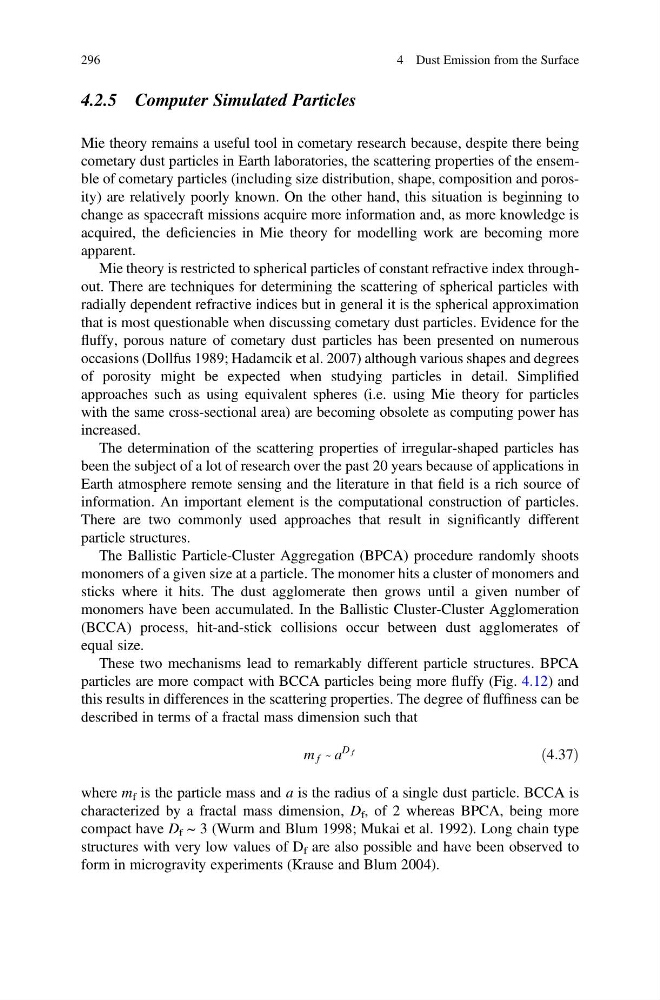
described in terms of a fractal mass dimension such that
m f ~ a
D f
ð4:37Þ
where m f is the particle mass and a is the radius of a single dust particle. BCCA is
characterized by a fractal mass dimension, D f , of 2 whereas BPCA, being more
compact have D f ~ 3 (Wurm and Blum 1998; Mukai et al. 1992). Long chain type
structures with very low values of D f are also possible and have been observed to
form in microgravity experiments (Krause and Blum 2004).
296
4 Dust Emission from the Surface