

σ x ¼ πa
2
ð4:30Þ
On the other hand, the efficiency of the scattering by particles is defined through
the scattering cross-section, σ sca . The scattering efficiency is then
Q sca ¼
σ sca
σ x
:
ð4:31Þ
The extinction cross-section, σ ext , defines the total amount of light removed from
the beam by the particle and is the sum of the light removed by scattering and the
light removed by absorption. The extinction efficiency is given by
Q ext ¼
σ ext
σ x
¼
σ sca þ σ abs
σ x
ð4:32Þ
and
Q ext ¼ Q sca þ Q abs
ð4:33Þ
where Q abs is the absorption efficiency. The single-scattering albedo of the particles
is then given by
ω ¼
Q sca
Q ext
ð4:34Þ
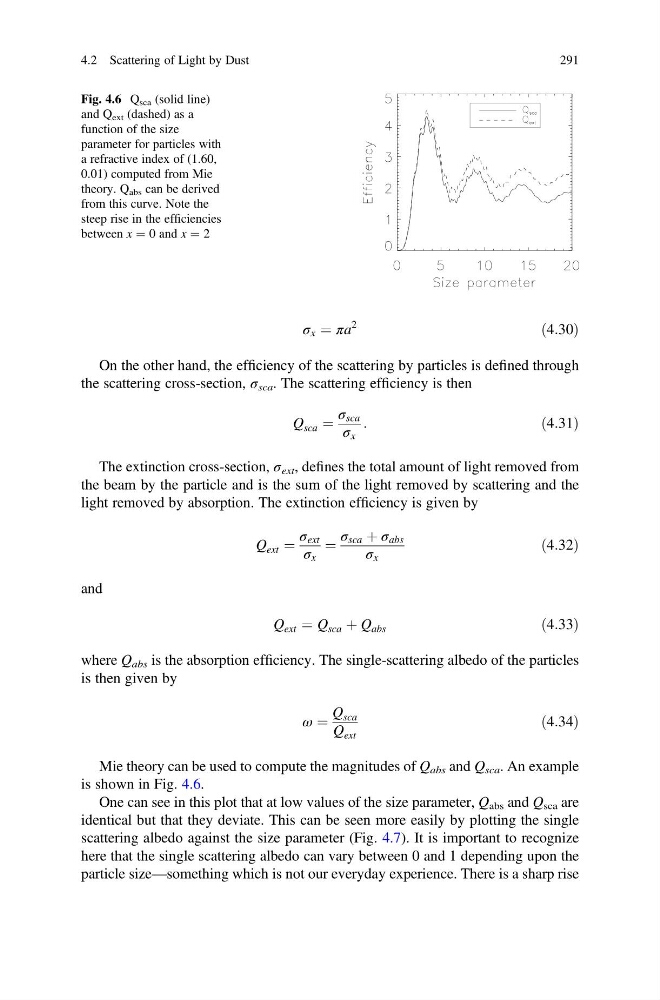
Mie theory can be used to compute the magnitudes of Q abs and Q sca . An example
is shown in Fig. 4.6.
One can see in this plot that at low values of the size parameter, Q abs and Q sca are
identical but that they deviate. This can be seen more easily by plotting the single
scattering albedo against the size parameter (Fig. 4.7). It is important to recognize
here that the single scattering albedo can vary between 0 and 1 depending upon the
particle size—something which is not our everyday experience. There is a sharp rise
Fig. 4.6 Q sca (solid line)
and Q ext (dashed) as a
function of the size
parameter for particles with
a refractive index of (1.60,
0.01) computed from Mie
theory. Q abs can be derived
from this curve. Note the
steep rise in the efficiencies
between x ¼ 0 and x ¼ 2
4.2 Scattering of Light by Dust
291
2
ð4:30Þ
On the other hand, the efficiency of the scattering by particles is defined through
the scattering cross-section, σ sca . The scattering efficiency is then
Q sca ¼
σ sca
σ x
:
ð4:31Þ
The extinction cross-section, σ ext , defines the total amount of light removed from
the beam by the particle and is the sum of the light removed by scattering and the
light removed by absorption. The extinction efficiency is given by
Q ext ¼
σ ext
σ x
¼
σ sca þ σ abs
σ x
ð4:32Þ
and
Q ext ¼ Q sca þ Q abs
ð4:33Þ
where Q abs is the absorption efficiency. The single-scattering albedo of the particles
is then given by
ω ¼
Q sca
Q ext
ð4:34Þ
Mie theory can be used to compute the magnitudes of Q abs and Q sca . An example
is shown in Fig. 4.6.
One can see in this plot that at low values of the size parameter, Q abs and Q sca are
identical but that they deviate. This can be seen more easily by plotting the single
scattering albedo against the size parameter (Fig. 4.7). It is important to recognize
here that the single scattering albedo can vary between 0 and 1 depending upon the
particle size—something which is not our everyday experience. There is a sharp rise
Fig. 4.6 Q sca (solid line)
and Q ext (dashed) as a
function of the size
parameter for particles with
a refractive index of (1.60,
0.01) computed from Mie
theory. Q abs can be derived
from this curve. Note the
steep rise in the efficiencies
between x ¼ 0 and x ¼ 2
4.2 Scattering of Light by Dust
291