

ε i ¼ 2 m ref ,r m ref ,i
ð4:28Þ
It should be noted that
ε
j j ¼
ffiffiffiffiffiffiffiffiffiffiffiffiffiffi
ε 2
r þ ε 2
i
q
ð4:29Þ
which is the complex modulus of the dielectric constant.
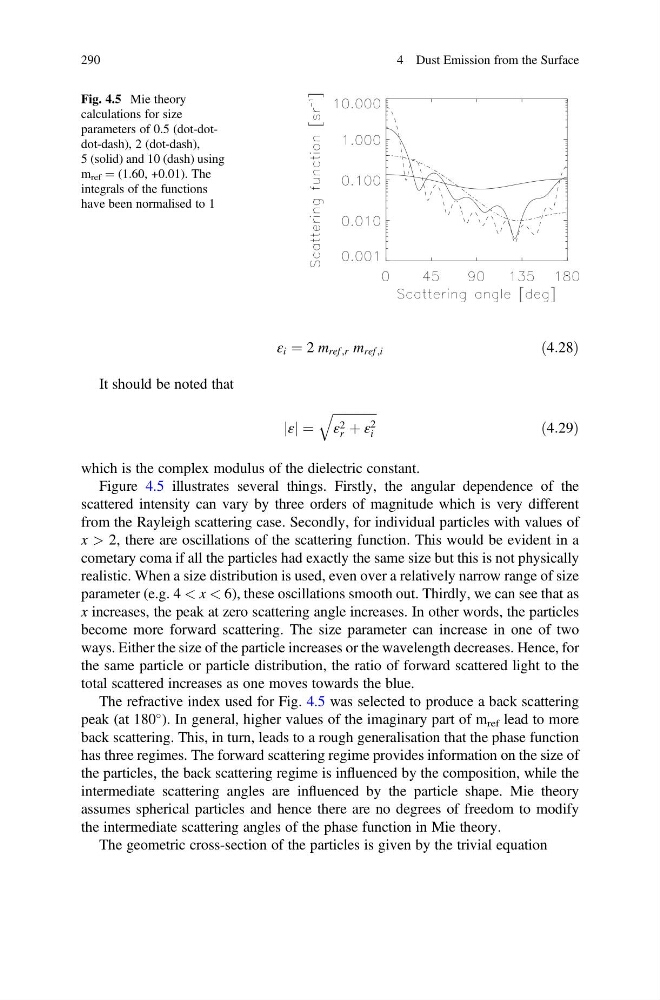
Figure 4.5 illustrates several things. Firstly, the angular dependence of the
scattered intensity can vary by three orders of magnitude which is very different
from the Rayleigh scattering case. Secondly, for individual particles with values of
x > 2, there are oscillations of the scattering function. This would be evident in a
cometary coma if all the particles had exactly the same size but this is not physically
realistic. When a size distribution is used, even over a relatively narrow range of size
parameter (e.g. 4 < x < 6), these oscillations smooth out. Thirdly, we can see that as
x increases, the peak at zero scattering angle increases. In other words, the particles
become more forward scattering. The size parameter can increase in one of two
ways. Either the size of the particle increases or the wavelength decreases. Hence, for
the same particle or particle distribution, the ratio of forward scattered light to the
total scattered increases as one moves towards the blue.
The refractive index used for Fig. 4.5 was selected to produce a back scattering
peak (at 180
). In general, higher values of the imaginary part of m ref lead to more
back scattering. This, in turn, leads to a rough generalisation that the phase function
has three regimes. The forward scattering regime provides information on the size of
the particles, the back scattering regime is influenced by the composition, while the
intermediate scattering angles are influenced by the particle shape. Mie theory
assumes spherical particles and hence there are no degrees of freedom to modify
the intermediate scattering angles of the phase function in Mie theory.
The geometric cross-section of the particles is given by the trivial equation
Fig. 4.5 Mie theory
calculations for size
parameters of 0.5 (dot-dotdot-dash), 2 (dot-dash),
5 (solid) and 10 (dash) using
m ref ¼ (1.60, +0.01). The
integrals of the functions
have been normalised to 1
290
4 Dust Emission from the Surface
ð4:28Þ
It should be noted that
ε
j j ¼
ffiffiffiffiffiffiffiffiffiffiffiffiffiffi
ε 2
r þ ε 2
i
q
ð4:29Þ
which is the complex modulus of the dielectric constant.
Figure 4.5 illustrates several things. Firstly, the angular dependence of the
scattered intensity can vary by three orders of magnitude which is very different
from the Rayleigh scattering case. Secondly, for individual particles with values of
x > 2, there are oscillations of the scattering function. This would be evident in a
cometary coma if all the particles had exactly the same size but this is not physically
realistic. When a size distribution is used, even over a relatively narrow range of size
parameter (e.g. 4 < x < 6), these oscillations smooth out. Thirdly, we can see that as
x increases, the peak at zero scattering angle increases. In other words, the particles
become more forward scattering. The size parameter can increase in one of two
ways. Either the size of the particle increases or the wavelength decreases. Hence, for
the same particle or particle distribution, the ratio of forward scattered light to the
total scattered increases as one moves towards the blue.
The refractive index used for Fig. 4.5 was selected to produce a back scattering
peak (at 180
). In general, higher values of the imaginary part of m ref lead to more
back scattering. This, in turn, leads to a rough generalisation that the phase function
has three regimes. The forward scattering regime provides information on the size of
the particles, the back scattering regime is influenced by the composition, while the
intermediate scattering angles are influenced by the particle shape. Mie theory
assumes spherical particles and hence there are no degrees of freedom to modify
the intermediate scattering angles of the phase function in Mie theory.
The geometric cross-section of the particles is given by the trivial equation
Fig. 4.5 Mie theory
calculations for size
parameters of 0.5 (dot-dotdot-dash), 2 (dot-dash),
5 (solid) and 10 (dash) using
m ref ¼ (1.60, +0.01). The
integrals of the functions
have been normalised to 1
290
4 Dust Emission from the Surface