

and Huffman who also include a computer code for its computation) describes the
way in which the electromagnetic wave passes through the particle and thus requires
the setting of a refractive index, m ref . The theory uses a dimensionless parameter, the
size parameter, x, defined as
x ¼
2πa
λ
¼ k N a
ð4:25Þ
where a is the particle radius and λ is the wavelength which can be used to scale
results for identical particle size to wavelength ratios.
In Fig. 4.5, Mie theory results are shown for three values of x for m ref ¼ (1.60,
+0.01). The refractive index is complex and the imaginary part, m ref,i , plays a role in
the absorption by the particle. For the three cases, the curves have been normalized
such that the integral over the 4π solid angle is one.
m ref,i is related to the absorption coefficient by the equation
κ λ ¼
4πm ref ,i
λ
ð4:26Þ
and also we can relate this to the real (ε r ) and imaginary (ε i ) parts of the dielectric
constant using
ε r ¼ m
2
ref ,r À m
2
ref ,i
ð4:27Þ
and
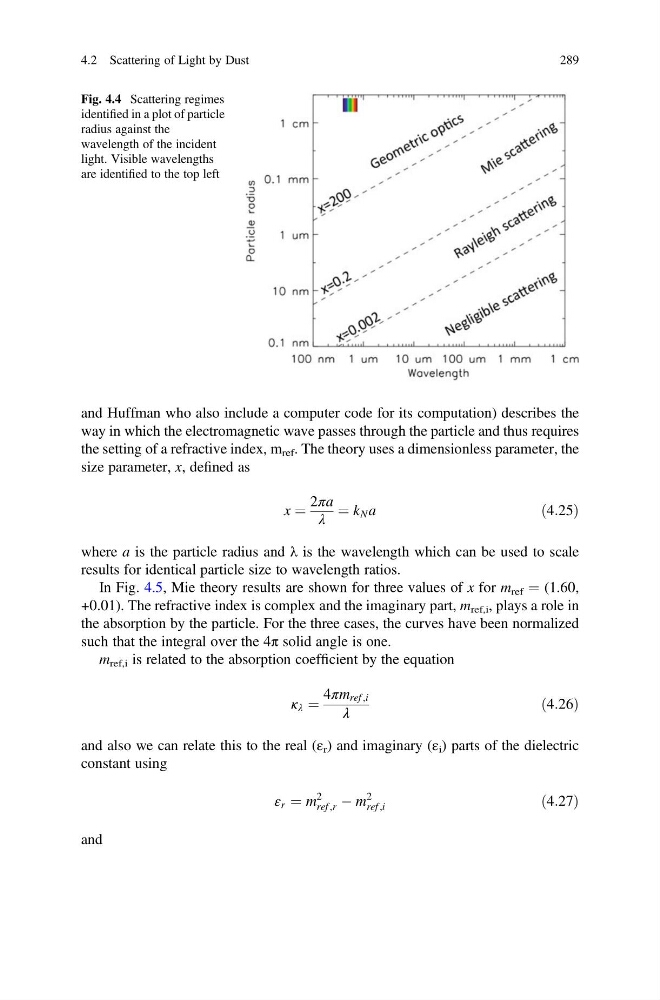
Fig. 4.4 Scattering regimes
identified in a plot of particle
radius against the
wavelength of the incident
light. Visible wavelengths
are identified to the top left
4.2 Scattering of Light by Dust
289
way in which the electromagnetic wave passes through the particle and thus requires
the setting of a refractive index, m ref . The theory uses a dimensionless parameter, the
size parameter, x, defined as
x ¼
2πa
λ
¼ k N a
ð4:25Þ
where a is the particle radius and λ is the wavelength which can be used to scale
results for identical particle size to wavelength ratios.
In Fig. 4.5, Mie theory results are shown for three values of x for m ref ¼ (1.60,
+0.01). The refractive index is complex and the imaginary part, m ref,i , plays a role in
the absorption by the particle. For the three cases, the curves have been normalized
such that the integral over the 4π solid angle is one.
m ref,i is related to the absorption coefficient by the equation
κ λ ¼
4πm ref ,i
λ
ð4:26Þ
and also we can relate this to the real (ε r ) and imaginary (ε i ) parts of the dielectric
constant using
ε r ¼ m
2
ref ,r À m
2
ref ,i
ð4:27Þ
and
Fig. 4.4 Scattering regimes
identified in a plot of particle
radius against the
wavelength of the incident
light. Visible wavelengths
are identified to the top left
4.2 Scattering of Light by Dust
289