

may not be a valid assumption in all cases. One might envisage elongated particles
all aligning themselves because of gas drag or electrostatic effects which could, in
principle, generate dependencies on ϕ although there is no evidence to support this.
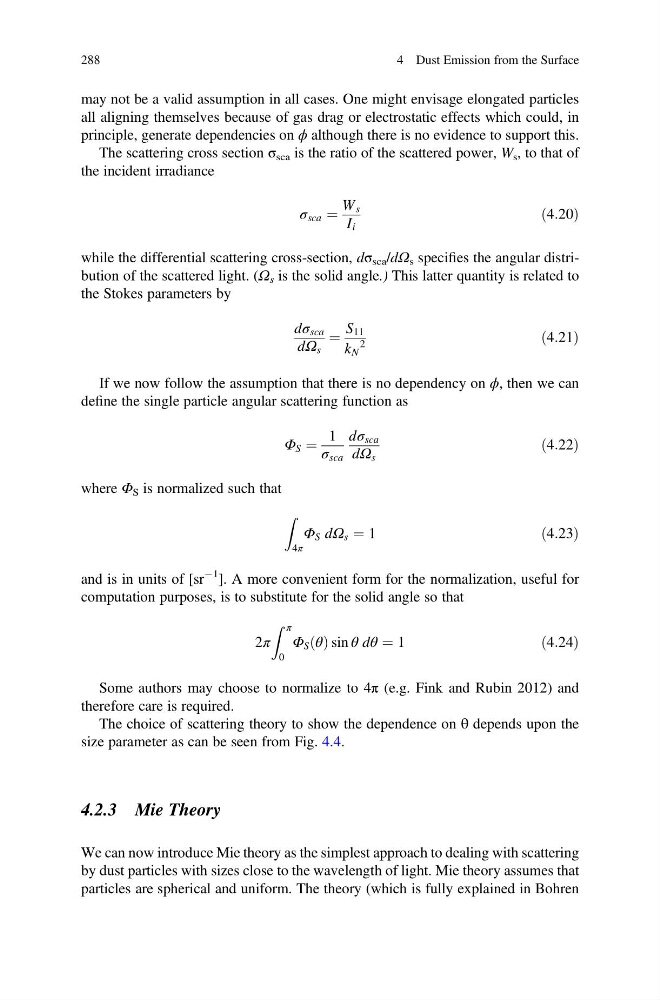
The scattering cross section σ sca is the ratio of the scattered power, W s , to that of
the incident irradiance
σ sca ¼
W s
I i
ð4:20Þ
while the differential scattering cross-section, dσ sca /dΩ s specifies the angular distribution of the scattered light. (Ω s is the solid angle.) This latter quantity is related to
the Stokes parameters by
dσ sca
dΩ s
¼
S 11
k N
2
ð4:21Þ
If we now follow the assumption that there is no dependency on ϕ, then we can
define the single particle angular scattering function as
Φ S ¼
1
σ sca
dσ sca
dΩ s
ð4:22Þ
where Φ S is normalized such that
Z
4π
Φ S dΩ s ¼ 1
ð4:23Þ
and is in units of [sr
À1 ]. A more convenient form for the normalization, useful for
computation purposes, is to substitute for the solid angle so that
2π
Z π
0
Φ S θ
ð Þ sin θ dθ ¼ 1
ð4:24Þ
Some authors may choose to normalize to 4π (e.g. Fink and Rubin 2012) and
therefore care is required.
The choice of scattering theory to show the dependence on θ depends upon the
size parameter as can be seen from Fig. 4.4.
4.2.3 Mie Theory
We can now introduce Mie theory as the simplest approach to dealing with scattering
by dust particles with sizes close to the wavelength of light. Mie theory assumes that
particles are spherical and uniform. The theory (which is fully explained in Bohren
288
4 Dust Emission from the Surface
all aligning themselves because of gas drag or electrostatic effects which could, in
principle, generate dependencies on ϕ although there is no evidence to support this.
The scattering cross section σ sca is the ratio of the scattered power, W s , to that of
the incident irradiance
σ sca ¼
W s
I i
ð4:20Þ
while the differential scattering cross-section, dσ sca /dΩ s specifies the angular distribution of the scattered light. (Ω s is the solid angle.) This latter quantity is related to
the Stokes parameters by
dσ sca
dΩ s
¼
S 11
k N
2
ð4:21Þ
If we now follow the assumption that there is no dependency on ϕ, then we can
define the single particle angular scattering function as
Φ S ¼
1
σ sca
dσ sca
dΩ s
ð4:22Þ
where Φ S is normalized such that
Z
4π
Φ S dΩ s ¼ 1
ð4:23Þ
and is in units of [sr
À1 ]. A more convenient form for the normalization, useful for
computation purposes, is to substitute for the solid angle so that
2π
Z π
0
Φ S θ
ð Þ sin θ dθ ¼ 1
ð4:24Þ
Some authors may choose to normalize to 4π (e.g. Fink and Rubin 2012) and
therefore care is required.
The choice of scattering theory to show the dependence on θ depends upon the
size parameter as can be seen from Fig. 4.4.
4.2.3 Mie Theory
We can now introduce Mie theory as the simplest approach to dealing with scattering
by dust particles with sizes close to the wavelength of light. Mie theory assumes that
particles are spherical and uniform. The theory (which is fully explained in Bohren
288
4 Dust Emission from the Surface