

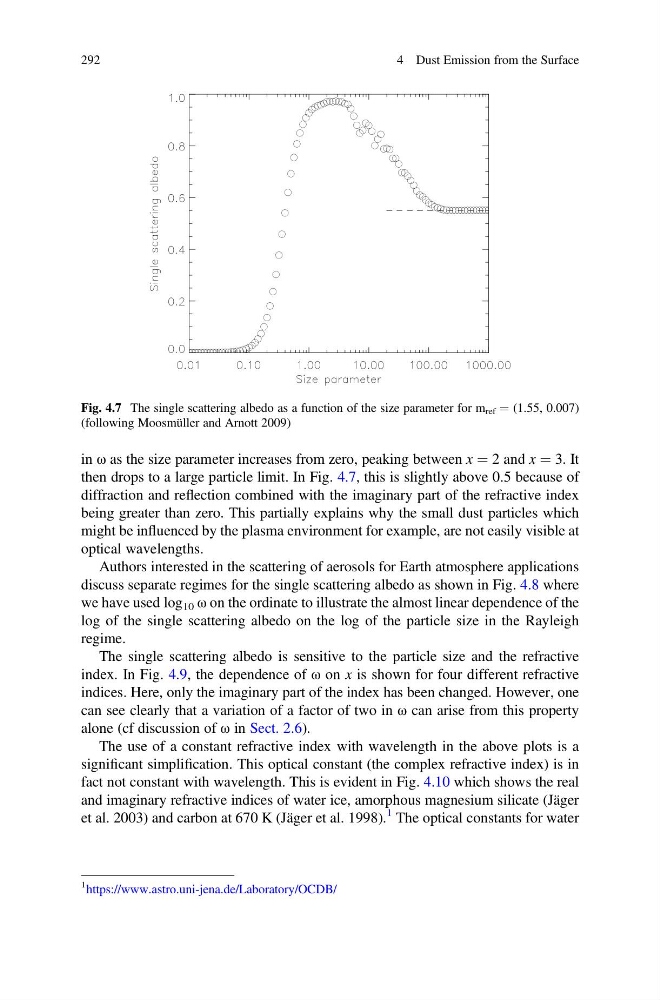
in ω as the size parameter increases from zero, peaking between x ¼ 2 and x ¼ 3. It
then drops to a large particle limit. In Fig. 4.7, this is slightly above 0.5 because of
diffraction and reflection combined with the imaginary part of the refractive index
being greater than zero. This partially explains why the small dust particles which
might be influenced by the plasma environment for example, are not easily visible at
optical wavelengths.
Authors interested in the scattering of aerosols for Earth atmosphere applications
discuss separate regimes for the single scattering albedo as shown in Fig. 4.8 where
we have used log 10 ω on the ordinate to illustrate the almost linear dependence of the
log of the single scattering albedo on the log of the particle size in the Rayleigh
regime.
The single scattering albedo is sensitive to the particle size and the refractive
index. In Fig. 4.9, the dependence of ω on x is shown for four different refractive
indices. Here, only the imaginary part of the index has been changed. However, one
can see clearly that a variation of a factor of two in ω can arise from this property
alone (cf discussion of ω in Sect. 2.6).
The use of a constant refractive index with wavelength in the above plots is a
significant simplification. This optical constant (the complex refractive index) is in
fact not constant with wavelength. This is evident in Fig. 4.10 which shows the real
and imaginary refractive indices of water ice, amorphous magnesium silicate (Jäger
et al. 2003) and carbon at 670 K (Jäger et al. 1998).
1 The optical constants for water
Fig. 4.7 The single scattering albedo as a function of the size parameter for m ref ¼ (1.55, 0.007)
(following Moosmüller and Arnott 2009)
1 https://www.astro.uni-jena.de/Laboratory/OCDB/
292
4 Dust Emission from the Surface
then drops to a large particle limit. In Fig. 4.7, this is slightly above 0.5 because of
diffraction and reflection combined with the imaginary part of the refractive index
being greater than zero. This partially explains why the small dust particles which
might be influenced by the plasma environment for example, are not easily visible at
optical wavelengths.
Authors interested in the scattering of aerosols for Earth atmosphere applications
discuss separate regimes for the single scattering albedo as shown in Fig. 4.8 where
we have used log 10 ω on the ordinate to illustrate the almost linear dependence of the
log of the single scattering albedo on the log of the particle size in the Rayleigh
regime.
The single scattering albedo is sensitive to the particle size and the refractive
index. In Fig. 4.9, the dependence of ω on x is shown for four different refractive
indices. Here, only the imaginary part of the index has been changed. However, one
can see clearly that a variation of a factor of two in ω can arise from this property
alone (cf discussion of ω in Sect. 2.6).
The use of a constant refractive index with wavelength in the above plots is a
significant simplification. This optical constant (the complex refractive index) is in
fact not constant with wavelength. This is evident in Fig. 4.10 which shows the real
and imaginary refractive indices of water ice, amorphous magnesium silicate (Jäger
et al. 2003) and carbon at 670 K (Jäger et al. 1998).
1 The optical constants for water
Fig. 4.7 The single scattering albedo as a function of the size parameter for m ref ¼ (1.55, 0.007)
(following Moosmüller and Arnott 2009)
1 https://www.astro.uni-jena.de/Laboratory/OCDB/
292
4 Dust Emission from the Surface