

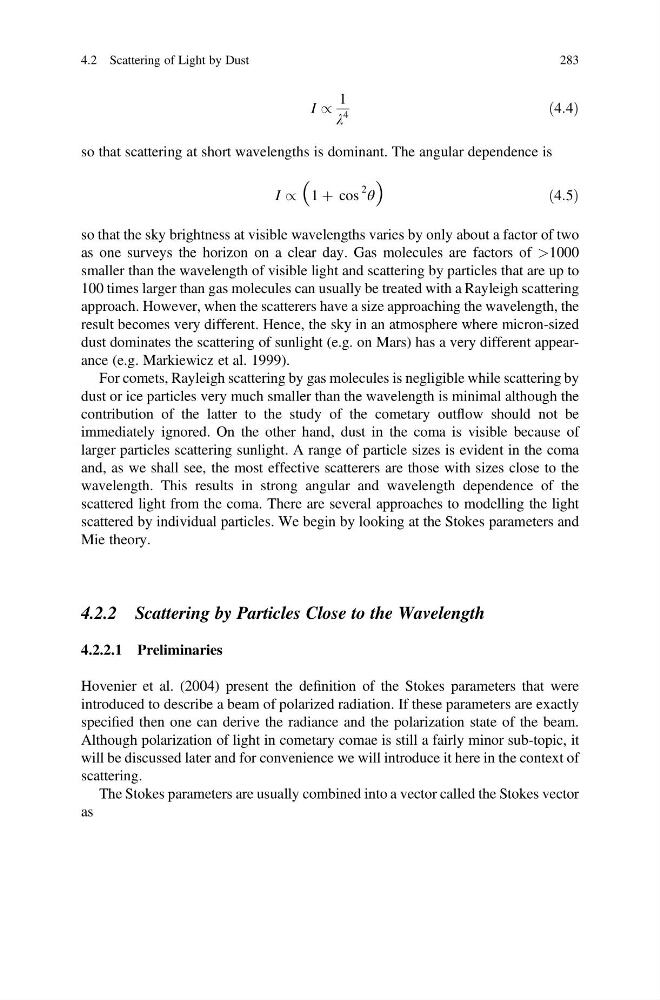
I /
1
λ
4
ð4:4Þ
so that scattering at short wavelengths is dominant. The angular dependence is
I / ð1 þ cos
2 θÞ
ð4:5Þ
so that the sky brightness at visible wavelengths varies by only about a factor of two
as one surveys the horizon on a clear day. Gas molecules are factors of >1000
smaller than the wavelength of visible light and scattering by particles that are up to
100 times larger than gas molecules can usually be treated with a Rayleigh scattering
approach. However, when the scatterers have a size approaching the wavelength, the
result becomes very different. Hence, the sky in an atmosphere where micron-sized
dust dominates the scattering of sunlight (e.g. on Mars) has a very different appearance (e.g. Markiewicz et al. 1999).
For comets, Rayleigh scattering by gas molecules is negligible while scattering by
dust or ice particles very much smaller than the wavelength is minimal although the
contribution of the latter to the study of the cometary outflow should not be
immediately ignored. On the other hand, dust in the coma is visible because of
larger particles scattering sunlight. A range of particle sizes is evident in the coma
and, as we shall see, the most effective scatterers are those with sizes close to the
wavelength. This results in strong angular and wavelength dependence of the
scattered light from the coma. There are several approaches to modelling the light
scattered by individual particles. We begin by looking at the Stokes parameters and
Mie theory.
4.2.2 Scattering by Particles Close to the Wavelength
4.2.2.1 Preliminaries
Hovenier et al. (2004) present the definition of the Stokes parameters that were
introduced to describe a beam of polarized radiation. If these parameters are exactly
specified then one can derive the radiance and the polarization state of the beam.
Although polarization of light in cometary comae is still a fairly minor sub-topic, it
will be discussed later and for convenience we will introduce it here in the context of
scattering.
The Stokes parameters are usually combined into a vector called the Stokes vector
as
4.2 Scattering of Light by Dust
283
1
λ
4
ð4:4Þ
so that scattering at short wavelengths is dominant. The angular dependence is
I / ð1 þ cos
2 θÞ
ð4:5Þ
so that the sky brightness at visible wavelengths varies by only about a factor of two
as one surveys the horizon on a clear day. Gas molecules are factors of >1000
smaller than the wavelength of visible light and scattering by particles that are up to
100 times larger than gas molecules can usually be treated with a Rayleigh scattering
approach. However, when the scatterers have a size approaching the wavelength, the
result becomes very different. Hence, the sky in an atmosphere where micron-sized
dust dominates the scattering of sunlight (e.g. on Mars) has a very different appearance (e.g. Markiewicz et al. 1999).
For comets, Rayleigh scattering by gas molecules is negligible while scattering by
dust or ice particles very much smaller than the wavelength is minimal although the
contribution of the latter to the study of the cometary outflow should not be
immediately ignored. On the other hand, dust in the coma is visible because of
larger particles scattering sunlight. A range of particle sizes is evident in the coma
and, as we shall see, the most effective scatterers are those with sizes close to the
wavelength. This results in strong angular and wavelength dependence of the
scattered light from the coma. There are several approaches to modelling the light
scattered by individual particles. We begin by looking at the Stokes parameters and
Mie theory.
4.2.2 Scattering by Particles Close to the Wavelength
4.2.2.1 Preliminaries
Hovenier et al. (2004) present the definition of the Stokes parameters that were
introduced to describe a beam of polarized radiation. If these parameters are exactly
specified then one can derive the radiance and the polarization state of the beam.
Although polarization of light in cometary comae is still a fairly minor sub-topic, it
will be discussed later and for convenience we will introduce it here in the context of
scattering.
The Stokes parameters are usually combined into a vector called the Stokes vector
as
4.2 Scattering of Light by Dust
283