

S ¼
I
Q
U
V
0
B
B
B
@
1
C
C
C
A
ð4:6Þ
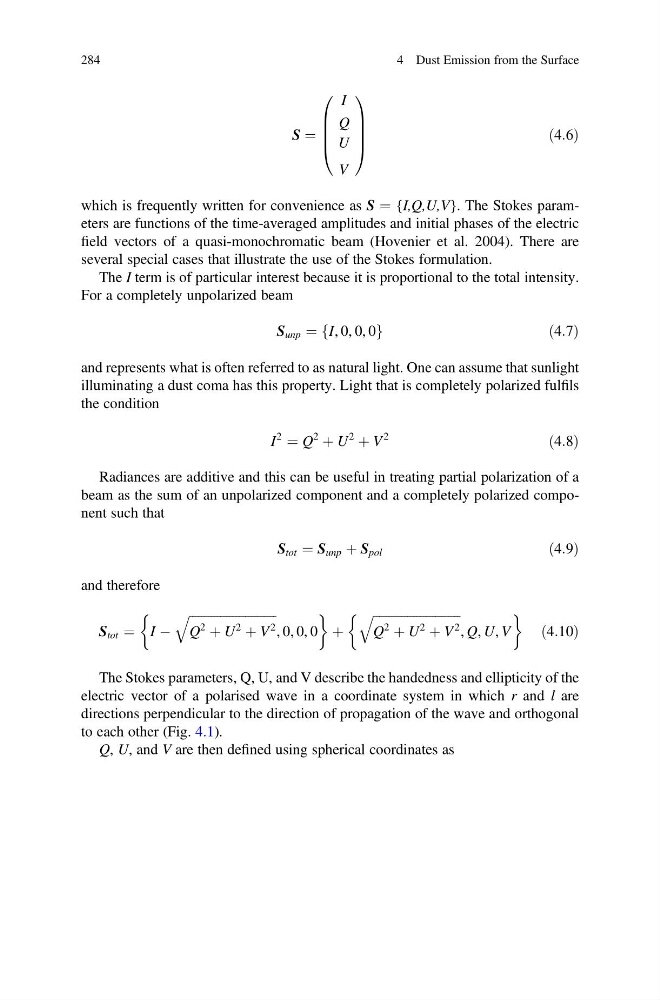
which is frequently written for convenience as S ¼ {I,Q,U,V}. The Stokes parameters are functions of the time-averaged amplitudes and initial phases of the electric
field vectors of a quasi-monochromatic beam (Hovenier et al. 2004). There are
several special cases that illustrate the use of the Stokes formulation.
The I term is of particular interest because it is proportional to the total intensity.
For a completely unpolarized beam
S unp ¼ I, 0, 0, 0
f
g
ð4:7Þ
and represents what is often referred to as natural light. One can assume that sunlight
illuminating a dust coma has this property. Light that is completely polarized fulfils
the condition
I
2
¼ Q
2
þ U
2
þ V
2
ð4:8Þ
Radiances are additive and this can be useful in treating partial polarization of a
beam as the sum of an unpolarized component and a completely polarized component such that
S tot ¼ S unp þ S pol
ð4:9Þ
and therefore
S tot ¼ I À
ffiffiffiffiffiffiffiffiffiffiffiffiffiffiffiffiffiffiffiffiffiffiffiffiffiffiffiffi
Q
2
þ U
2
þ V
2
q
, 0, 0, 0
&
'
þ
ffiffiffiffiffiffiffiffiffiffiffiffiffiffiffiffiffiffiffiffiffiffiffiffiffiffiffiffi
Q
2
þ U
2
þ V
2
q
, Q, U, V
&
'
ð4:10Þ
The Stokes parameters, Q, U, and V describe the handedness and ellipticity of the
electric vector of a polarised wave in a coordinate system in which r and l are
directions perpendicular to the direction of propagation of the wave and orthogonal
to each other (Fig. 4.1).
Q, U, and V are then defined using spherical coordinates as
284
4 Dust Emission from the Surface
I
Q
U
V
0
B
B
B
@
1
C
C
C
A
ð4:6Þ
which is frequently written for convenience as S ¼ {I,Q,U,V}. The Stokes parameters are functions of the time-averaged amplitudes and initial phases of the electric
field vectors of a quasi-monochromatic beam (Hovenier et al. 2004). There are
several special cases that illustrate the use of the Stokes formulation.
The I term is of particular interest because it is proportional to the total intensity.
For a completely unpolarized beam
S unp ¼ I, 0, 0, 0
f
g
ð4:7Þ
and represents what is often referred to as natural light. One can assume that sunlight
illuminating a dust coma has this property. Light that is completely polarized fulfils
the condition
I
2
¼ Q
2
þ U
2
þ V
2
ð4:8Þ
Radiances are additive and this can be useful in treating partial polarization of a
beam as the sum of an unpolarized component and a completely polarized component such that
S tot ¼ S unp þ S pol
ð4:9Þ
and therefore
S tot ¼ I À
ffiffiffiffiffiffiffiffiffiffiffiffiffiffiffiffiffiffiffiffiffiffiffiffiffiffiffiffi
Q
2
þ U
2
þ V
2
q
, 0, 0, 0
&
'
þ
ffiffiffiffiffiffiffiffiffiffiffiffiffiffiffiffiffiffiffiffiffiffiffiffiffiffiffiffi
Q
2
þ U
2
þ V
2
q
, Q, U, V
&
'
ð4:10Þ
The Stokes parameters, Q, U, and V describe the handedness and ellipticity of the
electric vector of a polarised wave in a coordinate system in which r and l are
directions perpendicular to the direction of propagation of the wave and orthogonal
to each other (Fig. 4.1).
Q, U, and V are then defined using spherical coordinates as
284
4 Dust Emission from the Surface