

through collisions whereas the decoupling of the dust from the gas leads to a larger
residual inhomogeneity in the coma. As with the gas, the integration of the force free
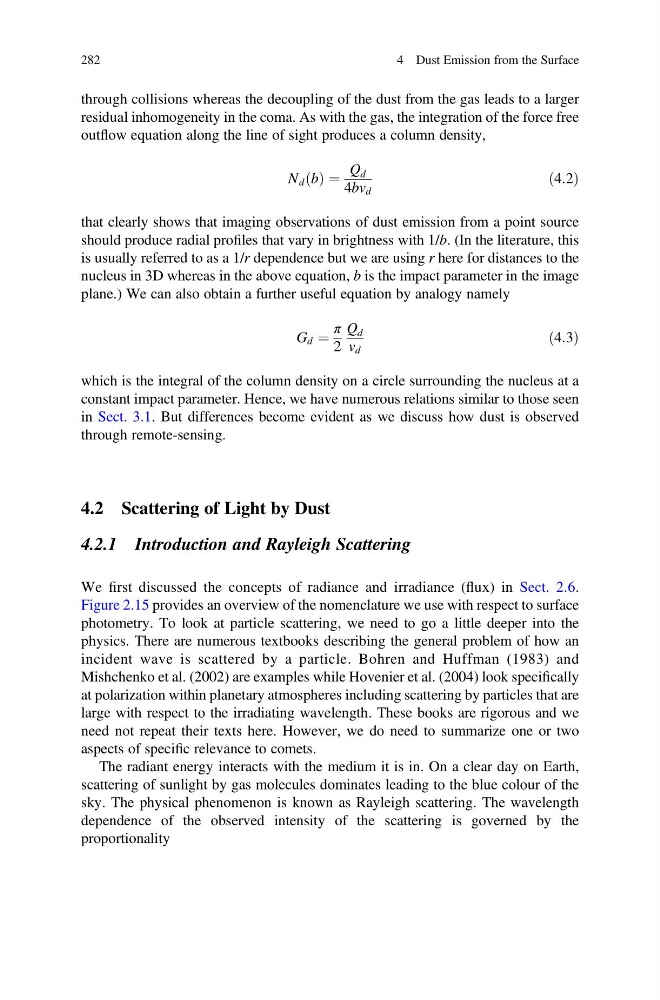
outflow equation along the line of sight produces a column density,
N d b
ð Þ ¼
Q d
4bv d
ð4:2Þ
that clearly shows that imaging observations of dust emission from a point source
should produce radial profiles that vary in brightness with 1/b. (In the literature, this
is usually referred to as a 1/r dependence but we are using r here for distances to the
nucleus in 3D whereas in the above equation, b is the impact parameter in the image
plane.) We can also obtain a further useful equation by analogy namely
G d ¼
π
2
Q d
v d
ð4:3Þ
which is the integral of the column density on a circle surrounding the nucleus at a
constant impact parameter. Hence, we have numerous relations similar to those seen
in Sect. 3.1. But differences become evident as we discuss how dust is observed
through remote-sensing.
4.2 Scattering of Light by Dust
4.2.1 Introduction and Rayleigh Scattering
We first discussed the concepts of radiance and irradiance (flux) in Sect. 2.6.
Figure 2.15 provides an overview of the nomenclature we use with respect to surface
photometry. To look at particle scattering, we need to go a little deeper into the
physics. There are numerous textbooks describing the general problem of how an
incident wave is scattered by a particle. Bohren and Huffman (1983) and
Mishchenko et al. (2002) are examples while Hovenier et al. (2004) look specifically
at polarization within planetary atmospheres including scattering by particles that are
large with respect to the irradiating wavelength. These books are rigorous and we
need not repeat their texts here. However, we do need to summarize one or two
aspects of specific relevance to comets.
The radiant energy interacts with the medium it is in. On a clear day on Earth,
scattering of sunlight by gas molecules dominates leading to the blue colour of the
sky. The physical phenomenon is known as Rayleigh scattering. The wavelength
dependence of the observed intensity of the scattering is governed by the
proportionality
282
4 Dust Emission from the Surface
residual inhomogeneity in the coma. As with the gas, the integration of the force free
outflow equation along the line of sight produces a column density,
N d b
ð Þ ¼
Q d
4bv d
ð4:2Þ
that clearly shows that imaging observations of dust emission from a point source
should produce radial profiles that vary in brightness with 1/b. (In the literature, this
is usually referred to as a 1/r dependence but we are using r here for distances to the
nucleus in 3D whereas in the above equation, b is the impact parameter in the image
plane.) We can also obtain a further useful equation by analogy namely
G d ¼
π
2
Q d
v d
ð4:3Þ
which is the integral of the column density on a circle surrounding the nucleus at a
constant impact parameter. Hence, we have numerous relations similar to those seen
in Sect. 3.1. But differences become evident as we discuss how dust is observed
through remote-sensing.
4.2 Scattering of Light by Dust
4.2.1 Introduction and Rayleigh Scattering
We first discussed the concepts of radiance and irradiance (flux) in Sect. 2.6.
Figure 2.15 provides an overview of the nomenclature we use with respect to surface
photometry. To look at particle scattering, we need to go a little deeper into the
physics. There are numerous textbooks describing the general problem of how an
incident wave is scattered by a particle. Bohren and Huffman (1983) and
Mishchenko et al. (2002) are examples while Hovenier et al. (2004) look specifically
at polarization within planetary atmospheres including scattering by particles that are
large with respect to the irradiating wavelength. These books are rigorous and we
need not repeat their texts here. However, we do need to summarize one or two
aspects of specific relevance to comets.
The radiant energy interacts with the medium it is in. On a clear day on Earth,
scattering of sunlight by gas molecules dominates leading to the blue colour of the
sky. The physical phenomenon is known as Rayleigh scattering. The wavelength
dependence of the observed intensity of the scattering is governed by the
proportionality
282
4 Dust Emission from the Surface