

3.8 Isotopic Ratios
Was the current inventory of water on Earth present at the time of its formation or has
it been transported to our planet by the impact of comet-like bodies? This subject has
provoked considerable disagreement and the answer also has implications for the
Earth’s organic inventory. As we shall see, roughly 25% of a comet’s mass is
organic. If the water has been brought in, then organics almost certainly came with
it. One of the best ways of studying this problem is by looking at isotopic ratios.
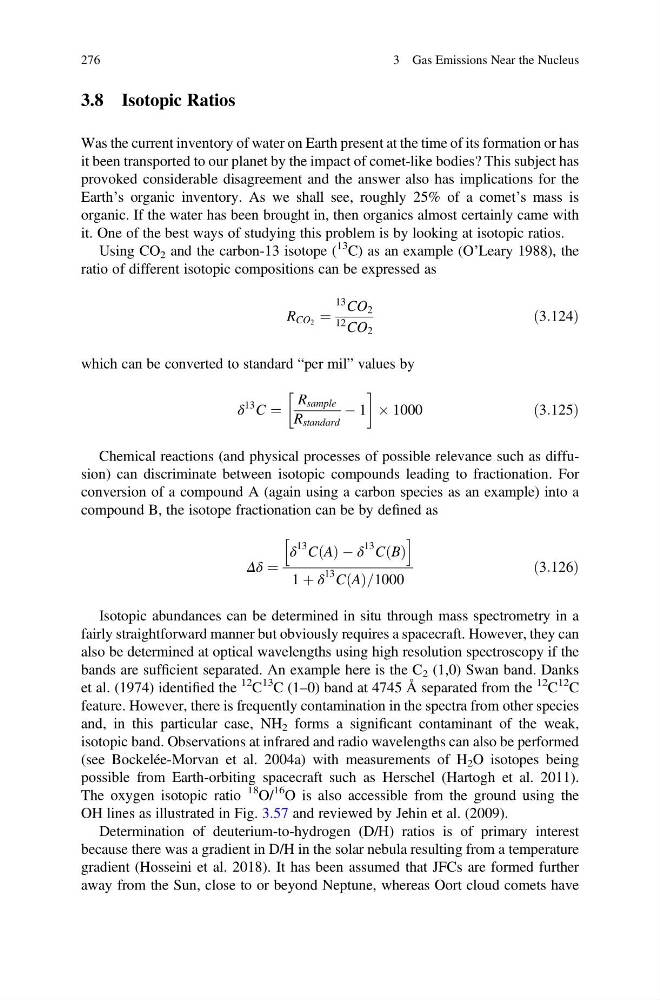
Using CO 2 and the carbon-13 isotope (
13 C) as an example (O’Leary 1988), the
ratio of different isotopic compositions can be expressed as
R CO 2 ¼
13 CO 2
12 CO 2
ð3:124Þ
which can be converted to standard “per mil” values by
δ
13 C ¼
R sample
R standard
À 1
!
 1000
ð3:125Þ
Chemical reactions (and physical processes of possible relevance such as diffusion) can discriminate between isotopic compounds leading to fractionation. For
conversion of a compound A (again using a carbon species as an example) into a
compound B, the isotope fractionation can be by defined as
Δδ ¼
δ
13 C A
ð Þ À δ
13 C B
ð Þ
h
i
1 þ δ
13 C A
ð Þ=1000
ð3:126Þ
Isotopic abundances can be determined in situ through mass spectrometry in a
fairly straightforward manner but obviously requires a spacecraft. However, they can
also be determined at optical wavelengths using high resolution spectroscopy if the
bands are sufficient separated. An example here is the C 2 (1,0) Swan band. Danks
et al. (1974) identified the
12 C
13 C (1–0) band at 4745 Å separated from the
12 C
12 C
feature. However, there is frequently contamination in the spectra from other species
and, in this particular case, NH 2 forms a significant contaminant of the weak,
isotopic band. Observations at infrared and radio wavelengths can also be performed
(see Bockelée-Morvan et al. 2004a) with measurements of H 2 O isotopes being
possible from Earth-orbiting spacecraft such as Herschel (Hartogh et al. 2011).
The oxygen isotopic ratio
18 O/
16 O is also accessible from the ground using the
OH lines as illustrated in Fig. 3.57 and reviewed by Jehin et al. (2009).
Determination of deuterium-to-hydrogen (D/H) ratios is of primary interest
because there was a gradient in D/H in the solar nebula resulting from a temperature
gradient (Hosseini et al. 2018). It has been assumed that JFCs are formed further
away from the Sun, close to or beyond Neptune, whereas Oort cloud comets have
276
3 Gas Emissions Near the Nucleus
Was the current inventory of water on Earth present at the time of its formation or has
it been transported to our planet by the impact of comet-like bodies? This subject has
provoked considerable disagreement and the answer also has implications for the
Earth’s organic inventory. As we shall see, roughly 25% of a comet’s mass is
organic. If the water has been brought in, then organics almost certainly came with
it. One of the best ways of studying this problem is by looking at isotopic ratios.
Using CO 2 and the carbon-13 isotope (
13 C) as an example (O’Leary 1988), the
ratio of different isotopic compositions can be expressed as
R CO 2 ¼
13 CO 2
12 CO 2
ð3:124Þ
which can be converted to standard “per mil” values by
δ
13 C ¼
R sample
R standard
À 1
!
 1000
ð3:125Þ
Chemical reactions (and physical processes of possible relevance such as diffusion) can discriminate between isotopic compounds leading to fractionation. For
conversion of a compound A (again using a carbon species as an example) into a
compound B, the isotope fractionation can be by defined as
Δδ ¼
δ
13 C A
ð Þ À δ
13 C B
ð Þ
h
i
1 þ δ
13 C A
ð Þ=1000
ð3:126Þ
Isotopic abundances can be determined in situ through mass spectrometry in a
fairly straightforward manner but obviously requires a spacecraft. However, they can
also be determined at optical wavelengths using high resolution spectroscopy if the
bands are sufficient separated. An example here is the C 2 (1,0) Swan band. Danks
et al. (1974) identified the
12 C
13 C (1–0) band at 4745 Å separated from the
12 C
12 C
feature. However, there is frequently contamination in the spectra from other species
and, in this particular case, NH 2 forms a significant contaminant of the weak,
isotopic band. Observations at infrared and radio wavelengths can also be performed
(see Bockelée-Morvan et al. 2004a) with measurements of H 2 O isotopes being
possible from Earth-orbiting spacecraft such as Herschel (Hartogh et al. 2011).
The oxygen isotopic ratio
18 O/
16 O is also accessible from the ground using the
OH lines as illustrated in Fig. 3.57 and reviewed by Jehin et al. (2009).
Determination of deuterium-to-hydrogen (D/H) ratios is of primary interest
because there was a gradient in D/H in the solar nebula resulting from a temperature
gradient (Hosseini et al. 2018). It has been assumed that JFCs are formed further
away from the Sun, close to or beyond Neptune, whereas Oort cloud comets have
276
3 Gas Emissions Near the Nucleus