

usually ignored although we have made provision for such an effect in Eq. 3.118).
The difference in direction between the absorbed and emitted photons gives a change
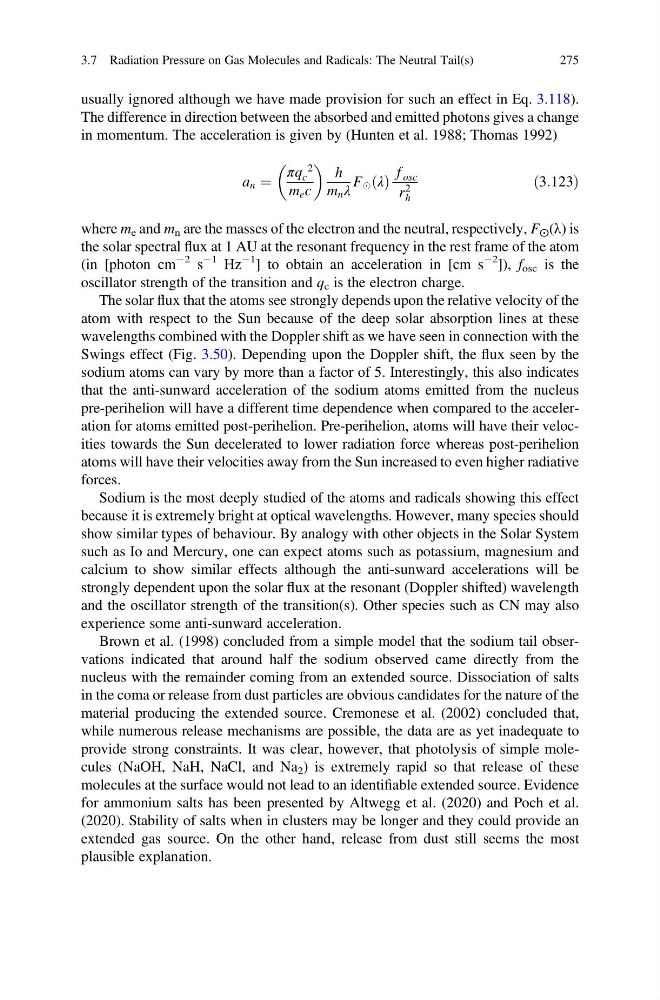
in momentum. The acceleration is given by (Hunten et al. 1988; Thomas 1992)
a n ¼
πq c
2
m e c
h
m n λ
F λ
ð Þ
f osc
r 2
h
ð3:123Þ
where m e and m n are the masses of the electron and the neutral, respectively, F ⨀ (λ) is
the solar spectral flux at 1 AU at the resonant frequency in the rest frame of the atom
(in [photon cm
À2 s
À1 Hz
À1 ] to obtain an acceleration in [cm s
À2 ]), f osc is the
oscillator strength of the transition and q c is the electron charge.
The solar flux that the atoms see strongly depends upon the relative velocity of the
atom with respect to the Sun because of the deep solar absorption lines at these
wavelengths combined with the Doppler shift as we have seen in connection with the
Swings effect (Fig. 3.50). Depending upon the Doppler shift, the flux seen by the
sodium atoms can vary by more than a factor of 5. Interestingly, this also indicates
that the anti-sunward acceleration of the sodium atoms emitted from the nucleus
pre-perihelion will have a different time dependence when compared to the acceleration for atoms emitted post-perihelion. Pre-perihelion, atoms will have their velocities towards the Sun decelerated to lower radiation force whereas post-perihelion
atoms will have their velocities away from the Sun increased to even higher radiative
forces.
Sodium is the most deeply studied of the atoms and radicals showing this effect
because it is extremely bright at optical wavelengths. However, many species should
show similar types of behaviour. By analogy with other objects in the Solar System
such as Io and Mercury, one can expect atoms such as potassium, magnesium and
calcium to show similar effects although the anti-sunward accelerations will be
strongly dependent upon the solar flux at the resonant (Doppler shifted) wavelength
and the oscillator strength of the transition(s). Other species such as CN may also
experience some anti-sunward acceleration.
Brown et al. (1998) concluded from a simple model that the sodium tail observations indicated that around half the sodium observed came directly from the
nucleus with the remainder coming from an extended source. Dissociation of salts
in the coma or release from dust particles are obvious candidates for the nature of the
material producing the extended source. Cremonese et al. (2002) concluded that,
while numerous release mechanisms are possible, the data are as yet inadequate to
provide strong constraints. It was clear, however, that photolysis of simple molecules (NaOH, NaH, NaCl, and Na 2 ) is extremely rapid so that release of these
molecules at the surface would not lead to an identifiable extended source. Evidence
for ammonium salts has been presented by Altwegg et al. (2020) and Poch et al.
(2020). Stability of salts when in clusters may be longer and they could provide an
extended gas source. On the other hand, release from dust still seems the most
plausible explanation.
3.7 Radiation Pressure on Gas Molecules and Radicals: The Neutral Tail(s)
275
The difference in direction between the absorbed and emitted photons gives a change
in momentum. The acceleration is given by (Hunten et al. 1988; Thomas 1992)
a n ¼
πq c
2
m e c
h
m n λ
F λ
ð Þ
f osc
r 2
h
ð3:123Þ
where m e and m n are the masses of the electron and the neutral, respectively, F ⨀ (λ) is
the solar spectral flux at 1 AU at the resonant frequency in the rest frame of the atom
(in [photon cm
À2 s
À1 Hz
À1 ] to obtain an acceleration in [cm s
À2 ]), f osc is the
oscillator strength of the transition and q c is the electron charge.
The solar flux that the atoms see strongly depends upon the relative velocity of the
atom with respect to the Sun because of the deep solar absorption lines at these
wavelengths combined with the Doppler shift as we have seen in connection with the
Swings effect (Fig. 3.50). Depending upon the Doppler shift, the flux seen by the
sodium atoms can vary by more than a factor of 5. Interestingly, this also indicates
that the anti-sunward acceleration of the sodium atoms emitted from the nucleus
pre-perihelion will have a different time dependence when compared to the acceleration for atoms emitted post-perihelion. Pre-perihelion, atoms will have their velocities towards the Sun decelerated to lower radiation force whereas post-perihelion
atoms will have their velocities away from the Sun increased to even higher radiative
forces.
Sodium is the most deeply studied of the atoms and radicals showing this effect
because it is extremely bright at optical wavelengths. However, many species should
show similar types of behaviour. By analogy with other objects in the Solar System
such as Io and Mercury, one can expect atoms such as potassium, magnesium and
calcium to show similar effects although the anti-sunward accelerations will be
strongly dependent upon the solar flux at the resonant (Doppler shifted) wavelength
and the oscillator strength of the transition(s). Other species such as CN may also
experience some anti-sunward acceleration.
Brown et al. (1998) concluded from a simple model that the sodium tail observations indicated that around half the sodium observed came directly from the
nucleus with the remainder coming from an extended source. Dissociation of salts
in the coma or release from dust particles are obvious candidates for the nature of the
material producing the extended source. Cremonese et al. (2002) concluded that,
while numerous release mechanisms are possible, the data are as yet inadequate to
provide strong constraints. It was clear, however, that photolysis of simple molecules (NaOH, NaH, NaCl, and Na 2 ) is extremely rapid so that release of these
molecules at the surface would not lead to an identifiable extended source. Evidence
for ammonium salts has been presented by Altwegg et al. (2020) and Poch et al.
(2020). Stability of salts when in clusters may be longer and they could provide an
extended gas source. On the other hand, release from dust still seems the most
plausible explanation.
3.7 Radiation Pressure on Gas Molecules and Radicals: The Neutral Tail(s)
275