

formed closer in. If correct, then a trend of higher D/H ratio in JFCs than in Oort
cloud comets should be seen. However, cometary D/H measurements suggest a wide
range of D/H ratios in the water within Jupiter family objects although, as noted
earlier, the exact place of origin of a specific comet is no longer given if planetary
migration was significant in our Solar System.
D/H in the interstellar medium using the hydrogen molecule is estimated to be
2.0–2.3 10
À5 (Geiss and Gloeckler 1998). For the proto-planetary nebula which
produced our Solar System, a value of 2.6 Æ 0.7 10
À5 has been determined based on
measurements of H 2 in the atmosphere of Jupiter (Mahaffy et al. 1998). This is
considerably less than that of the Earth as can be seen from the standards given in
Table 3.13 (Hoppe et al. 2018). The D/H ratio in comets appears to cover a range of
values. Hartogh et al. (2011), using the Heterodyne Instrument for the Far Infrared
(HIFI) instrument on the Herschel Space Observatory to measure HDO and H 2
18 O at
509.292 and 547.676 GHz, obtained a value of 1.61 Æ 0.24 10
À4 for 103P/Hartley
2 which would be consistent with the Earth’s oceans. On the other hand, the in situ
measurements at 1P/Halley and 67P both indicate enrichment compared to the Earth.
The similar approach of Biver et al. (2016) for measurements of two different comets
giving two very different results (Table 3.13) argues that comets do indeed come
from different source regions but it does not really clarify the issue of the source of
Earth’s water. Altwegg et al. (2019) conclude that the notion that different comet
families formed at different distances from the Sun is probably not correct. The large
differences in D/H values in cometary water, independent of the comet family, point
more to a scenario in which comets formed over a relatively large region of the
protoplanetary nebula and were later scattered as we have seen in Fig. 1.12.
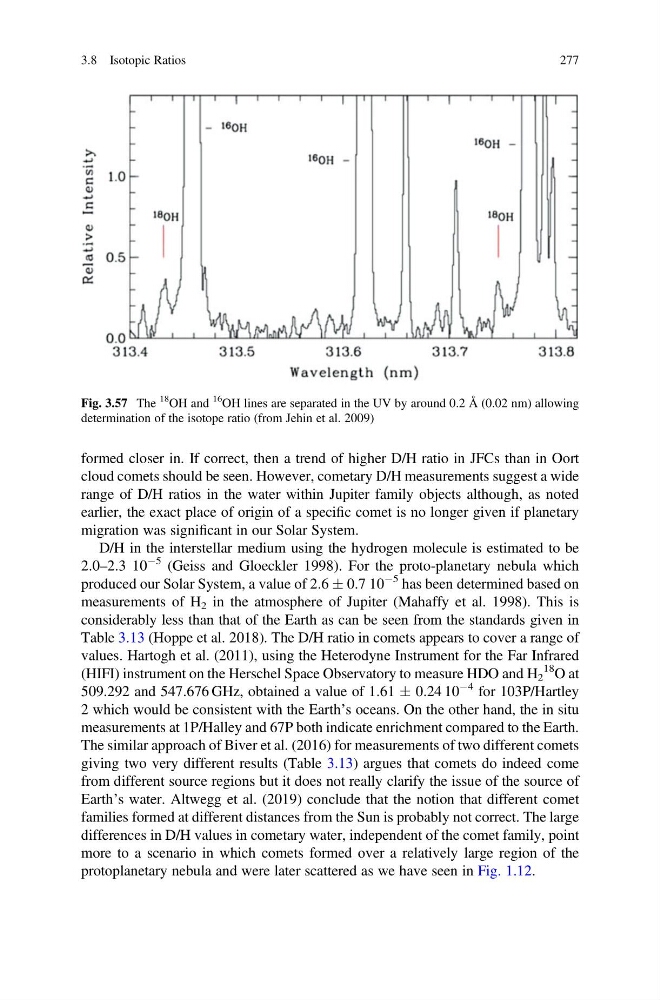
Fig. 3.57 The
18
OH and
16
OH lines are separated in the UV by around 0.2 Å (0.02 nm) allowing
determination of the isotope ratio (from Jehin et al. 2009)
3.8 Isotopic Ratios
277
cloud comets should be seen. However, cometary D/H measurements suggest a wide
range of D/H ratios in the water within Jupiter family objects although, as noted
earlier, the exact place of origin of a specific comet is no longer given if planetary
migration was significant in our Solar System.
D/H in the interstellar medium using the hydrogen molecule is estimated to be
2.0–2.3 10
À5 (Geiss and Gloeckler 1998). For the proto-planetary nebula which
produced our Solar System, a value of 2.6 Æ 0.7 10
À5 has been determined based on
measurements of H 2 in the atmosphere of Jupiter (Mahaffy et al. 1998). This is
considerably less than that of the Earth as can be seen from the standards given in
Table 3.13 (Hoppe et al. 2018). The D/H ratio in comets appears to cover a range of
values. Hartogh et al. (2011), using the Heterodyne Instrument for the Far Infrared
(HIFI) instrument on the Herschel Space Observatory to measure HDO and H 2
18 O at
509.292 and 547.676 GHz, obtained a value of 1.61 Æ 0.24 10
À4 for 103P/Hartley
2 which would be consistent with the Earth’s oceans. On the other hand, the in situ
measurements at 1P/Halley and 67P both indicate enrichment compared to the Earth.
The similar approach of Biver et al. (2016) for measurements of two different comets
giving two very different results (Table 3.13) argues that comets do indeed come
from different source regions but it does not really clarify the issue of the source of
Earth’s water. Altwegg et al. (2019) conclude that the notion that different comet
families formed at different distances from the Sun is probably not correct. The large
differences in D/H values in cometary water, independent of the comet family, point
more to a scenario in which comets formed over a relatively large region of the
protoplanetary nebula and were later scattered as we have seen in Fig. 1.12.
Fig. 3.57 The
18
OH and
16
OH lines are separated in the UV by around 0.2 Å (0.02 nm) allowing
determination of the isotope ratio (from Jehin et al. 2009)
3.8 Isotopic Ratios
277