

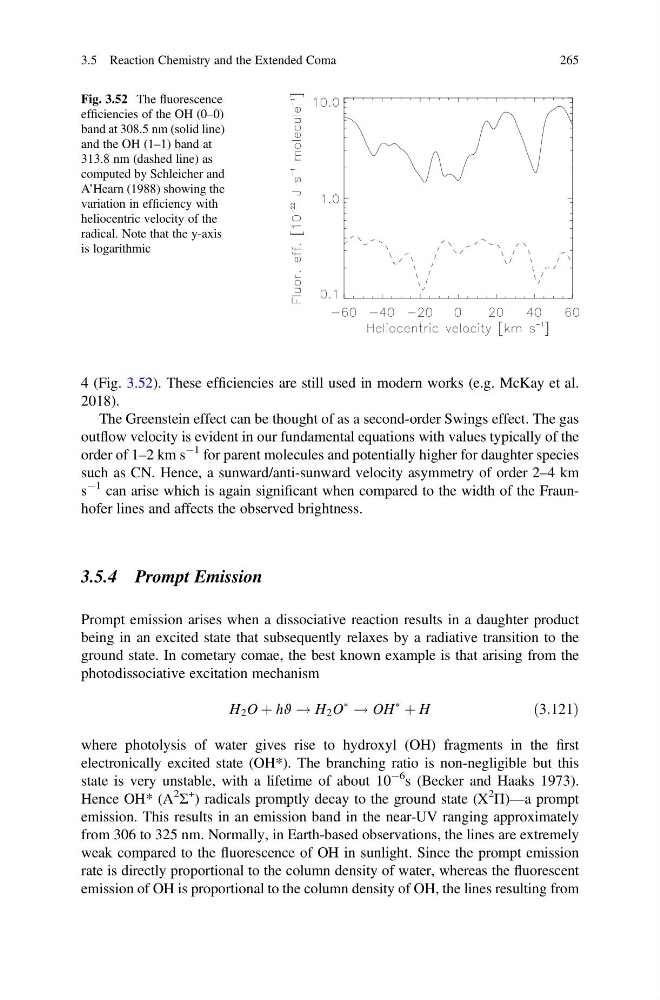
4 (Fig. 3.52). These efficiencies are still used in modern works (e.g. McKay et al.
2018).
The Greenstein effect can be thought of as a second-order Swings effect. The gas
outflow velocity is evident in our fundamental equations with values typically of the
order of 1–2 km s
À1 for parent molecules and potentially higher for daughter species
such as CN. Hence, a sunward/anti-sunward velocity asymmetry of order 2–4 km
s
À1 can arise which is again significant when compared to the width of the Fraunhofer lines and affects the observed brightness.
3.5.4 Prompt Emission
Prompt emission arises when a dissociative reaction results in a daughter product
being in an excited state that subsequently relaxes by a radiative transition to the
ground state. In cometary comae, the best known example is that arising from the
photodissociative excitation mechanism
H 2 O þ hϑ ! H 2 O
Ã
! OH
Ã
þ H
ð3:121Þ
where photolysis of water gives rise to hydroxyl (OH) fragments in the first
electronically excited state (OH*). The branching ratio is non-negligible but this
state is very unstable, with a lifetime of about 10
À6 s (Becker and Haaks 1973).
Hence OH* (A
2
Σ
+
) radicals promptly decay to the ground state (X
2
Π)—a prompt
emission. This results in an emission band in the near-UV ranging approximately
from 306 to 325 nm. Normally, in Earth-based observations, the lines are extremely
weak compared to the fluorescence of OH in sunlight. Since the prompt emission
rate is directly proportional to the column density of water, whereas the fluorescent
emission of OH is proportional to the column density of OH, the lines resulting from
Fig. 3.52 The fluorescence
efficiencies of the OH (0–0)
band at 308.5 nm (solid line)
and the OH (1–1) band at
313.8 nm (dashed line) as
computed by Schleicher and
A’Hearn (1988) showing the
variation in efficiency with
heliocentric velocity of the
radical. Note that the y-axis
is logarithmic
3.5 Reaction Chemistry and the Extended Coma
265
2018).
The Greenstein effect can be thought of as a second-order Swings effect. The gas
outflow velocity is evident in our fundamental equations with values typically of the
order of 1–2 km s
À1 for parent molecules and potentially higher for daughter species
such as CN. Hence, a sunward/anti-sunward velocity asymmetry of order 2–4 km
s
À1 can arise which is again significant when compared to the width of the Fraunhofer lines and affects the observed brightness.
3.5.4 Prompt Emission
Prompt emission arises when a dissociative reaction results in a daughter product
being in an excited state that subsequently relaxes by a radiative transition to the
ground state. In cometary comae, the best known example is that arising from the
photodissociative excitation mechanism
H 2 O þ hϑ ! H 2 O
Ã
! OH
Ã
þ H
ð3:121Þ
where photolysis of water gives rise to hydroxyl (OH) fragments in the first
electronically excited state (OH*). The branching ratio is non-negligible but this
state is very unstable, with a lifetime of about 10
À6 s (Becker and Haaks 1973).
Hence OH* (A
2
Σ
+
) radicals promptly decay to the ground state (X
2
Π)—a prompt
emission. This results in an emission band in the near-UV ranging approximately
from 306 to 325 nm. Normally, in Earth-based observations, the lines are extremely
weak compared to the fluorescence of OH in sunlight. Since the prompt emission
rate is directly proportional to the column density of water, whereas the fluorescent
emission of OH is proportional to the column density of OH, the lines resulting from
Fig. 3.52 The fluorescence
efficiencies of the OH (0–0)
band at 308.5 nm (solid line)
and the OH (1–1) band at
313.8 nm (dashed line) as
computed by Schleicher and
A’Hearn (1988) showing the
variation in efficiency with
heliocentric velocity of the
radical. Note that the y-axis
is logarithmic
3.5 Reaction Chemistry and the Extended Coma
265