

Swings identified this effect in observations of the violet (0,0) band of CN in
cometary spectra and, in cometary sciences, it now bears his name. Unlike the
sodium lines (which constitute a simple doublet), CN, C 3 , and C 2 emissions are
from bands and the Swings effect results in irregular variation of the individual line
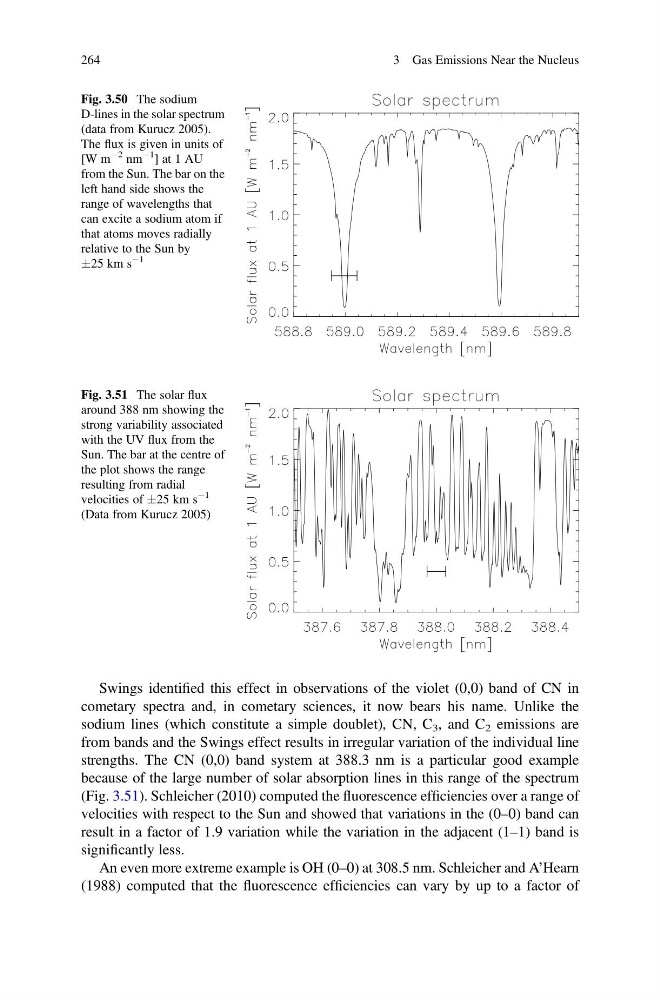
strengths. The CN (0,0) band system at 388.3 nm is a particular good example
because of the large number of solar absorption lines in this range of the spectrum
(Fig. 3.51). Schleicher (2010) computed the fluorescence efficiencies over a range of
velocities with respect to the Sun and showed that variations in the (0–0) band can
result in a factor of 1.9 variation while the variation in the adjacent (1–1) band is
significantly less.
An even more extreme example is OH (0–0) at 308.5 nm. Schleicher and A’Hearn
(1988) computed that the fluorescence efficiencies can vary by up to a factor of
Fig. 3.50 The sodium
D-lines in the solar spectrum
(data from Kurucz 2005).
The flux is given in units of
[W m
À2 nm
À1
] at 1 AU
from the Sun. The bar on the
left hand side shows the
range of wavelengths that
can excite a sodium atom if
that atoms moves radially
relative to the Sun by
Æ25 km s
À1
Fig. 3.51 The solar flux
around 388 nm showing the
strong variability associated
with the UV flux from the
Sun. The bar at the centre of
the plot shows the range
resulting from radial
velocities of Æ25 km s
À1
(Data from Kurucz 2005)
264
3 Gas Emissions Near the Nucleus
cometary spectra and, in cometary sciences, it now bears his name. Unlike the
sodium lines (which constitute a simple doublet), CN, C 3 , and C 2 emissions are
from bands and the Swings effect results in irregular variation of the individual line
strengths. The CN (0,0) band system at 388.3 nm is a particular good example
because of the large number of solar absorption lines in this range of the spectrum
(Fig. 3.51). Schleicher (2010) computed the fluorescence efficiencies over a range of
velocities with respect to the Sun and showed that variations in the (0–0) band can
result in a factor of 1.9 variation while the variation in the adjacent (1–1) band is
significantly less.
An even more extreme example is OH (0–0) at 308.5 nm. Schleicher and A’Hearn
(1988) computed that the fluorescence efficiencies can vary by up to a factor of
Fig. 3.50 The sodium
D-lines in the solar spectrum
(data from Kurucz 2005).
The flux is given in units of
[W m
À2 nm
À1
] at 1 AU
from the Sun. The bar on the
left hand side shows the
range of wavelengths that
can excite a sodium atom if
that atoms moves radially
relative to the Sun by
Æ25 km s
À1
Fig. 3.51 The solar flux
around 388 nm showing the
strong variability associated
with the UV flux from the
Sun. The bar at the centre of
the plot shows the range
resulting from radial
velocities of Æ25 km s
À1
(Data from Kurucz 2005)
264
3 Gas Emissions Near the Nucleus