

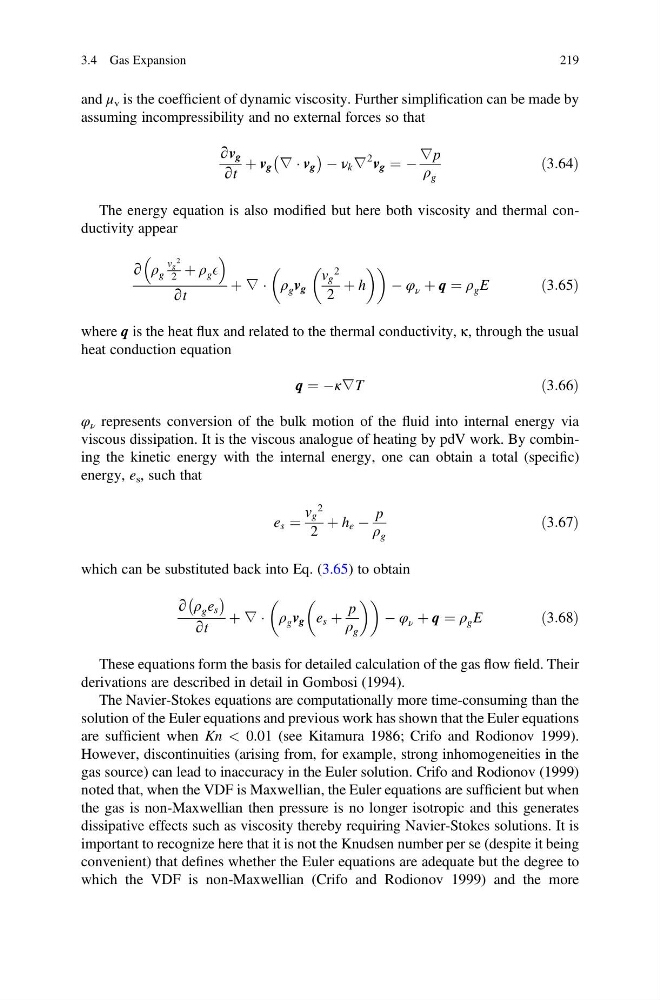
and μ v is the coefficient of dynamic viscosity. Further simplification can be made by
assuming incompressibility and no external forces so that
∂v g
∂t
þ v g ∇ Á v g
À
Á À ν k ∇
2 v g ¼ À
∇p
ρ g
ð3:64Þ
The energy equation is also modified but here both viscosity and thermal conductivity appear
∂ ρ g
v g
2
2 þ ρ g E
∂t
þ ∇ Á ρ g v g
v g
2
2
þ h
À φ ν þ q ¼ ρ g E
ð3:65Þ
where q is the heat flux and related to the thermal conductivity, κ, through the usual
heat conduction equation
q ¼ Àκ∇T
ð3:66Þ
φ ν represents conversion of the bulk motion of the fluid into internal energy via
viscous dissipation. It is the viscous analogue of heating by pdV work. By combining the kinetic energy with the internal energy, one can obtain a total (specific)
energy, e s , such that
e s ¼
v g
2
2
þ h e À
p
ρ g
ð3:67Þ
which can be substituted back into Eq. (3.65) to obtain
∂ ρ g e s
À
Á
∂t
þ ∇ Á ρ g v g e s þ
p
ρ g
À φ ν þ q ¼ ρ g E
ð3:68Þ
These equations form the basis for detailed calculation of the gas flow field. Their
derivations are described in detail in Gombosi (1994).
The Navier-Stokes equations are computationally more time-consuming than the
solution of the Euler equations and previous work has shown that the Euler equations
are sufficient when Kn < 0.01 (see Kitamura 1986; Crifo and Rodionov 1999).
However, discontinuities (arising from, for example, strong inhomogeneities in the
gas source) can lead to inaccuracy in the Euler solution. Crifo and Rodionov (1999)
noted that, when the VDF is Maxwellian, the Euler equations are sufficient but when
the gas is non-Maxwellian then pressure is no longer isotropic and this generates
dissipative effects such as viscosity thereby requiring Navier-Stokes solutions. It is
important to recognize here that it is not the Knudsen number per se (despite it being
convenient) that defines whether the Euler equations are adequate but the degree to
which the VDF is non-Maxwellian (Crifo and Rodionov 1999) and the more
3.4 Gas Expansion
219
assuming incompressibility and no external forces so that
∂v g
∂t
þ v g ∇ Á v g
À
Á À ν k ∇
2 v g ¼ À
∇p
ρ g
ð3:64Þ
The energy equation is also modified but here both viscosity and thermal conductivity appear
∂ ρ g
v g
2
2 þ ρ g E
∂t
þ ∇ Á ρ g v g
v g
2
2
þ h
À φ ν þ q ¼ ρ g E
ð3:65Þ
where q is the heat flux and related to the thermal conductivity, κ, through the usual
heat conduction equation
q ¼ Àκ∇T
ð3:66Þ
φ ν represents conversion of the bulk motion of the fluid into internal energy via
viscous dissipation. It is the viscous analogue of heating by pdV work. By combining the kinetic energy with the internal energy, one can obtain a total (specific)
energy, e s , such that
e s ¼
v g
2
2
þ h e À
p
ρ g
ð3:67Þ
which can be substituted back into Eq. (3.65) to obtain
∂ ρ g e s
À
Á
∂t
þ ∇ Á ρ g v g e s þ
p
ρ g
À φ ν þ q ¼ ρ g E
ð3:68Þ
These equations form the basis for detailed calculation of the gas flow field. Their
derivations are described in detail in Gombosi (1994).
The Navier-Stokes equations are computationally more time-consuming than the
solution of the Euler equations and previous work has shown that the Euler equations
are sufficient when Kn < 0.01 (see Kitamura 1986; Crifo and Rodionov 1999).
However, discontinuities (arising from, for example, strong inhomogeneities in the
gas source) can lead to inaccuracy in the Euler solution. Crifo and Rodionov (1999)
noted that, when the VDF is Maxwellian, the Euler equations are sufficient but when
the gas is non-Maxwellian then pressure is no longer isotropic and this generates
dissipative effects such as viscosity thereby requiring Navier-Stokes solutions. It is
important to recognize here that it is not the Knudsen number per se (despite it being
convenient) that defines whether the Euler equations are adequate but the degree to
which the VDF is non-Maxwellian (Crifo and Rodionov 1999) and the more
3.4 Gas Expansion
219