

∂ ρ g
v g
2
2 þ ρ g E
∂t
þ ∇ Á ρ g v g
v g
2
2
þ h e
¼ ρ g E
ð3:58Þ
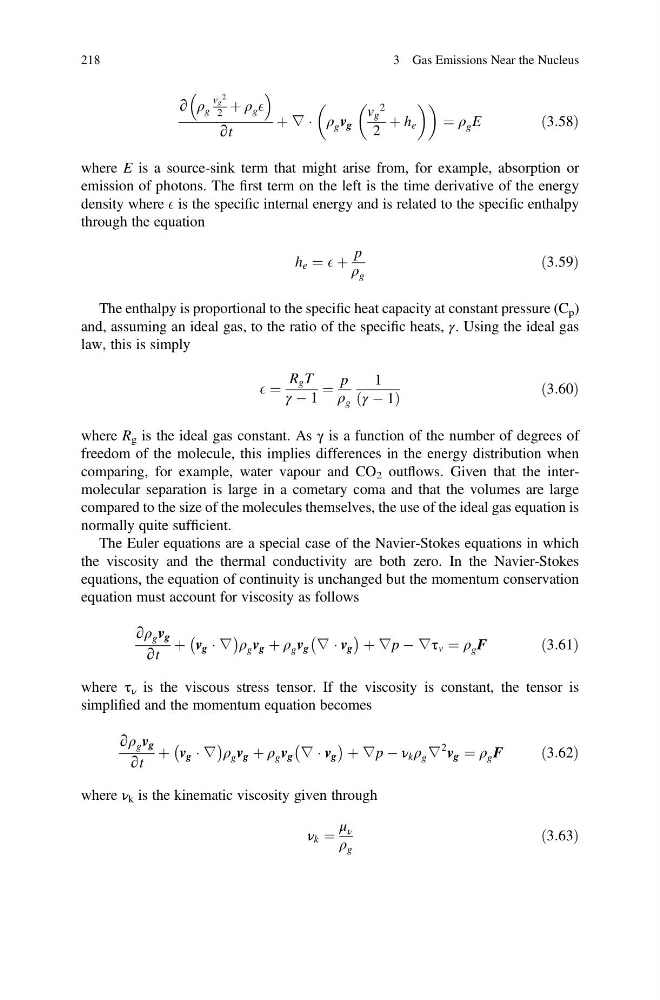
where E is a source-sink term that might arise from, for example, absorption or
emission of photons. The first term on the left is the time derivative of the energy
density where E is the specific internal energy and is related to the specific enthalpy
through the equation
h e ¼ E þ
p
ρ g
ð3:59Þ
The enthalpy is proportional to the specific heat capacity at constant pressure (C p )
and, assuming an ideal gas, to the ratio of the specific heats, γ. Using the ideal gas
law, this is simply
E ¼
R g T
γ À 1
¼
p
ρ g
1
γ À 1
ð
Þ
ð3:60Þ
where R g is the ideal gas constant. As γ is a function of the number of degrees of
freedom of the molecule, this implies differences in the energy distribution when
comparing, for example, water vapour and CO 2 outflows. Given that the intermolecular separation is large in a cometary coma and that the volumes are large
compared to the size of the molecules themselves, the use of the ideal gas equation is
normally quite sufficient.
The Euler equations are a special case of the Navier-Stokes equations in which
the viscosity and the thermal conductivity are both zero. In the Navier-Stokes
equations, the equation of continuity is unchanged but the momentum conservation
equation must account for viscosity as follows
∂ρ g v g
∂t
þ v g Á ∇
À
Á ρ g v g þ ρ g v g ∇ Á v g
À
Á þ ∇p À ∇τ v ¼ ρ g F
ð3:61Þ
where τ ν is the viscous stress tensor. If the viscosity is constant, the tensor is
simplified and the momentum equation becomes
∂ρ g v g
∂t
þ v g Á ∇
À
Á ρ g v g þ ρ g v g ∇ Á v g
À
Á þ ∇p À ν k ρ g ∇
2 v g ¼ ρ g F
ð3:62Þ
where ν k is the kinematic viscosity given through
ν k ¼
μ ν
ρ g
ð3:63Þ
218
3 Gas Emissions Near the Nucleus
v g
2
2 þ ρ g E
∂t
þ ∇ Á ρ g v g
v g
2
2
þ h e
¼ ρ g E
ð3:58Þ
where E is a source-sink term that might arise from, for example, absorption or
emission of photons. The first term on the left is the time derivative of the energy
density where E is the specific internal energy and is related to the specific enthalpy
through the equation
h e ¼ E þ
p
ρ g
ð3:59Þ
The enthalpy is proportional to the specific heat capacity at constant pressure (C p )
and, assuming an ideal gas, to the ratio of the specific heats, γ. Using the ideal gas
law, this is simply
E ¼
R g T
γ À 1
¼
p
ρ g
1
γ À 1
ð
Þ
ð3:60Þ
where R g is the ideal gas constant. As γ is a function of the number of degrees of
freedom of the molecule, this implies differences in the energy distribution when
comparing, for example, water vapour and CO 2 outflows. Given that the intermolecular separation is large in a cometary coma and that the volumes are large
compared to the size of the molecules themselves, the use of the ideal gas equation is
normally quite sufficient.
The Euler equations are a special case of the Navier-Stokes equations in which
the viscosity and the thermal conductivity are both zero. In the Navier-Stokes
equations, the equation of continuity is unchanged but the momentum conservation
equation must account for viscosity as follows
∂ρ g v g
∂t
þ v g Á ∇
À
Á ρ g v g þ ρ g v g ∇ Á v g
À
Á þ ∇p À ∇τ v ¼ ρ g F
ð3:61Þ
where τ ν is the viscous stress tensor. If the viscosity is constant, the tensor is
simplified and the momentum equation becomes
∂ρ g v g
∂t
þ v g Á ∇
À
Á ρ g v g þ ρ g v g ∇ Á v g
À
Á þ ∇p À ν k ρ g ∇
2 v g ¼ ρ g F
ð3:62Þ
where ν k is the kinematic viscosity given through
ν k ¼
μ ν
ρ g
ð3:63Þ
218
3 Gas Emissions Near the Nucleus