

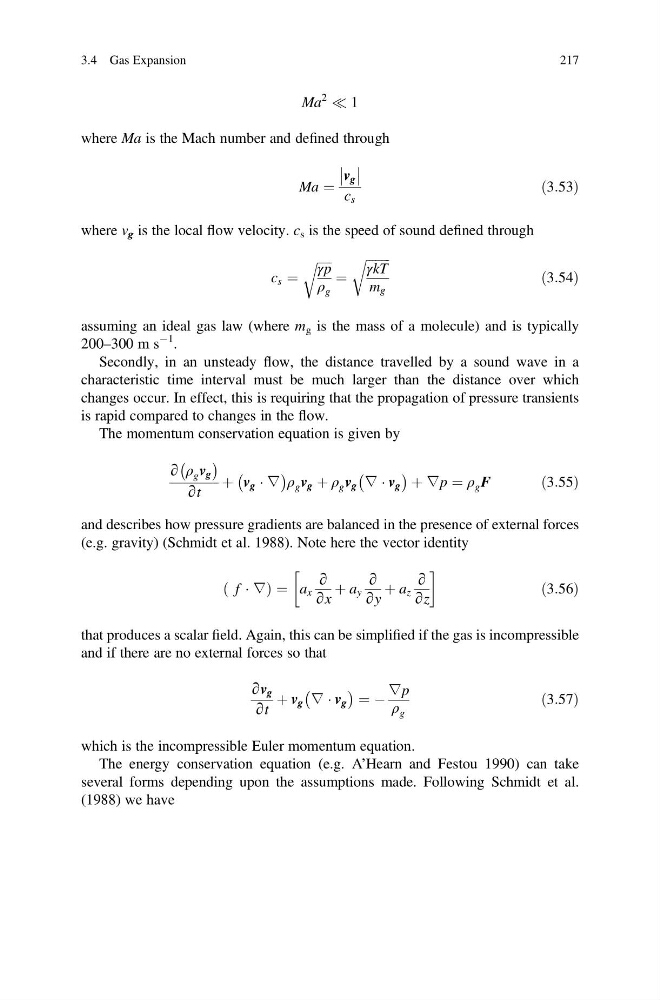
Ma
2
( 1
where Ma is the Mach number and defined through
Ma ¼
v g
c s
ð3:53Þ
where v g is the local flow velocity. c s is the speed of sound defined through
c s ¼
ffiffiffiffiffi
γp
ρ g
r
¼
ffiffiffiffiffiffiffi ffi
γkT
m g
r
ð3:54Þ
assuming an ideal gas law (where m g is the mass of a molecule) and is typically
200–300 m s
À1 .
Secondly, in an unsteady flow, the distance travelled by a sound wave in a
characteristic time interval must be much larger than the distance over which
changes occur. In effect, this is requiring that the propagation of pressure transients
is rapid compared to changes in the flow.
The momentum conservation equation is given by
∂ ρ g v g
À
Á
∂t
þ v g Á ∇
À
Á ρ g v g þ ρ g v g ∇ Á v g
À
Á þ ∇p ¼ ρ g F
ð3:55Þ
and describes how pressure gradients are balanced in the presence of external forces
(e.g. gravity) (Schmidt et al. 1988). Note here the vector identity
f Á ∇
ð
Þ¼ a x
∂
∂x
þ a y
∂
∂y
þ a z
∂
∂z
!
ð3:56Þ
that produces a scalar field. Again, this can be simplified if the gas is incompressible
and if there are no external forces so that
∂v g
∂t
þ v g ∇ Á v g
À
Á ¼ À
∇p
ρ g
ð3:57Þ
which is the incompressible Euler momentum equation.
The energy conservation equation (e.g. A’Hearn and Festou 1990) can take
several forms depending upon the assumptions made. Following Schmidt et al.
(1988) we have
3.4 Gas Expansion
217
2
( 1
where Ma is the Mach number and defined through
Ma ¼
v g
c s
ð3:53Þ
where v g is the local flow velocity. c s is the speed of sound defined through
c s ¼
ffiffiffiffiffi
γp
ρ g
r
¼
ffiffiffiffiffiffiffi ffi
γkT
m g
r
ð3:54Þ
assuming an ideal gas law (where m g is the mass of a molecule) and is typically
200–300 m s
À1 .
Secondly, in an unsteady flow, the distance travelled by a sound wave in a
characteristic time interval must be much larger than the distance over which
changes occur. In effect, this is requiring that the propagation of pressure transients
is rapid compared to changes in the flow.
The momentum conservation equation is given by
∂ ρ g v g
À
Á
∂t
þ v g Á ∇
À
Á ρ g v g þ ρ g v g ∇ Á v g
À
Á þ ∇p ¼ ρ g F
ð3:55Þ
and describes how pressure gradients are balanced in the presence of external forces
(e.g. gravity) (Schmidt et al. 1988). Note here the vector identity
f Á ∇
ð
Þ¼ a x
∂
∂x
þ a y
∂
∂y
þ a z
∂
∂z
!
ð3:56Þ
that produces a scalar field. Again, this can be simplified if the gas is incompressible
and if there are no external forces so that
∂v g
∂t
þ v g ∇ Á v g
À
Á ¼ À
∇p
ρ g
ð3:57Þ
which is the incompressible Euler momentum equation.
The energy conservation equation (e.g. A’Hearn and Festou 1990) can take
several forms depending upon the assumptions made. Following Schmidt et al.
(1988) we have
3.4 Gas Expansion
217