

The mean free path in space can become extremely large so that Kn can approach
infinity. This is the free-molecular flow regime when individual molecules no longer
interact with each other. The free molecular approximation has its uses in cometary
coma studies and, while it is invalid close to the nucleus for typical comets <3 AU
from the Sun, there are cases where its simplicity is helpful at larger cometocentric
distances.
3.4.3 Fluid Expansion
3.4.3.1 Fluid Equations for Equilibrium Flow
For low values of the Knudsen number (Kn≲0.01), flows in the inner gas coma can
be described by the Euler equations for inviscid flow. The three Euler equations are
conservation equations for mass, momentum, and energy. In the compressible form,
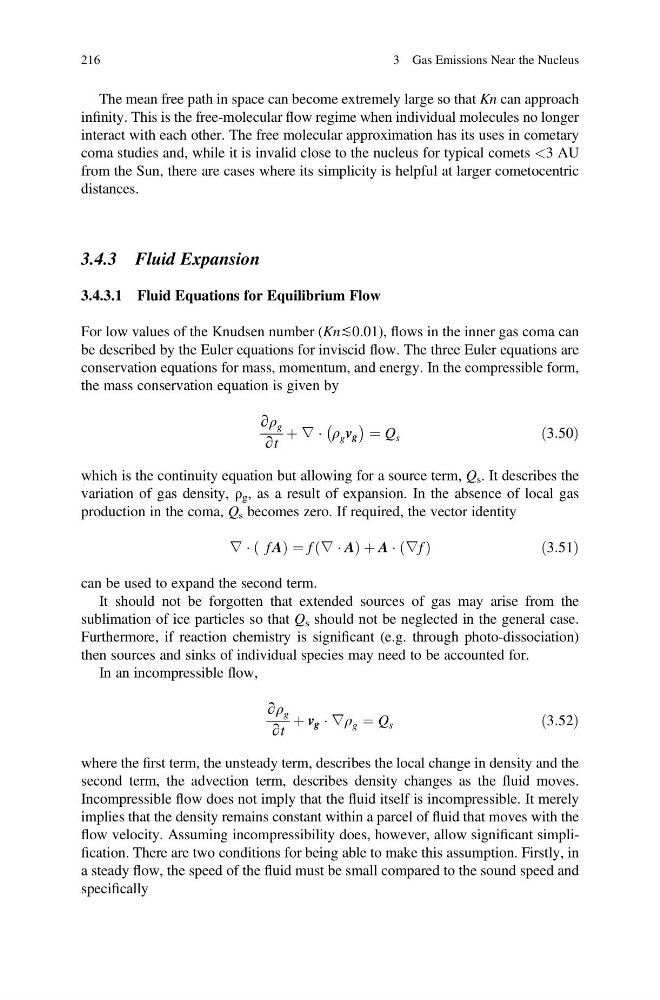
the mass conservation equation is given by
∂ρ g
∂t
þ ∇ Á ρ g v g
À
Á ¼ Q s
ð3:50Þ
which is the continuity equation but allowing for a source term, Q s . It describes the
variation of gas density, ρ g , as a result of expansion. In the absence of local gas
production in the coma, Q s becomes zero. If required, the vector identity
∇ Á f A
ð
Þ ¼ f ∇ Á A
ð
ÞþA Á ∇f
ð Þ
ð3:51Þ
can be used to expand the second term.
It should not be forgotten that extended sources of gas may arise from the
sublimation of ice particles so that Q s should not be neglected in the general case.
Furthermore, if reaction chemistry is significant (e.g. through photo-dissociation)
then sources and sinks of individual species may need to be accounted for.
In an incompressible flow,
∂ρ g
∂t
þ v g Á ∇ρ g ¼ Q s
ð3:52Þ
where the first term, the unsteady term, describes the local change in density and the
second term, the advection term, describes density changes as the fluid moves.
Incompressible flow does not imply that the fluid itself is incompressible. It merely
implies that the density remains constant within a parcel of fluid that moves with the
flow velocity. Assuming incompressibility does, however, allow significant simplification. There are two conditions for being able to make this assumption. Firstly, in
a steady flow, the speed of the fluid must be small compared to the sound speed and
specifically
216
3 Gas Emissions Near the Nucleus
infinity. This is the free-molecular flow regime when individual molecules no longer
interact with each other. The free molecular approximation has its uses in cometary
coma studies and, while it is invalid close to the nucleus for typical comets <3 AU
from the Sun, there are cases where its simplicity is helpful at larger cometocentric
distances.
3.4.3 Fluid Expansion
3.4.3.1 Fluid Equations for Equilibrium Flow
For low values of the Knudsen number (Kn≲0.01), flows in the inner gas coma can
be described by the Euler equations for inviscid flow. The three Euler equations are
conservation equations for mass, momentum, and energy. In the compressible form,
the mass conservation equation is given by
∂ρ g
∂t
þ ∇ Á ρ g v g
À
Á ¼ Q s
ð3:50Þ
which is the continuity equation but allowing for a source term, Q s . It describes the
variation of gas density, ρ g , as a result of expansion. In the absence of local gas
production in the coma, Q s becomes zero. If required, the vector identity
∇ Á f A
ð
Þ ¼ f ∇ Á A
ð
ÞþA Á ∇f
ð Þ
ð3:51Þ
can be used to expand the second term.
It should not be forgotten that extended sources of gas may arise from the
sublimation of ice particles so that Q s should not be neglected in the general case.
Furthermore, if reaction chemistry is significant (e.g. through photo-dissociation)
then sources and sinks of individual species may need to be accounted for.
In an incompressible flow,
∂ρ g
∂t
þ v g Á ∇ρ g ¼ Q s
ð3:52Þ
where the first term, the unsteady term, describes the local change in density and the
second term, the advection term, describes density changes as the fluid moves.
Incompressible flow does not imply that the fluid itself is incompressible. It merely
implies that the density remains constant within a parcel of fluid that moves with the
flow velocity. Assuming incompressibility does, however, allow significant simplification. There are two conditions for being able to make this assumption. Firstly, in
a steady flow, the speed of the fluid must be small compared to the sound speed and
specifically
216
3 Gas Emissions Near the Nucleus