

r HD $
ffiffi ffi
2
p σ col Q g
πv g
ð3:46Þ
where σ col is the collisional cross-section. (This is a slightly modified form of the
expression used by Wallis 1974).
The quantity used to establish the validity or otherwise of the continuum description is the Knudsen number (Kn) which is the ratio of λ MFP to a characteristic
dimension, L Kn ,
Kn ¼
λ MFP
L Kn
:
ð3:47Þ
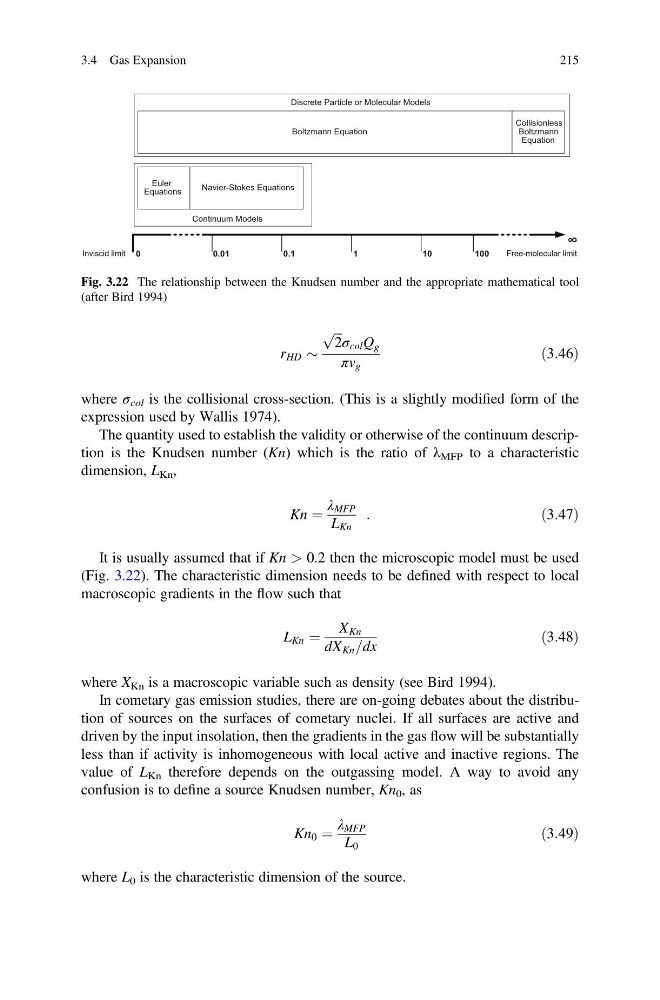
It is usually assumed that if Kn > 0.2 then the microscopic model must be used
(Fig. 3.22). The characteristic dimension needs to be defined with respect to local
macroscopic gradients in the flow such that
L Kn ¼
X Kn
dX Kn =dx
ð3:48Þ
where X Kn is a macroscopic variable such as density (see Bird 1994).
In cometary gas emission studies, there are on-going debates about the distribution of sources on the surfaces of cometary nuclei. If all surfaces are active and
driven by the input insolation, then the gradients in the gas flow will be substantially
less than if activity is inhomogeneous with local active and inactive regions. The
value of L Kn therefore depends on the outgassing model. A way to avoid any
confusion is to define a source Knudsen number, Kn 0 , as
Kn 0 ¼
λ MFP
L 0
ð3:49Þ
where L 0 is the characteristic dimension of the source.
0
∞
100
10
1
0.1
0.01
Continuum Models
Discrete Particle or Molecular Models
Boltzmann Equation
Collisionless
Boltzmann
Equation
Euler
Equations
Navier-Stokes Equations
Free-molecular limit
Inviscid limit
Fig. 3.22 The relationship between the Knudsen number and the appropriate mathematical tool
(after Bird 1994)
3.4 Gas Expansion
215
ffiffi ffi
2
p σ col Q g
πv g
ð3:46Þ
where σ col is the collisional cross-section. (This is a slightly modified form of the
expression used by Wallis 1974).
The quantity used to establish the validity or otherwise of the continuum description is the Knudsen number (Kn) which is the ratio of λ MFP to a characteristic
dimension, L Kn ,
Kn ¼
λ MFP
L Kn
:
ð3:47Þ
It is usually assumed that if Kn > 0.2 then the microscopic model must be used
(Fig. 3.22). The characteristic dimension needs to be defined with respect to local
macroscopic gradients in the flow such that
L Kn ¼
X Kn
dX Kn =dx
ð3:48Þ
where X Kn is a macroscopic variable such as density (see Bird 1994).
In cometary gas emission studies, there are on-going debates about the distribution of sources on the surfaces of cometary nuclei. If all surfaces are active and
driven by the input insolation, then the gradients in the gas flow will be substantially
less than if activity is inhomogeneous with local active and inactive regions. The
value of L Kn therefore depends on the outgassing model. A way to avoid any
confusion is to define a source Knudsen number, Kn 0 , as
Kn 0 ¼
λ MFP
L 0
ð3:49Þ
where L 0 is the characteristic dimension of the source.
0
∞
100
10
1
0.1
0.01
Continuum Models
Discrete Particle or Molecular Models
Boltzmann Equation
Collisionless
Boltzmann
Equation
Euler
Equations
Navier-Stokes Equations
Free-molecular limit
Inviscid limit
Fig. 3.22 The relationship between the Knudsen number and the appropriate mathematical tool
(after Bird 1994)
3.4 Gas Expansion
215