

subjective issue of how necessary it is to define the exact properties of discontinuities
in the flow.
Simplification by assuming incompressibility is probably inadequate and the flow
in the inner coma clearly breaches the required conditions. Authors such as
Knollenberg (1994), Schmidt et al. (1988), and Crifo et al. (2005), who used the
Euler equations, adopted the compressible formulation. However, there does not
appear to have been a published, direct comparison between the compressible and
incompressible formulations for cometary applications.
3.4.3.2 The Initial Evolution of the Velocity Distribution Function
In order to initiate the flow field, an initial condition is required. Physically, the
source in the cometary case is the nucleus surface. The process provides sublimation
at a given rate and an initial temperature of the gas. This can be converted to a source
density, n 0 , and a source temperature, T 0 . However, even in the fluid case, the change
from a half-Maxwellian to a full-Maxwellian cannot be ignored (the Knudsen layer)
because the energy to go from the initial distribution to the full Maxwellian is,
effectively, extracted from the gas itself and is no longer available to drive the flow.
This leads to the concept of a macroscopic “jump” in density and temperature
between the source and the equilibrium flow regime.
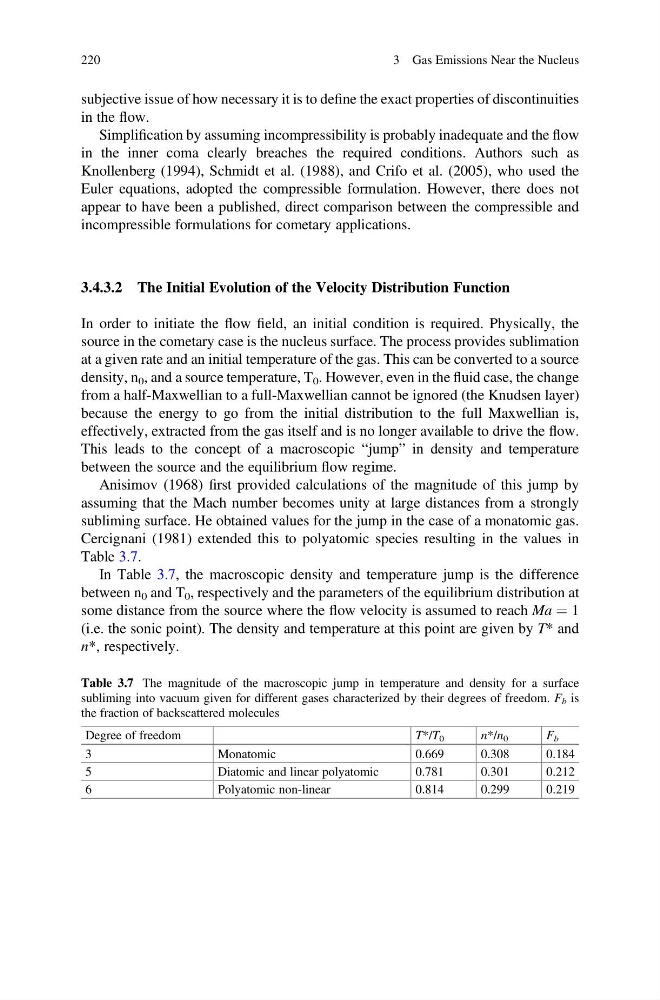
Anisimov (1968) first provided calculations of the magnitude of this jump by
assuming that the Mach number becomes unity at large distances from a strongly
subliming surface. He obtained values for the jump in the case of a monatomic gas.
Cercignani (1981) extended this to polyatomic species resulting in the values in
Table 3.7.
In Table 3.7, the macroscopic density and temperature jump is the difference
between n 0 and T 0 , respectively and the parameters of the equilibrium distribution at
some distance from the source where the flow velocity is assumed to reach Ma ¼ 1
(i.e. the sonic point). The density and temperature at this point are given by T* and
n*, respectively.
Table 3.7 The magnitude of the macroscopic jump in temperature and density for a surface
subliming into vacuum given for different gases characterized by their degrees of freedom. F b is
the fraction of backscattered molecules
Degree of freedom
T*/T 0
n*/n 0
F b
3
Monatomic
0.669
0.308
0.184
5
Diatomic and linear polyatomic
0.781
0.301
0.212
6
Polyatomic non-linear
0.814
0.299
0.219
220
3 Gas Emissions Near the Nucleus
in the flow.
Simplification by assuming incompressibility is probably inadequate and the flow
in the inner coma clearly breaches the required conditions. Authors such as
Knollenberg (1994), Schmidt et al. (1988), and Crifo et al. (2005), who used the
Euler equations, adopted the compressible formulation. However, there does not
appear to have been a published, direct comparison between the compressible and
incompressible formulations for cometary applications.
3.4.3.2 The Initial Evolution of the Velocity Distribution Function
In order to initiate the flow field, an initial condition is required. Physically, the
source in the cometary case is the nucleus surface. The process provides sublimation
at a given rate and an initial temperature of the gas. This can be converted to a source
density, n 0 , and a source temperature, T 0 . However, even in the fluid case, the change
from a half-Maxwellian to a full-Maxwellian cannot be ignored (the Knudsen layer)
because the energy to go from the initial distribution to the full Maxwellian is,
effectively, extracted from the gas itself and is no longer available to drive the flow.
This leads to the concept of a macroscopic “jump” in density and temperature
between the source and the equilibrium flow regime.
Anisimov (1968) first provided calculations of the magnitude of this jump by
assuming that the Mach number becomes unity at large distances from a strongly
subliming surface. He obtained values for the jump in the case of a monatomic gas.
Cercignani (1981) extended this to polyatomic species resulting in the values in
Table 3.7.
In Table 3.7, the macroscopic density and temperature jump is the difference
between n 0 and T 0 , respectively and the parameters of the equilibrium distribution at
some distance from the source where the flow velocity is assumed to reach Ma ¼ 1
(i.e. the sonic point). The density and temperature at this point are given by T* and
n*, respectively.
Table 3.7 The magnitude of the macroscopic jump in temperature and density for a surface
subliming into vacuum given for different gases characterized by their degrees of freedom. F b is
the fraction of backscattered molecules
Degree of freedom
T*/T 0
n*/n 0
F b
3
Monatomic
0.669
0.308
0.184
5
Diatomic and linear polyatomic
0.781
0.301
0.212
6
Polyatomic non-linear
0.814
0.299
0.219
220
3 Gas Emissions Near the Nucleus