

optical depths of 1 or more within 10–20 km of the nucleus for typical values of the
outflow velocity. Hence, the observed infrared emission from the coma will be
influenced by absorption in an active comet and, for non-isotropic outflow, will be
dependent upon the observing geometry. This effect leads to a major increase in the
complexity of the interpretation of the water vapour lines requiring determination of
the spatial distribution, the gas velocity, and the gas temperature to determine the
opacity from the Sun to the position of interest and from that point to the observer.
The usual equations of radiative transfer can be used in constructing the solution if
the coma properties are known. However, it is often precisely these quantities that
we are interested in determining from the observed intensity, not the other around!
The intensity of a band is typically given in units of [W m
À2 sr
À1 ]. It remains
somewhat unfashionable in cometary physics but the Rayleigh is a unit that is a
useful way to describe the luminosity of a column of an emitting species but has the
units of surface brightness. It was first proposed by Hunten et al. (1956) and defines
1 Rayleigh (R) as 10
6 /4π photon s
À1 cm
À2 sr
À1 . Hence 1 W m
À2 sr
À1 corresponds to
6.33 Â 10
9
λ Rayleigh where λ is the wavelength in [μm].
We saw earlier that the total change of intensity within a beam requires inclusion
of absorption and a source function, j ϑ , and we can re-write Eq. (3.19) as
dI ϑ
ds
¼ Àκ ϑ I ϑ þ j ϑ
ð3:40Þ
For the infrared bands, when optical depth is significant, the source function can
be written as
j ϑ ¼
hϑ 0
4π
g f φ ϑ, ϑ 0
ð
Þ
ð3:41Þ
where the value of the g-factor in Eq. (3.41) requires knowledge of the partition
function as well as the optical depth to the source position (assuming that the
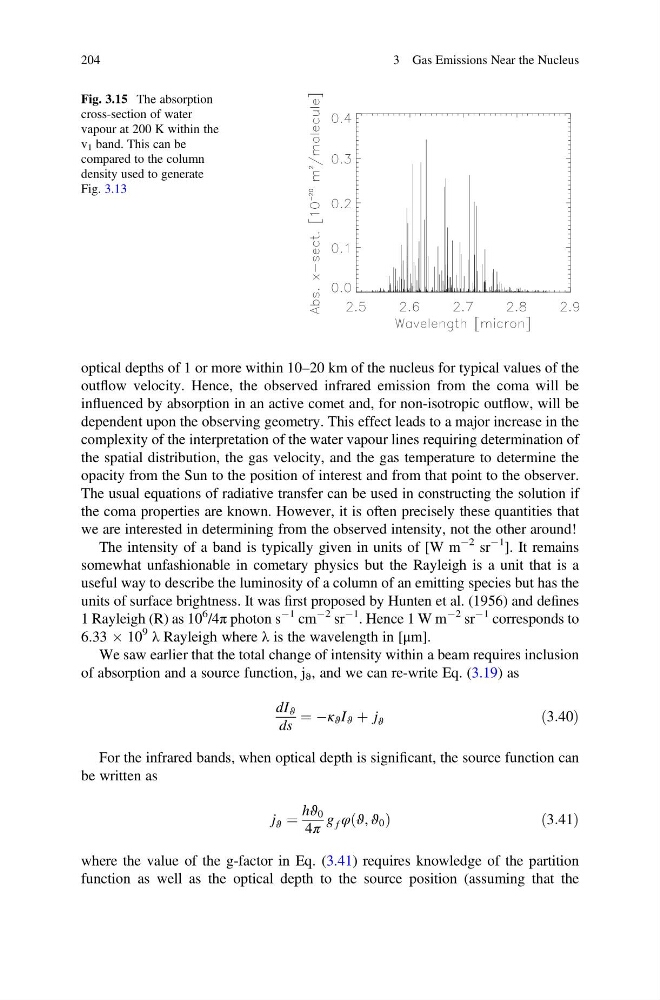
Fig. 3.15 The absorption
cross-section of water
vapour at 200 K within the
v 1 band. This can be
compared to the column
density used to generate
Fig. 3.13
204
3 Gas Emissions Near the Nucleus
outflow velocity. Hence, the observed infrared emission from the coma will be
influenced by absorption in an active comet and, for non-isotropic outflow, will be
dependent upon the observing geometry. This effect leads to a major increase in the
complexity of the interpretation of the water vapour lines requiring determination of
the spatial distribution, the gas velocity, and the gas temperature to determine the
opacity from the Sun to the position of interest and from that point to the observer.
The usual equations of radiative transfer can be used in constructing the solution if
the coma properties are known. However, it is often precisely these quantities that
we are interested in determining from the observed intensity, not the other around!
The intensity of a band is typically given in units of [W m
À2 sr
À1 ]. It remains
somewhat unfashionable in cometary physics but the Rayleigh is a unit that is a
useful way to describe the luminosity of a column of an emitting species but has the
units of surface brightness. It was first proposed by Hunten et al. (1956) and defines
1 Rayleigh (R) as 10
6 /4π photon s
À1 cm
À2 sr
À1 . Hence 1 W m
À2 sr
À1 corresponds to
6.33 Â 10
9
λ Rayleigh where λ is the wavelength in [μm].
We saw earlier that the total change of intensity within a beam requires inclusion
of absorption and a source function, j ϑ , and we can re-write Eq. (3.19) as
dI ϑ
ds
¼ Àκ ϑ I ϑ þ j ϑ
ð3:40Þ
For the infrared bands, when optical depth is significant, the source function can
be written as
j ϑ ¼
hϑ 0
4π
g f φ ϑ, ϑ 0
ð
Þ
ð3:41Þ
where the value of the g-factor in Eq. (3.41) requires knowledge of the partition
function as well as the optical depth to the source position (assuming that the
Fig. 3.15 The absorption
cross-section of water
vapour at 200 K within the
v 1 band. This can be
compared to the column
density used to generate
Fig. 3.13
204
3 Gas Emissions Near the Nucleus