

state (Laporta et al. 2012; see also Itikawa 2015). The collisional excitation rate in
units of [m
À3 s
À1 ] is given in this case by the equation
C ex ¼ n e n N σ col v rel
ð3:39Þ
where n e is the electron density, n N is the local density of the neutral, σ col is the
collision cross-section at a given electron temperature and v rel is the relative velocity.
The product σ col v rel is the collision rate coefficient which is itself dependent upon the
collision strength. For electron impact excitation of simple ions (e.g. O
+
) at a
constant electron temperature, collision strengths are frequently tabulated and equilibria can be calculated between excitation and collisional de-excitation (see
e.g. Osterbrock 1989). However, this is far less straightforward in the case of
water in the innermost coma of comets where outflow and gas drag are important
and the properties of the electron distribution are strongly varying with the gas
production rate with rapid electron cooling occurring with cometocentric distance
(Cravens and Korosmezey 1986; Engelhardt et al. 2018). It continues to be assumed
that excitation rates for H 2 O due to this process are very low within a few thousand
kilometres of the nucleus (Xie and Mumma 1992) although the sharp rise in electron
temperature beyond the contact surface (see below) probably leads to changes in the
populations of rotational energy states for several species through this mechanism at
larger cometocentric distances (see e.g. Biver et al. 1999).
H 2 O-H 2 O collisional de-excitation cross-sections have been presented by Buffa
et al. (2000) and an equation similar to that shown in Eq. (3.39) can be used (e.g. Lee
et al. 2011). But, in general, there is a lack of fundamental atomic data to describe
collisions. There are numerous topics that remain only partially addressed in the
literature with several processes (e.g. molecular collisions with CO) taken as being
insignificant for the sake of simplicity (e.g. Zakharov et al. 2007).
A further critical issue close to the nucleus is the influence of optical depth. As
can be seen in Fig. 3.15, the absorption cross-section of water vapour within some
lines can exceed 10
À21 m
2 molecule
À1 . Using the equation for column density
(Eq. 3.4), water production rates greater than a few 10
27 molecule s
À1 can produce
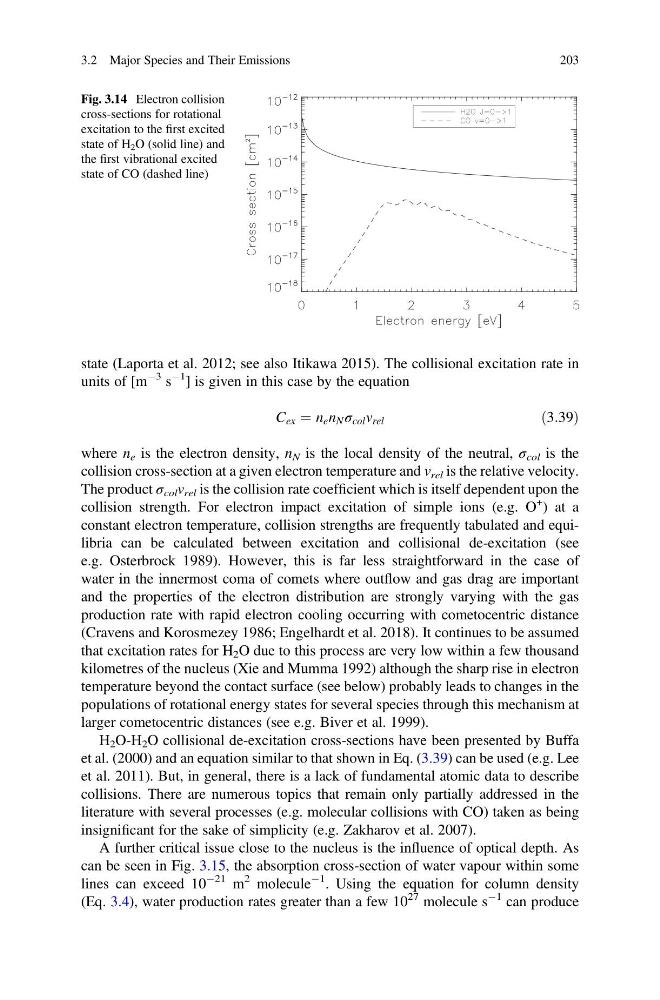
Fig. 3.14 Electron collision
cross-sections for rotational
excitation to the first excited
state of H 2 O (solid line) and
the first vibrational excited
state of CO (dashed line)
3.2 Major Species and Their Emissions
203
units of [m
À3 s
À1 ] is given in this case by the equation
C ex ¼ n e n N σ col v rel
ð3:39Þ
where n e is the electron density, n N is the local density of the neutral, σ col is the
collision cross-section at a given electron temperature and v rel is the relative velocity.
The product σ col v rel is the collision rate coefficient which is itself dependent upon the
collision strength. For electron impact excitation of simple ions (e.g. O
+
) at a
constant electron temperature, collision strengths are frequently tabulated and equilibria can be calculated between excitation and collisional de-excitation (see
e.g. Osterbrock 1989). However, this is far less straightforward in the case of
water in the innermost coma of comets where outflow and gas drag are important
and the properties of the electron distribution are strongly varying with the gas
production rate with rapid electron cooling occurring with cometocentric distance
(Cravens and Korosmezey 1986; Engelhardt et al. 2018). It continues to be assumed
that excitation rates for H 2 O due to this process are very low within a few thousand
kilometres of the nucleus (Xie and Mumma 1992) although the sharp rise in electron
temperature beyond the contact surface (see below) probably leads to changes in the
populations of rotational energy states for several species through this mechanism at
larger cometocentric distances (see e.g. Biver et al. 1999).
H 2 O-H 2 O collisional de-excitation cross-sections have been presented by Buffa
et al. (2000) and an equation similar to that shown in Eq. (3.39) can be used (e.g. Lee
et al. 2011). But, in general, there is a lack of fundamental atomic data to describe
collisions. There are numerous topics that remain only partially addressed in the
literature with several processes (e.g. molecular collisions with CO) taken as being
insignificant for the sake of simplicity (e.g. Zakharov et al. 2007).
A further critical issue close to the nucleus is the influence of optical depth. As
can be seen in Fig. 3.15, the absorption cross-section of water vapour within some
lines can exceed 10
À21 m
2 molecule
À1 . Using the equation for column density
(Eq. 3.4), water production rates greater than a few 10
27 molecule s
À1 can produce
Fig. 3.14 Electron collision
cross-sections for rotational
excitation to the first excited
state of H 2 O (solid line) and
the first vibrational excited
state of CO (dashed line)
3.2 Major Species and Their Emissions
203