

2.10.17 Evidence for Large-Scale Mass Loss
In Fig. 1.3, we noted that 1P/Halley exhibited a large, rapid, increase in brightness
several years after perihelion. Outbursts are seen relatively frequently in groundbased observations. Recent examples include C/2011 W3 (Lovejoy) (Sekanina and
Chodas 2012), C/2015 ER 61 (PAN-STARRS) (Sekanina 2017), P/2010 V1 (IkeyaMurakami), 217P/LINEAR (Sarugaku et al. 2010), C/2010 G2 (Hill) (Kawakita
et al. 2014), 17P/Holmes (Watanabe et al. 2009), and 2P/Encke (Lamy et al. 2003).
These observations suggest that comets can lose mass in rapid, relatively largescale, events. For the 17P/Holmes outburst in 2007, an isolated dust cloud was
observed moving away from the nucleus suggesting an abrupt end to the mass
loss rather than a slow decay as might be expected for a slow shutdown of a
subliming area. The problem here lies in a lack of substantive knowledge of the
mechanism(s) causing these outbursts although there are several hypotheses that
have been reviewed by Gronkoski and Wesolowski (2016). Several of the early
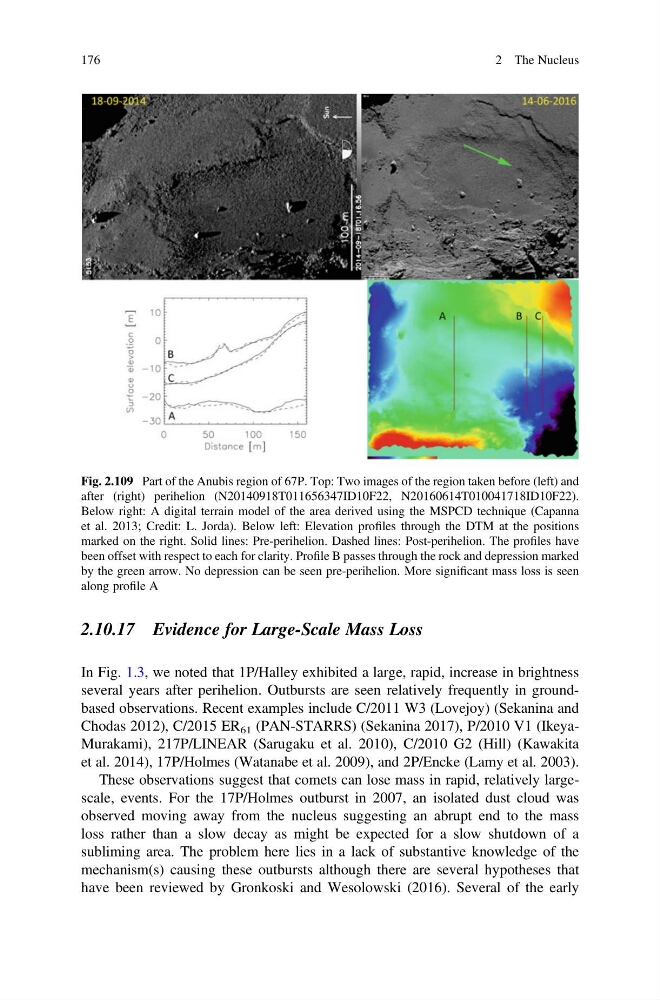
Fig. 2.109 Part of the Anubis region of 67P. Top: Two images of the region taken before (left) and
after (right) perihelion (N20140918T011656347ID10F22, N20160614T010041718ID10F22).
Below right: A digital terrain model of the area derived using the MSPCD technique (Capanna
et al. 2013; Credit: L. Jorda). Below left: Elevation profiles through the DTM at the positions
marked on the right. Solid lines: Pre-perihelion. Dashed lines: Post-perihelion. The profiles have
been offset with respect to each for clarity. Profile B passes through the rock and depression marked
by the green arrow. No depression can be seen pre-perihelion. More significant mass loss is seen
along profile A
176
2 The Nucleus
In Fig. 1.3, we noted that 1P/Halley exhibited a large, rapid, increase in brightness
several years after perihelion. Outbursts are seen relatively frequently in groundbased observations. Recent examples include C/2011 W3 (Lovejoy) (Sekanina and
Chodas 2012), C/2015 ER 61 (PAN-STARRS) (Sekanina 2017), P/2010 V1 (IkeyaMurakami), 217P/LINEAR (Sarugaku et al. 2010), C/2010 G2 (Hill) (Kawakita
et al. 2014), 17P/Holmes (Watanabe et al. 2009), and 2P/Encke (Lamy et al. 2003).
These observations suggest that comets can lose mass in rapid, relatively largescale, events. For the 17P/Holmes outburst in 2007, an isolated dust cloud was
observed moving away from the nucleus suggesting an abrupt end to the mass
loss rather than a slow decay as might be expected for a slow shutdown of a
subliming area. The problem here lies in a lack of substantive knowledge of the
mechanism(s) causing these outbursts although there are several hypotheses that
have been reviewed by Gronkoski and Wesolowski (2016). Several of the early
Fig. 2.109 Part of the Anubis region of 67P. Top: Two images of the region taken before (left) and
after (right) perihelion (N20140918T011656347ID10F22, N20160614T010041718ID10F22).
Below right: A digital terrain model of the area derived using the MSPCD technique (Capanna
et al. 2013; Credit: L. Jorda). Below left: Elevation profiles through the DTM at the positions
marked on the right. Solid lines: Pre-perihelion. Dashed lines: Post-perihelion. The profiles have
been offset with respect to each for clarity. Profile B passes through the rock and depression marked
by the green arrow. No depression can be seen pre-perihelion. More significant mass loss is seen
along profile A
176
2 The Nucleus