

theories were somewhat fanciful. The concepts worthy of more detailed investigation seem to be those where sub-surface volatiles are heated to produce internal
pressure that destabilises the surface layer until the pressure is, perhaps violently,
released.
The transition and subsequent energy release from amorphous to crystalline ice
has been discussed as a means of producing outburst activity at high heliocentric
distances. Given low local thermal conductivity, a runaway might occur because of
the exothermic nature of the transition possibly leading to internal disruption
provoking either collapse or larger scales ejections of mass. Other mechanisms
might involve slow warming of CO or CO 2 pockets through conduction. But is
there any evidence of large scale mass loss on the surface or indeed would we
recognize it if we saw it?
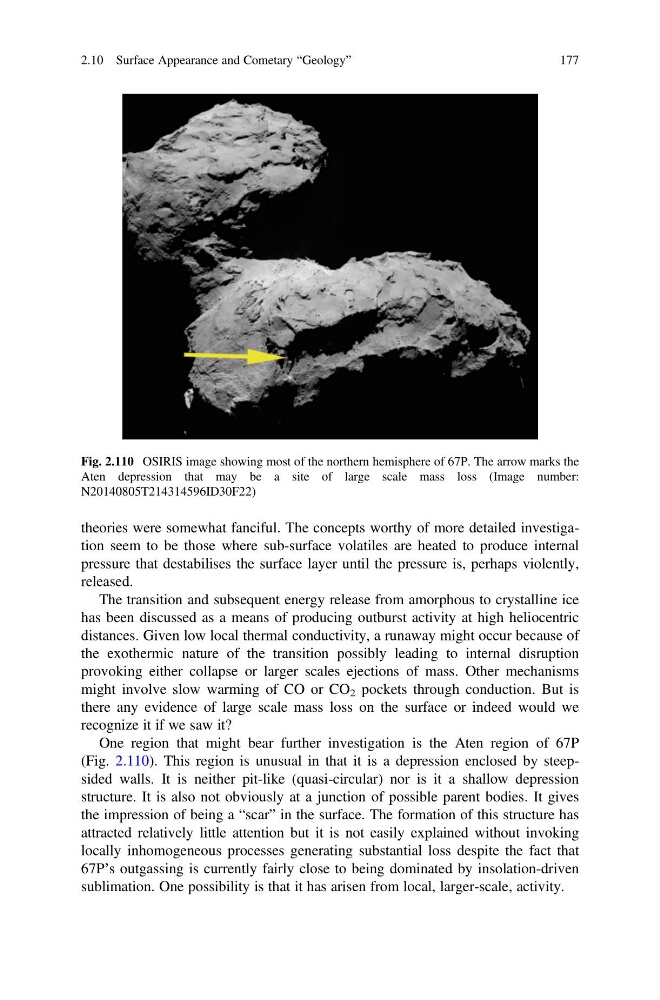
One region that might bear further investigation is the Aten region of 67P
(Fig. 2.110). This region is unusual in that it is a depression enclosed by steepsided walls. It is neither pit-like (quasi-circular) nor is it a shallow depression
structure. It is also not obviously at a junction of possible parent bodies. It gives
the impression of being a “scar” in the surface. The formation of this structure has
attracted relatively little attention but it is not easily explained without invoking
locally inhomogeneous processes generating substantial loss despite the fact that
67P’s outgassing is currently fairly close to being dominated by insolation-driven
sublimation. One possibility is that it has arisen from local, larger-scale, activity.
Fig. 2.110 OSIRIS image showing most of the northern hemisphere of 67P. The arrow marks the
Aten depression that may be a site of large scale mass loss (Image number:
N20140805T214314596ID30F22)
2.10 Surface Appearance and Cometary “Geology”
177
pressure that destabilises the surface layer until the pressure is, perhaps violently,
released.
The transition and subsequent energy release from amorphous to crystalline ice
has been discussed as a means of producing outburst activity at high heliocentric
distances. Given low local thermal conductivity, a runaway might occur because of
the exothermic nature of the transition possibly leading to internal disruption
provoking either collapse or larger scales ejections of mass. Other mechanisms
might involve slow warming of CO or CO 2 pockets through conduction. But is
there any evidence of large scale mass loss on the surface or indeed would we
recognize it if we saw it?
One region that might bear further investigation is the Aten region of 67P
(Fig. 2.110). This region is unusual in that it is a depression enclosed by steepsided walls. It is neither pit-like (quasi-circular) nor is it a shallow depression
structure. It is also not obviously at a junction of possible parent bodies. It gives
the impression of being a “scar” in the surface. The formation of this structure has
attracted relatively little attention but it is not easily explained without invoking
locally inhomogeneous processes generating substantial loss despite the fact that
67P’s outgassing is currently fairly close to being dominated by insolation-driven
sublimation. One possibility is that it has arisen from local, larger-scale, activity.
Fig. 2.110 OSIRIS image showing most of the northern hemisphere of 67P. The arrow marks the
Aten depression that may be a site of large scale mass loss (Image number:
N20140805T214314596ID30F22)
2.10 Surface Appearance and Cometary “Geology”
177