

direction. These have been categorized as wind-tails by Keller et al. (2017). However, this interpretation should be treated with some caution because there are rarely
strong relationships of these features to an obstacle retarding the flow. It should also
be noted that to generate wind-tails, the obstacle and the tail itself should have
dimensions considerably larger than the mean free path and it is not clear that this
condition is met even at times of high activity in the southern hemisphere. The
presence of large particles (boulders) is also of note.
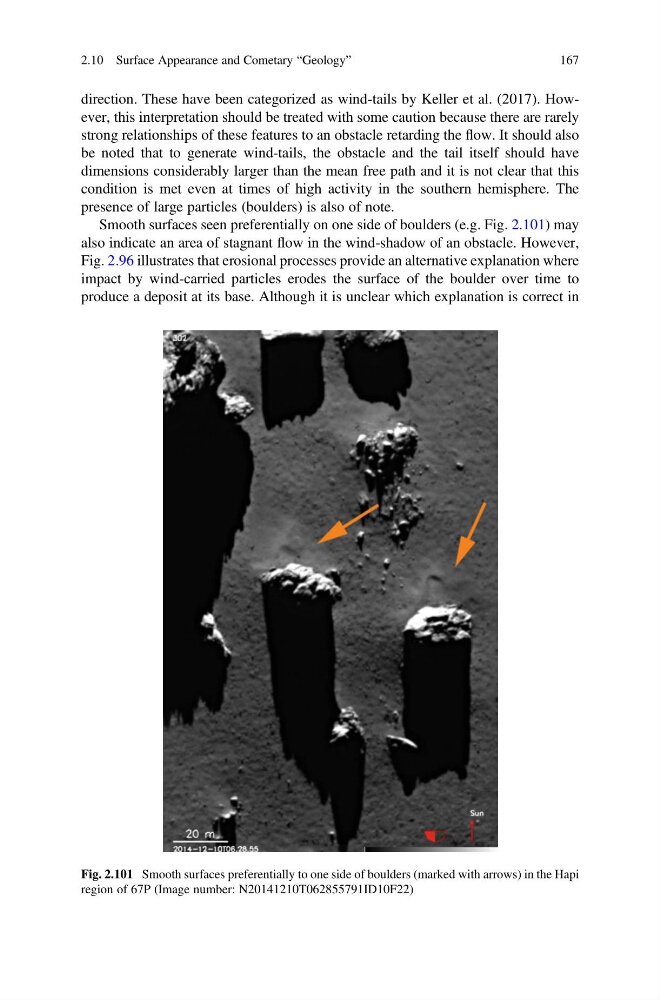
Smooth surfaces seen preferentially on one side of boulders (e.g. Fig. 2.101) may
also indicate an area of stagnant flow in the wind-shadow of an obstacle. However,
Fig. 2.96 illustrates that erosional processes provide an alternative explanation where
impact by wind-carried particles erodes the surface of the boulder over time to
produce a deposit at its base. Although it is unclear which explanation is correct in
Fig. 2.101 Smooth surfaces preferentially to one side of boulders (marked with arrows) in the Hapi
region of 67P (Image number: N20141210T062855791ID10F22)
2.10 Surface Appearance and Cometary “Geology”
167
strong relationships of these features to an obstacle retarding the flow. It should also
be noted that to generate wind-tails, the obstacle and the tail itself should have
dimensions considerably larger than the mean free path and it is not clear that this
condition is met even at times of high activity in the southern hemisphere. The
presence of large particles (boulders) is also of note.
Smooth surfaces seen preferentially on one side of boulders (e.g. Fig. 2.101) may
also indicate an area of stagnant flow in the wind-shadow of an obstacle. However,
Fig. 2.96 illustrates that erosional processes provide an alternative explanation where
impact by wind-carried particles erodes the surface of the boulder over time to
produce a deposit at its base. Although it is unclear which explanation is correct in
Fig. 2.101 Smooth surfaces preferentially to one side of boulders (marked with arrows) in the Hapi
region of 67P (Image number: N20141210T062855791ID10F22)
2.10 Surface Appearance and Cometary “Geology”
167