

the case of Fig. 2.101, the important conclusion is that dust transport across the
surface is an important process in defining local surface morphology.
2.10.14 Dune Pits
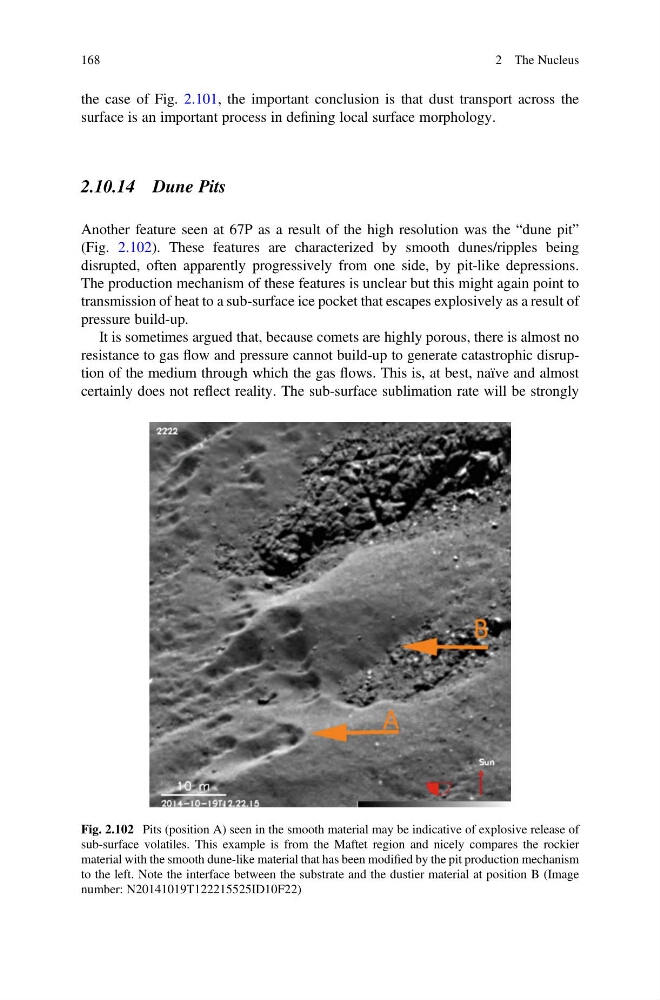
Another feature seen at 67P as a result of the high resolution was the “dune pit”
(Fig. 2.102). These features are characterized by smooth dunes/ripples being
disrupted, often apparently progressively from one side, by pit-like depressions.
The production mechanism of these features is unclear but this might again point to
transmission of heat to a sub-surface ice pocket that escapes explosively as a result of
pressure build-up.
It is sometimes argued that, because comets are highly porous, there is almost no
resistance to gas flow and pressure cannot build-up to generate catastrophic disruption of the medium through which the gas flows. This is, at best, naïve and almost
certainly does not reflect reality. The sub-surface sublimation rate will be strongly
Fig. 2.102 Pits (position A) seen in the smooth material may be indicative of explosive release of
sub-surface volatiles. This example is from the Maftet region and nicely compares the rockier
material with the smooth dune-like material that has been modified by the pit production mechanism
to the left. Note the interface between the substrate and the dustier material at position B (Image
number: N20141019T122215525ID10F22)
168
2 The Nucleus
surface is an important process in defining local surface morphology.
2.10.14 Dune Pits
Another feature seen at 67P as a result of the high resolution was the “dune pit”
(Fig. 2.102). These features are characterized by smooth dunes/ripples being
disrupted, often apparently progressively from one side, by pit-like depressions.
The production mechanism of these features is unclear but this might again point to
transmission of heat to a sub-surface ice pocket that escapes explosively as a result of
pressure build-up.
It is sometimes argued that, because comets are highly porous, there is almost no
resistance to gas flow and pressure cannot build-up to generate catastrophic disruption of the medium through which the gas flows. This is, at best, naïve and almost
certainly does not reflect reality. The sub-surface sublimation rate will be strongly
Fig. 2.102 Pits (position A) seen in the smooth material may be indicative of explosive release of
sub-surface volatiles. This example is from the Maftet region and nicely compares the rockier
material with the smooth dune-like material that has been modified by the pit production mechanism
to the left. Note the interface between the substrate and the dustier material at position B (Image
number: N20141019T122215525ID10F22)
168
2 The Nucleus