

perihelion. Changes of over 1 m in height can be seen indicating local motion of
tonnes of material.
The remaining point of discussion concerning this phenomenon is the actual
mechanism that initiates movement. Wind-driven reptation of large particles appears
feasible but does require fairly extreme lateral gas flow that is, in some ways,
counter-intuitive in a vacuum environment. The cohesive forces can be much higher
than the gravitational force and hence, once the cohesive force is overcome, the lifted
particle should be lost. The conclusion is either cohesive forces are weak implying
large particles, or the lifting mechanism is not purely wind-driven. Flow of
sub-surface sublimed gas through the bed to levitate particles may be effective in a
fluidization-type mechanism (Jia et al. favoured a mechanism similar to this).
Alternatively, non-escaping particles from active regions may provide a source by
impact (a ‘splash’ mechanism) although it is difficult to envisage this mechanism
being sufficient to levitate tonnes of material locally as observed. There are numerous subtle effects that may also play a role. Saffman lift force, for example, results
from the shear flow of gas over a surface although the usual cases where this is
significant normally involve sub-micron particles.
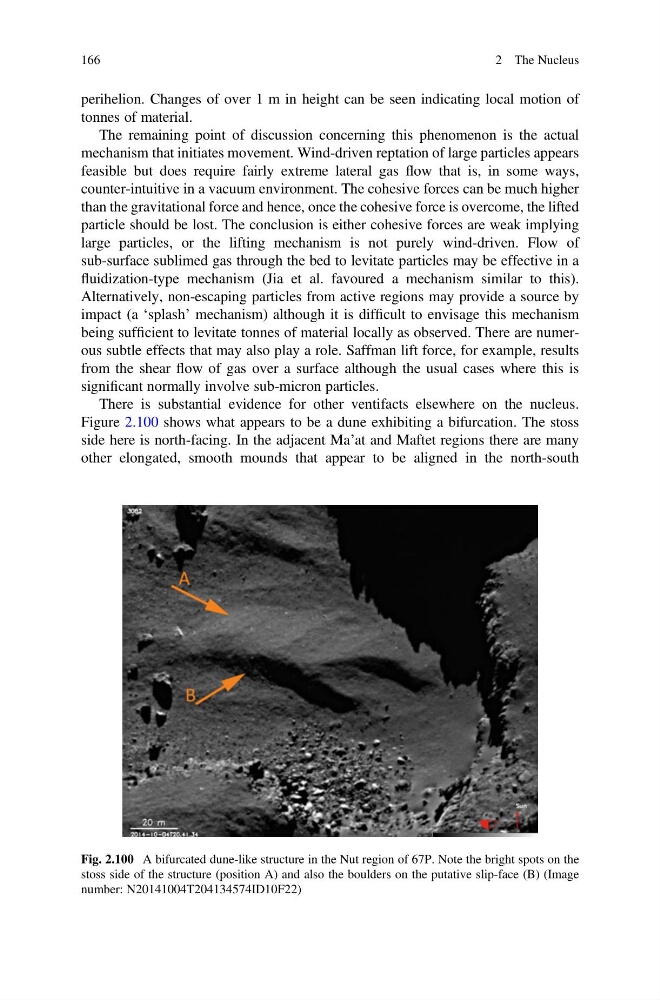
There is substantial evidence for other ventifacts elsewhere on the nucleus.
Figure 2.100 shows what appears to be a dune exhibiting a bifurcation. The stoss
side here is north-facing. In the adjacent Ma’at and Maftet regions there are many
other elongated, smooth mounds that appear to be aligned in the north-south
Fig. 2.100 A bifurcated dune-like structure in the Nut region of 67P. Note the bright spots on the
stoss side of the structure (position A) and also the boulders on the putative slip-face (B) (Image
number: N20141004T204134574ID10F22)
166
2 The Nucleus
tonnes of material.
The remaining point of discussion concerning this phenomenon is the actual
mechanism that initiates movement. Wind-driven reptation of large particles appears
feasible but does require fairly extreme lateral gas flow that is, in some ways,
counter-intuitive in a vacuum environment. The cohesive forces can be much higher
than the gravitational force and hence, once the cohesive force is overcome, the lifted
particle should be lost. The conclusion is either cohesive forces are weak implying
large particles, or the lifting mechanism is not purely wind-driven. Flow of
sub-surface sublimed gas through the bed to levitate particles may be effective in a
fluidization-type mechanism (Jia et al. favoured a mechanism similar to this).
Alternatively, non-escaping particles from active regions may provide a source by
impact (a ‘splash’ mechanism) although it is difficult to envisage this mechanism
being sufficient to levitate tonnes of material locally as observed. There are numerous subtle effects that may also play a role. Saffman lift force, for example, results
from the shear flow of gas over a surface although the usual cases where this is
significant normally involve sub-micron particles.
There is substantial evidence for other ventifacts elsewhere on the nucleus.
Figure 2.100 shows what appears to be a dune exhibiting a bifurcation. The stoss
side here is north-facing. In the adjacent Ma’at and Maftet regions there are many
other elongated, smooth mounds that appear to be aligned in the north-south
Fig. 2.100 A bifurcated dune-like structure in the Nut region of 67P. Note the bright spots on the
stoss side of the structure (position A) and also the boulders on the putative slip-face (B) (Image
number: N20141004T204134574ID10F22)
166
2 The Nucleus