

chamber at the University of Bern. The simulant has been illuminated by a bright
light representing the Sun. It is apparent that sub-surface sublimation of the ice
occurs at depth and a type of bubbling fluidization of the charcoal is seen as the gas
passes through the more desiccated surface layer. The bubbles eject charcoal particles that fall back on to the surface. This experiment is, in principle, more severe than
expected at a comet. The gravitational acceleration is 5 orders of magnitude higher
than on the comet and charcoal should be extremely cohesive. And yet this process is
strong enough to counter these higher restraining forces and would be sufficient to
eject particles from the surface of any comet.
2.10.11 Surface Changes in Smooth Terrains
Groussin et al. (2015b) first noted the significant changes evident in the smooth
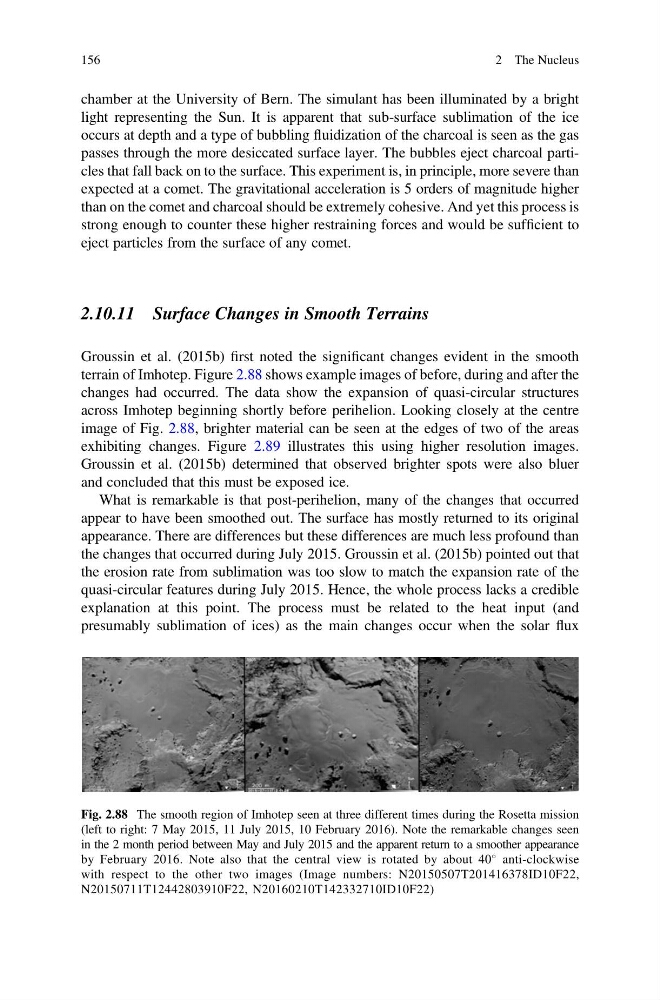
terrain of Imhotep. Figure 2.88 shows example images of before, during and after the
changes had occurred. The data show the expansion of quasi-circular structures
across Imhotep beginning shortly before perihelion. Looking closely at the centre
image of Fig. 2.88, brighter material can be seen at the edges of two of the areas
exhibiting changes. Figure 2.89 illustrates this using higher resolution images.
Groussin et al. (2015b) determined that observed brighter spots were also bluer
and concluded that this must be exposed ice.
What is remarkable is that post-perihelion, many of the changes that occurred
appear to have been smoothed out. The surface has mostly returned to its original
appearance. There are differences but these differences are much less profound than
the changes that occurred during July 2015. Groussin et al. (2015b) pointed out that
the erosion rate from sublimation was too slow to match the expansion rate of the
quasi-circular features during July 2015. Hence, the whole process lacks a credible
explanation at this point. The process must be related to the heat input (and
presumably sublimation of ices) as the main changes occur when the solar flux
Fig. 2.88 The smooth region of Imhotep seen at three different times during the Rosetta mission
(left to right: 7 May 2015, 11 July 2015, 10 February 2016). Note the remarkable changes seen
in the 2 month period between May and July 2015 and the apparent return to a smoother appearance
by February 2016. Note also that the central view is rotated by about 40
anti-clockwise
with respect to the other two images (Image numbers: N20150507T201416378ID10F22,
N20150711T12442803910F22, N20160210T142332710ID10F22)
156
2 The Nucleus
light representing the Sun. It is apparent that sub-surface sublimation of the ice
occurs at depth and a type of bubbling fluidization of the charcoal is seen as the gas
passes through the more desiccated surface layer. The bubbles eject charcoal particles that fall back on to the surface. This experiment is, in principle, more severe than
expected at a comet. The gravitational acceleration is 5 orders of magnitude higher
than on the comet and charcoal should be extremely cohesive. And yet this process is
strong enough to counter these higher restraining forces and would be sufficient to
eject particles from the surface of any comet.
2.10.11 Surface Changes in Smooth Terrains
Groussin et al. (2015b) first noted the significant changes evident in the smooth
terrain of Imhotep. Figure 2.88 shows example images of before, during and after the
changes had occurred. The data show the expansion of quasi-circular structures
across Imhotep beginning shortly before perihelion. Looking closely at the centre
image of Fig. 2.88, brighter material can be seen at the edges of two of the areas
exhibiting changes. Figure 2.89 illustrates this using higher resolution images.
Groussin et al. (2015b) determined that observed brighter spots were also bluer
and concluded that this must be exposed ice.
What is remarkable is that post-perihelion, many of the changes that occurred
appear to have been smoothed out. The surface has mostly returned to its original
appearance. There are differences but these differences are much less profound than
the changes that occurred during July 2015. Groussin et al. (2015b) pointed out that
the erosion rate from sublimation was too slow to match the expansion rate of the
quasi-circular features during July 2015. Hence, the whole process lacks a credible
explanation at this point. The process must be related to the heat input (and
presumably sublimation of ices) as the main changes occur when the solar flux
Fig. 2.88 The smooth region of Imhotep seen at three different times during the Rosetta mission
(left to right: 7 May 2015, 11 July 2015, 10 February 2016). Note the remarkable changes seen
in the 2 month period between May and July 2015 and the apparent return to a smoother appearance
by February 2016. Note also that the central view is rotated by about 40
anti-clockwise
with respect to the other two images (Image numbers: N20150507T201416378ID10F22,
N20150711T12442803910F22, N20160210T142332710ID10F22)
156
2 The Nucleus