

packed with solid particles, the gas will move upwards through the gaps between the
particles. When the gas velocity is low, the drag force on each individual particle is
also low, and the bed remains in a fixed state. By increasing the velocity or density of
the flow, the aerodynamic drag forces begin to counteract the gravitational forces,
causing the bed to expand in volume as the particles move away from each other.
Further increasing the velocity, it will reach a critical value at which the upward drag
forces will exactly equal the downward gravitational forces, causing the particles to
become suspended within the fluid. At this critical value, the bed is said to be
fluidized and will exhibit fluid behaviour.
In industrial cases, the pressure gradient, Δp, across a bed of depth, z, can be
controlled so that the weight of the particles can be equated with the buoyancy
provided by the gas flow. This leads to the equation
Δp ¼ z 1 À Ψ
ð
Þ ρ s À ρ g
À
Á
g
ð2:132Þ
where ρ s is the density of the solid, ρ g is the gas density, Ψ is the porosity and g is the
gravitational acceleration. It is straightforward to calculate that for 67P, a pressure
gradient of around 10
À2 Pa across a 10 cm bed would be sufficient to fluidize the
material in the absence of cohesive forces. This very low value arises from the low
gravitational acceleration, of course. Note that the gas flux through a porous layer as
a consequence of a pressure gradient is discussed in Sect. 3.4.7.
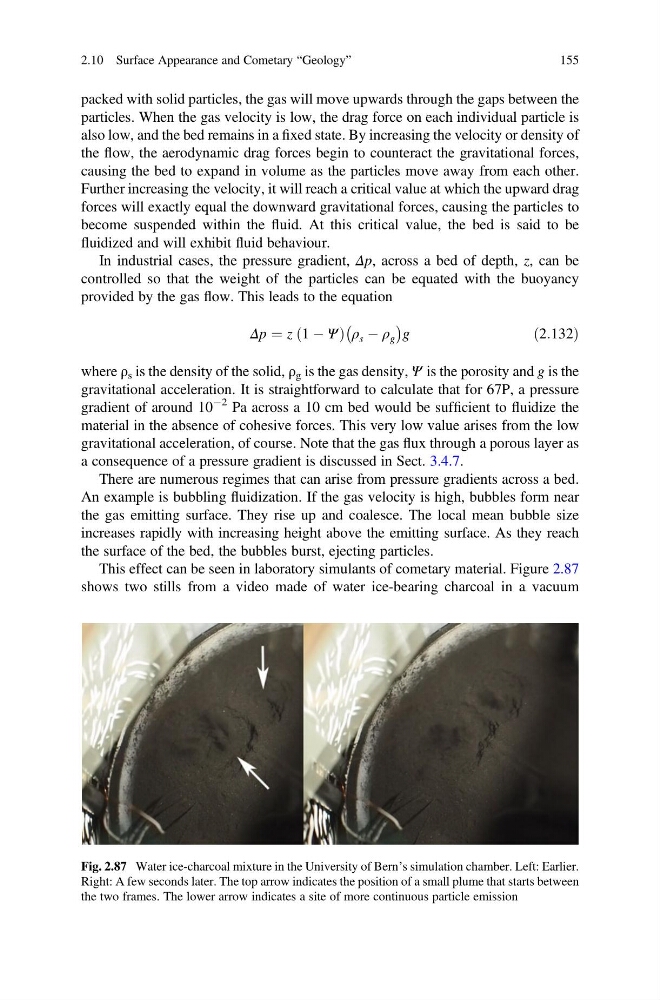
There are numerous regimes that can arise from pressure gradients across a bed.
An example is bubbling fluidization. If the gas velocity is high, bubbles form near
the gas emitting surface. They rise up and coalesce. The local mean bubble size
increases rapidly with increasing height above the emitting surface. As they reach
the surface of the bed, the bubbles burst, ejecting particles.
This effect can be seen in laboratory simulants of cometary material. Figure 2.87
shows two stills from a video made of water ice-bearing charcoal in a vacuum
Fig. 2.87 Water ice-charcoal mixture in the University of Bern’s simulation chamber. Left: Earlier.
Right: A few seconds later. The top arrow indicates the position of a small plume that starts between
the two frames. The lower arrow indicates a site of more continuous particle emission
2.10 Surface Appearance and Cometary “Geology”
155
particles. When the gas velocity is low, the drag force on each individual particle is
also low, and the bed remains in a fixed state. By increasing the velocity or density of
the flow, the aerodynamic drag forces begin to counteract the gravitational forces,
causing the bed to expand in volume as the particles move away from each other.
Further increasing the velocity, it will reach a critical value at which the upward drag
forces will exactly equal the downward gravitational forces, causing the particles to
become suspended within the fluid. At this critical value, the bed is said to be
fluidized and will exhibit fluid behaviour.
In industrial cases, the pressure gradient, Δp, across a bed of depth, z, can be
controlled so that the weight of the particles can be equated with the buoyancy
provided by the gas flow. This leads to the equation
Δp ¼ z 1 À Ψ
ð
Þ ρ s À ρ g
À
Á
g
ð2:132Þ
where ρ s is the density of the solid, ρ g is the gas density, Ψ is the porosity and g is the
gravitational acceleration. It is straightforward to calculate that for 67P, a pressure
gradient of around 10
À2 Pa across a 10 cm bed would be sufficient to fluidize the
material in the absence of cohesive forces. This very low value arises from the low
gravitational acceleration, of course. Note that the gas flux through a porous layer as
a consequence of a pressure gradient is discussed in Sect. 3.4.7.
There are numerous regimes that can arise from pressure gradients across a bed.
An example is bubbling fluidization. If the gas velocity is high, bubbles form near
the gas emitting surface. They rise up and coalesce. The local mean bubble size
increases rapidly with increasing height above the emitting surface. As they reach
the surface of the bed, the bubbles burst, ejecting particles.
This effect can be seen in laboratory simulants of cometary material. Figure 2.87
shows two stills from a video made of water ice-bearing charcoal in a vacuum
Fig. 2.87 Water ice-charcoal mixture in the University of Bern’s simulation chamber. Left: Earlier.
Right: A few seconds later. The top arrow indicates the position of a small plume that starts between
the two frames. The lower arrow indicates a site of more continuous particle emission
2.10 Surface Appearance and Cometary “Geology”
155