

Micrometeoroid impact has been proposed but found to be insufficient in the case of
Eros (Colwell et al. 2005). For electrostatic lofting, cohesive forces need to be
account for and this leads to preferential lifting of intermediate-sized (15 μm) grains
(Hartzell et al. 2013). In the case of 67P, this problem may not exist because grains
are being levitated by the sublimation process and sedimenting through airfall.
Hence, only the preferential transport of these grains into depressions needs to be
clarified. The Poppe et al. (2012) paper appears to demonstrate that this is feasible
although we note the relatively small scale of the modelled crater (7 m diameter) in
their work compared to the observed deposits on 67P. The application to 67P is
nonetheless an extremely complicated physical problem. There are numerous effects
at work. For the dust particles themselves, impacts of electrons and ions can transfer
charge to directly the grain, ultraviolet radiation from the Sun can lead to photoemission of electrons, and recombination with free electrons from the dust grain
environment can occur. In addition, the surface itself can become positively charged
as a result of the release of photo-electrons and a dayside-nightside electric field can
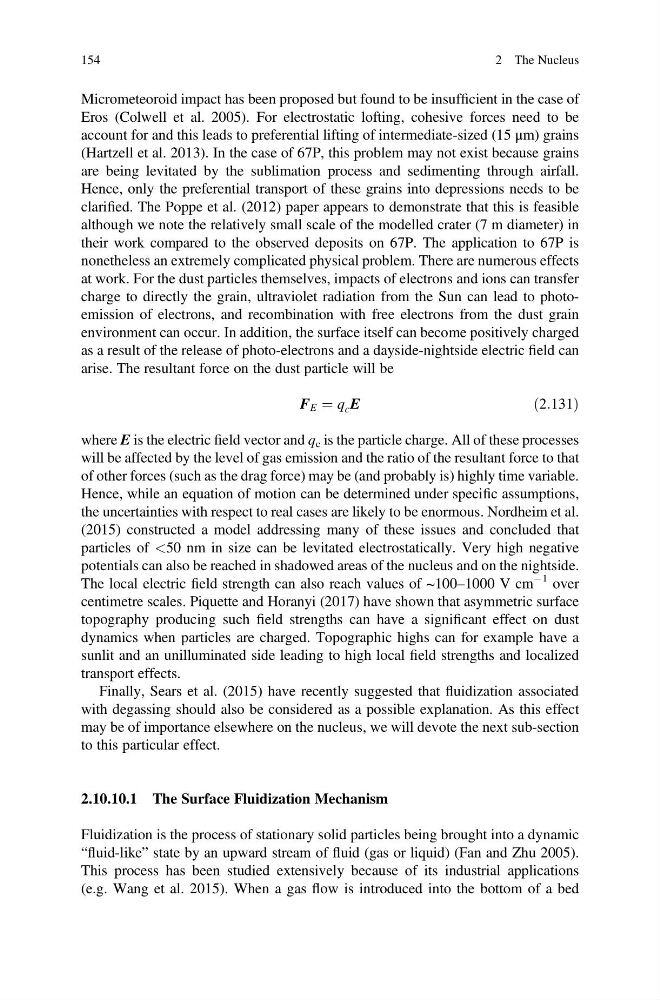
arise. The resultant force on the dust particle will be
F E ¼ q c E
ð2:131Þ
where E is the electric field vector and q c is the particle charge. All of these processes
will be affected by the level of gas emission and the ratio of the resultant force to that
of other forces (such as the drag force) may be (and probably is) highly time variable.
Hence, while an equation of motion can be determined under specific assumptions,
the uncertainties with respect to real cases are likely to be enormous. Nordheim et al.
(2015) constructed a model addressing many of these issues and concluded that
particles of <50 nm in size can be levitated electrostatically. Very high negative
potentials can also be reached in shadowed areas of the nucleus and on the nightside.
The local electric field strength can also reach values of ~100–1000 V cm
À1 over
centimetre scales. Piquette and Horanyi (2017) have shown that asymmetric surface
topography producing such field strengths can have a significant effect on dust
dynamics when particles are charged. Topographic highs can for example have a
sunlit and an unilluminated side leading to high local field strengths and localized
transport effects.
Finally, Sears et al. (2015) have recently suggested that fluidization associated
with degassing should also be considered as a possible explanation. As this effect
may be of importance elsewhere on the nucleus, we will devote the next sub-section
to this particular effect.
2.10.10.1 The Surface Fluidization Mechanism
Fluidization is the process of stationary solid particles being brought into a dynamic
“fluid-like” state by an upward stream of fluid (gas or liquid) (Fan and Zhu 2005).
This process has been studied extensively because of its industrial applications
(e.g. Wang et al. 2015). When a gas flow is introduced into the bottom of a bed
154
2 The Nucleus
Eros (Colwell et al. 2005). For electrostatic lofting, cohesive forces need to be
account for and this leads to preferential lifting of intermediate-sized (15 μm) grains
(Hartzell et al. 2013). In the case of 67P, this problem may not exist because grains
are being levitated by the sublimation process and sedimenting through airfall.
Hence, only the preferential transport of these grains into depressions needs to be
clarified. The Poppe et al. (2012) paper appears to demonstrate that this is feasible
although we note the relatively small scale of the modelled crater (7 m diameter) in
their work compared to the observed deposits on 67P. The application to 67P is
nonetheless an extremely complicated physical problem. There are numerous effects
at work. For the dust particles themselves, impacts of electrons and ions can transfer
charge to directly the grain, ultraviolet radiation from the Sun can lead to photoemission of electrons, and recombination with free electrons from the dust grain
environment can occur. In addition, the surface itself can become positively charged
as a result of the release of photo-electrons and a dayside-nightside electric field can
arise. The resultant force on the dust particle will be
F E ¼ q c E
ð2:131Þ
where E is the electric field vector and q c is the particle charge. All of these processes
will be affected by the level of gas emission and the ratio of the resultant force to that
of other forces (such as the drag force) may be (and probably is) highly time variable.
Hence, while an equation of motion can be determined under specific assumptions,
the uncertainties with respect to real cases are likely to be enormous. Nordheim et al.
(2015) constructed a model addressing many of these issues and concluded that
particles of <50 nm in size can be levitated electrostatically. Very high negative
potentials can also be reached in shadowed areas of the nucleus and on the nightside.
The local electric field strength can also reach values of ~100–1000 V cm
À1 over
centimetre scales. Piquette and Horanyi (2017) have shown that asymmetric surface
topography producing such field strengths can have a significant effect on dust
dynamics when particles are charged. Topographic highs can for example have a
sunlit and an unilluminated side leading to high local field strengths and localized
transport effects.
Finally, Sears et al. (2015) have recently suggested that fluidization associated
with degassing should also be considered as a possible explanation. As this effect
may be of importance elsewhere on the nucleus, we will devote the next sub-section
to this particular effect.
2.10.10.1 The Surface Fluidization Mechanism
Fluidization is the process of stationary solid particles being brought into a dynamic
“fluid-like” state by an upward stream of fluid (gas or liquid) (Fan and Zhu 2005).
This process has been studied extensively because of its industrial applications
(e.g. Wang et al. 2015). When a gas flow is introduced into the bottom of a bed
154
2 The Nucleus