

non-gravitational forces acting on the nucleus. The low porosity would imply that
settling is quite possible. However, on 67P the ponded deposits are fairly localised
and limited in areal extent which seems contrary to the more global effects of NGFs.
Dombard et al. (2010) have suggested that the ponds form as a consequence of
thermal disaggregation of boulder material within the depression in a type of
insolation weathering driven by the repeated day/night cycling (see also Sect.
2.10.5). The flattening is produced by seismic shaking of ponds in response to
impact. Roberts et al. (2014) have criticized this by showing that the pond material
follows the underlying topography which is inconsistent with the material originating by erosion of central boulders.
Electrostatic levitation of dust and transport has been proposed and investigated
by several authors. Poppe et al. (2012) have pointed out that there is now significant
evidence for electrostatically-induced dust grain transport above the lunar surface
and they extended previous modelling work to include the ponded deposits of Eros
and the trapping efficiency of dust grains by craters. They showed that grains will
tend to accumulate within crater boundaries as a consequence of the presence of
complex fields at crater rims with larger grains being trapped more efficiently. The
main problem, however, is the absence of a well-defined launch mechanism.
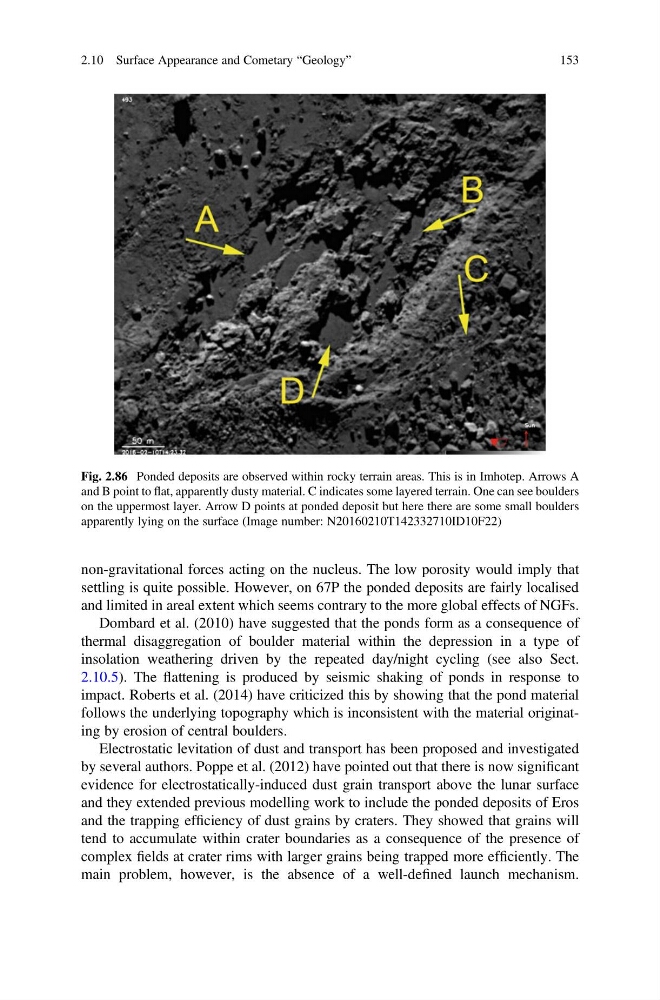
Fig. 2.86 Ponded deposits are observed within rocky terrain areas. This is in Imhotep. Arrows A
and B point to flat, apparently dusty material. C indicates some layered terrain. One can see boulders
on the uppermost layer. Arrow D points at ponded deposit but here there are some small boulders
apparently lying on the surface (Image number: N20160210T142332710ID10F22)
2.10 Surface Appearance and Cometary “Geology”
153
settling is quite possible. However, on 67P the ponded deposits are fairly localised
and limited in areal extent which seems contrary to the more global effects of NGFs.
Dombard et al. (2010) have suggested that the ponds form as a consequence of
thermal disaggregation of boulder material within the depression in a type of
insolation weathering driven by the repeated day/night cycling (see also Sect.
2.10.5). The flattening is produced by seismic shaking of ponds in response to
impact. Roberts et al. (2014) have criticized this by showing that the pond material
follows the underlying topography which is inconsistent with the material originating by erosion of central boulders.
Electrostatic levitation of dust and transport has been proposed and investigated
by several authors. Poppe et al. (2012) have pointed out that there is now significant
evidence for electrostatically-induced dust grain transport above the lunar surface
and they extended previous modelling work to include the ponded deposits of Eros
and the trapping efficiency of dust grains by craters. They showed that grains will
tend to accumulate within crater boundaries as a consequence of the presence of
complex fields at crater rims with larger grains being trapped more efficiently. The
main problem, however, is the absence of a well-defined launch mechanism.
Fig. 2.86 Ponded deposits are observed within rocky terrain areas. This is in Imhotep. Arrows A
and B point to flat, apparently dusty material. C indicates some layered terrain. One can see boulders
on the uppermost layer. Arrow D points at ponded deposit but here there are some small boulders
apparently lying on the surface (Image number: N20160210T142332710ID10F22)
2.10 Surface Appearance and Cometary “Geology”
153