

The disrupted material produces a large surface area for sublimation and can lead
locally to a large increase in gas production post-collapse. The presence of ice-rich
material in the talus may therefore be important in the total mass loss
budget although we have little information on the frequency of these collapses.
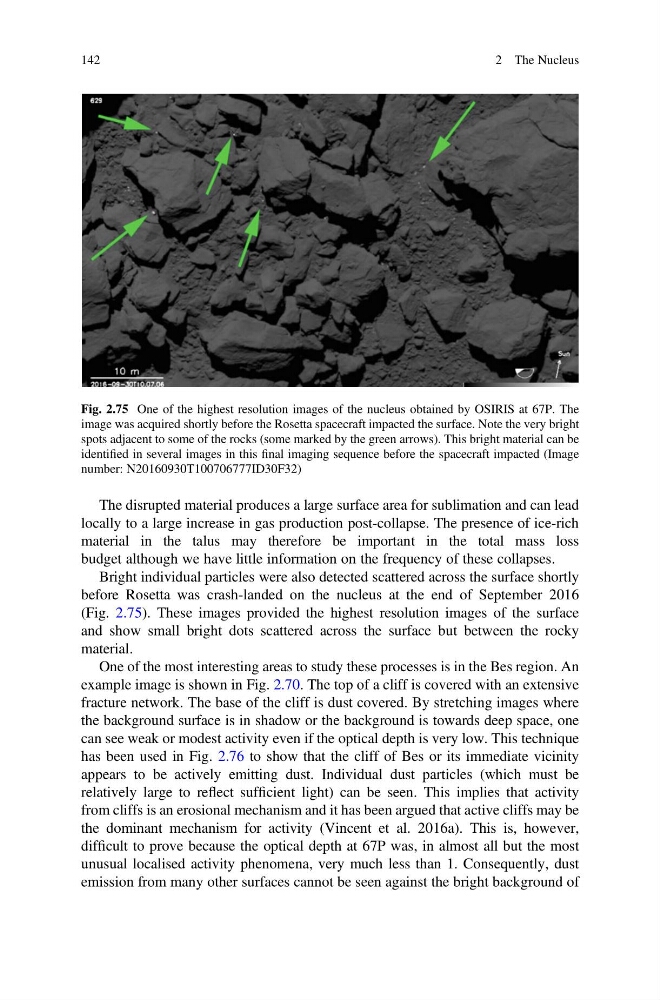
Bright individual particles were also detected scattered across the surface shortly
before Rosetta was crash-landed on the nucleus at the end of September 2016
(Fig. 2.75). These images provided the highest resolution images of the surface
and show small bright dots scattered across the surface but between the rocky
material.
One of the most interesting areas to study these processes is in the Bes region. An
example image is shown in Fig. 2.70. The top of a cliff is covered with an extensive
fracture network. The base of the cliff is dust covered. By stretching images where
the background surface is in shadow or the background is towards deep space, one
can see weak or modest activity even if the optical depth is very low. This technique
has been used in Fig. 2.76 to show that the cliff of Bes or its immediate vicinity
appears to be actively emitting dust. Individual dust particles (which must be
relatively large to reflect sufficient light) can be seen. This implies that activity
from cliffs is an erosional mechanism and it has been argued that active cliffs may be
the dominant mechanism for activity (Vincent et al. 2016a). This is, however,
difficult to prove because the optical depth at 67P was, in almost all but the most
unusual localised activity phenomena, very much less than 1. Consequently, dust
emission from many other surfaces cannot be seen against the bright background of
Fig. 2.75 One of the highest resolution images of the nucleus obtained by OSIRIS at 67P. The
image was acquired shortly before the Rosetta spacecraft impacted the surface. Note the very bright
spots adjacent to some of the rocks (some marked by the green arrows). This bright material can be
identified in several images in this final imaging sequence before the spacecraft impacted (Image
number: N20160930T100706777ID30F32)
142
2 The Nucleus
locally to a large increase in gas production post-collapse. The presence of ice-rich
material in the talus may therefore be important in the total mass loss
budget although we have little information on the frequency of these collapses.
Bright individual particles were also detected scattered across the surface shortly
before Rosetta was crash-landed on the nucleus at the end of September 2016
(Fig. 2.75). These images provided the highest resolution images of the surface
and show small bright dots scattered across the surface but between the rocky
material.
One of the most interesting areas to study these processes is in the Bes region. An
example image is shown in Fig. 2.70. The top of a cliff is covered with an extensive
fracture network. The base of the cliff is dust covered. By stretching images where
the background surface is in shadow or the background is towards deep space, one
can see weak or modest activity even if the optical depth is very low. This technique
has been used in Fig. 2.76 to show that the cliff of Bes or its immediate vicinity
appears to be actively emitting dust. Individual dust particles (which must be
relatively large to reflect sufficient light) can be seen. This implies that activity
from cliffs is an erosional mechanism and it has been argued that active cliffs may be
the dominant mechanism for activity (Vincent et al. 2016a). This is, however,
difficult to prove because the optical depth at 67P was, in almost all but the most
unusual localised activity phenomena, very much less than 1. Consequently, dust
emission from many other surfaces cannot be seen against the bright background of
Fig. 2.75 One of the highest resolution images of the nucleus obtained by OSIRIS at 67P. The
image was acquired shortly before the Rosetta spacecraft impacted the surface. Note the very bright
spots adjacent to some of the rocks (some marked by the green arrows). This bright material can be
identified in several images in this final imaging sequence before the spacecraft impacted (Image
number: N20160930T100706777ID30F32)
142
2 The Nucleus