

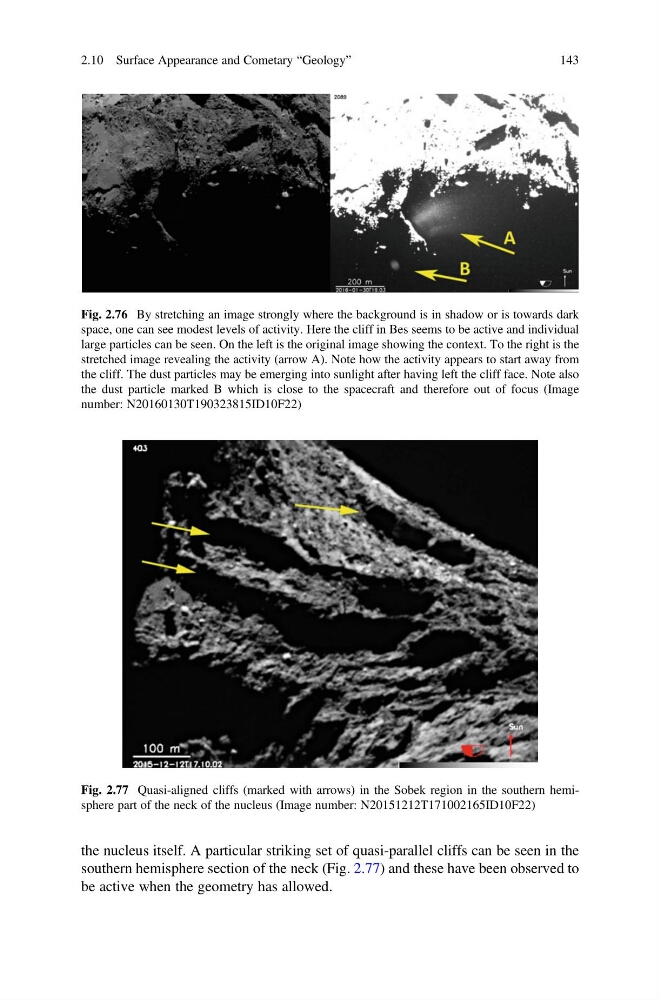
the nucleus itself. A particular striking set of quasi-parallel cliffs can be seen in the
southern hemisphere section of the neck (Fig. 2.77) and these have been observed to
be active when the geometry has allowed.
Fig. 2.76 By stretching an image strongly where the background is in shadow or is towards dark
space, one can see modest levels of activity. Here the cliff in Bes seems to be active and individual
large particles can be seen. On the left is the original image showing the context. To the right is the
stretched image revealing the activity (arrow A). Note how the activity appears to start away from
the cliff. The dust particles may be emerging into sunlight after having left the cliff face. Note also
the dust particle marked B which is close to the spacecraft and therefore out of focus (Image
number: N20160130T190323815ID10F22)
Fig. 2.77 Quasi-aligned cliffs (marked with arrows) in the Sobek region in the southern hemisphere part of the neck of the nucleus (Image number: N20151212T171002165ID10F22)
2.10 Surface Appearance and Cometary “Geology”
143
southern hemisphere section of the neck (Fig. 2.77) and these have been observed to
be active when the geometry has allowed.
Fig. 2.76 By stretching an image strongly where the background is in shadow or is towards dark
space, one can see modest levels of activity. Here the cliff in Bes seems to be active and individual
large particles can be seen. On the left is the original image showing the context. To the right is the
stretched image revealing the activity (arrow A). Note how the activity appears to start away from
the cliff. The dust particles may be emerging into sunlight after having left the cliff face. Note also
the dust particle marked B which is close to the spacecraft and therefore out of focus (Image
number: N20160130T190323815ID10F22)
Fig. 2.77 Quasi-aligned cliffs (marked with arrows) in the Sobek region in the southern hemisphere part of the neck of the nucleus (Image number: N20151212T171002165ID10F22)
2.10 Surface Appearance and Cometary “Geology”
143