

continuous process. This illustrates, however, that specific geometries could lead to
enhanced sublimation producing locally higher surface erosion rates. One area that
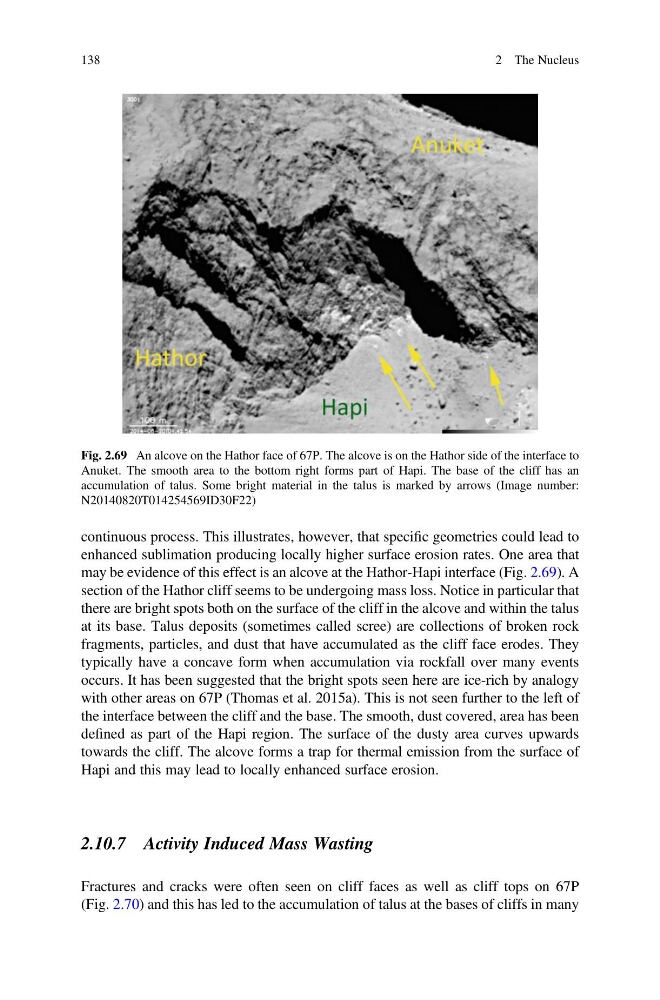
may be evidence of this effect is an alcove at the Hathor-Hapi interface (Fig. 2.69). A
section of the Hathor cliff seems to be undergoing mass loss. Notice in particular that
there are bright spots both on the surface of the cliff in the alcove and within the talus
at its base. Talus deposits (sometimes called scree) are collections of broken rock
fragments, particles, and dust that have accumulated as the cliff face erodes. They
typically have a concave form when accumulation via rockfall over many events
occurs. It has been suggested that the bright spots seen here are ice-rich by analogy
with other areas on 67P (Thomas et al. 2015a). This is not seen further to the left of
the interface between the cliff and the base. The smooth, dust covered, area has been
defined as part of the Hapi region. The surface of the dusty area curves upwards
towards the cliff. The alcove forms a trap for thermal emission from the surface of
Hapi and this may lead to locally enhanced surface erosion.
2.10.7 Activity Induced Mass Wasting
Fractures and cracks were often seen on cliff faces as well as cliff tops on 67P
(Fig. 2.70) and this has led to the accumulation of talus at the bases of cliffs in many
Fig. 2.69 An alcove on the Hathor face of 67P. The alcove is on the Hathor side of the interface to
Anuket. The smooth area to the bottom right forms part of Hapi. The base of the cliff has an
accumulation of talus. Some bright material in the talus is marked by arrows (Image number:
N20140820T014254569ID30F22)
138
2 The Nucleus
enhanced sublimation producing locally higher surface erosion rates. One area that
may be evidence of this effect is an alcove at the Hathor-Hapi interface (Fig. 2.69). A
section of the Hathor cliff seems to be undergoing mass loss. Notice in particular that
there are bright spots both on the surface of the cliff in the alcove and within the talus
at its base. Talus deposits (sometimes called scree) are collections of broken rock
fragments, particles, and dust that have accumulated as the cliff face erodes. They
typically have a concave form when accumulation via rockfall over many events
occurs. It has been suggested that the bright spots seen here are ice-rich by analogy
with other areas on 67P (Thomas et al. 2015a). This is not seen further to the left of
the interface between the cliff and the base. The smooth, dust covered, area has been
defined as part of the Hapi region. The surface of the dusty area curves upwards
towards the cliff. The alcove forms a trap for thermal emission from the surface of
Hapi and this may lead to locally enhanced surface erosion.
2.10.7 Activity Induced Mass Wasting
Fractures and cracks were often seen on cliff faces as well as cliff tops on 67P
(Fig. 2.70) and this has led to the accumulation of talus at the bases of cliffs in many
Fig. 2.69 An alcove on the Hathor face of 67P. The alcove is on the Hathor side of the interface to
Anuket. The smooth area to the bottom right forms part of Hapi. The base of the cliff has an
accumulation of talus. Some bright material in the talus is marked by arrows (Image number:
N20140820T014254569ID30F22)
138
2 The Nucleus