

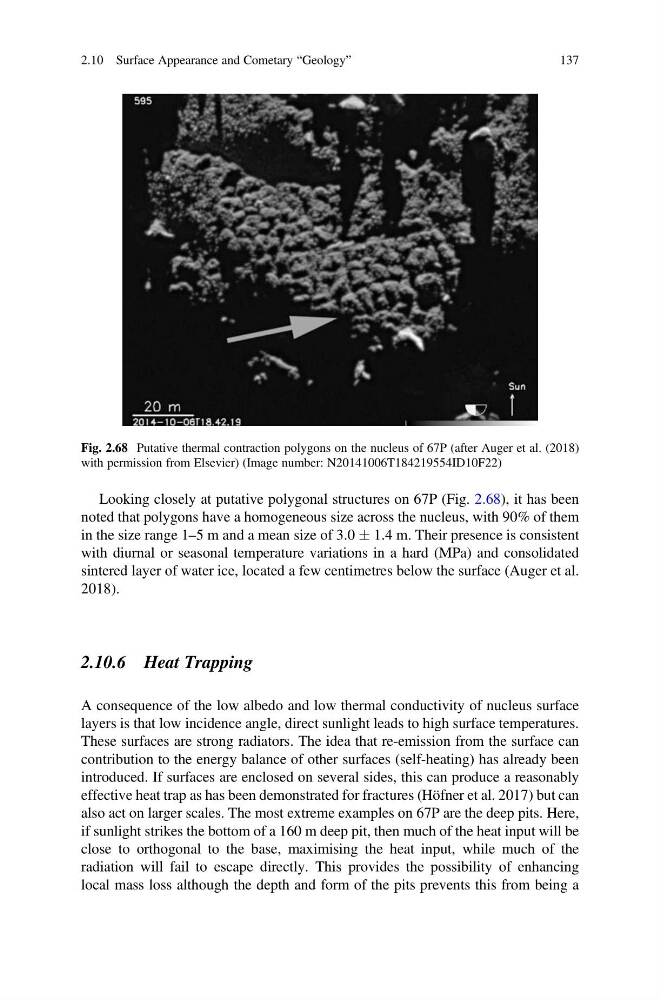
Looking closely at putative polygonal structures on 67P (Fig. 2.68), it has been
noted that polygons have a homogeneous size across the nucleus, with 90% of them
in the size range 1–5 m and a mean size of 3.0 Æ 1.4 m. Their presence is consistent
with diurnal or seasonal temperature variations in a hard (MPa) and consolidated
sintered layer of water ice, located a few centimetres below the surface (Auger et al.
2018).
2.10.6 Heat Trapping
A consequence of the low albedo and low thermal conductivity of nucleus surface
layers is that low incidence angle, direct sunlight leads to high surface temperatures.
These surfaces are strong radiators. The idea that re-emission from the surface can
contribution to the energy balance of other surfaces (self-heating) has already been
introduced. If surfaces are enclosed on several sides, this can produce a reasonably
effective heat trap as has been demonstrated for fractures (Höfner et al. 2017) but can
also act on larger scales. The most extreme examples on 67P are the deep pits. Here,
if sunlight strikes the bottom of a 160 m deep pit, then much of the heat input will be
close to orthogonal to the base, maximising the heat input, while much of the
radiation will fail to escape directly. This provides the possibility of enhancing
local mass loss although the depth and form of the pits prevents this from being a
Fig. 2.68 Putative thermal contraction polygons on the nucleus of 67P (after Auger et al. (2018)
with permission from Elsevier) (Image number: N20141006T184219554ID10F22)
2.10 Surface Appearance and Cometary “Geology”
137
noted that polygons have a homogeneous size across the nucleus, with 90% of them
in the size range 1–5 m and a mean size of 3.0 Æ 1.4 m. Their presence is consistent
with diurnal or seasonal temperature variations in a hard (MPa) and consolidated
sintered layer of water ice, located a few centimetres below the surface (Auger et al.
2018).
2.10.6 Heat Trapping
A consequence of the low albedo and low thermal conductivity of nucleus surface
layers is that low incidence angle, direct sunlight leads to high surface temperatures.
These surfaces are strong radiators. The idea that re-emission from the surface can
contribution to the energy balance of other surfaces (self-heating) has already been
introduced. If surfaces are enclosed on several sides, this can produce a reasonably
effective heat trap as has been demonstrated for fractures (Höfner et al. 2017) but can
also act on larger scales. The most extreme examples on 67P are the deep pits. Here,
if sunlight strikes the bottom of a 160 m deep pit, then much of the heat input will be
close to orthogonal to the base, maximising the heat input, while much of the
radiation will fail to escape directly. This provides the possibility of enhancing
local mass loss although the depth and form of the pits prevents this from being a
Fig. 2.68 Putative thermal contraction polygons on the nucleus of 67P (after Auger et al. (2018)
with permission from Elsevier) (Image number: N20141006T184219554ID10F22)
2.10 Surface Appearance and Cometary “Geology”
137