

et al. (2017) have looked at how thermal re-radiation from hot mouths of cracks can
promote the propagation of heat into a fracture even if the deeper sections of the
crack are in shadow. If CO 2 (or CO) ice is available at depth then this becomes a very
simple means of initiating new activity and might lead to ejection of larger blocks of
material thereby explaining structures similar to those seen in Wosret. Under
optimum conditions, water ice may serve the same purpose.
2.10.5.3 Polygonal Networks
The observation of polygonal networks on 67P was not expected but it is a common
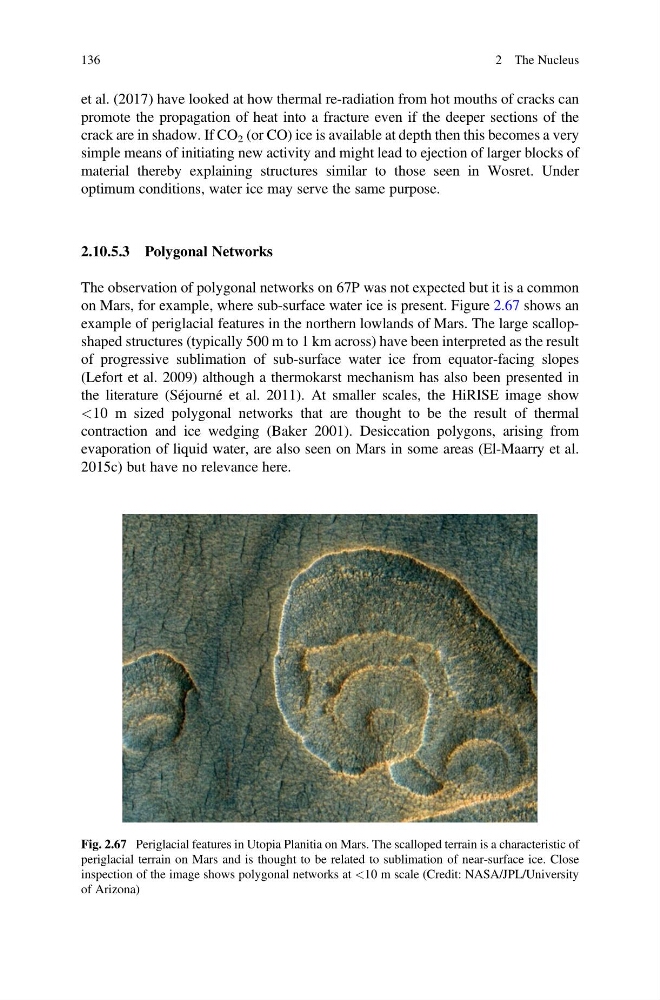
on Mars, for example, where sub-surface water ice is present. Figure 2.67 shows an
example of periglacial features in the northern lowlands of Mars. The large scallopshaped structures (typically 500 m to 1 km across) have been interpreted as the result
of progressive sublimation of sub-surface water ice from equator-facing slopes
(Lefort et al. 2009) although a thermokarst mechanism has also been presented in
the literature (Séjourné et al. 2011). At smaller scales, the HiRISE image show
<10 m sized polygonal networks that are thought to be the result of thermal
contraction and ice wedging (Baker 2001). Desiccation polygons, arising from
evaporation of liquid water, are also seen on Mars in some areas (El-Maarry et al.
2015c) but have no relevance here.
Fig. 2.67 Periglacial features in Utopia Planitia on Mars. The scalloped terrain is a characteristic of
periglacial terrain on Mars and is thought to be related to sublimation of near-surface ice. Close
inspection of the image shows polygonal networks at <10 m scale (Credit: NASA/JPL/University
of Arizona)
136
2 The Nucleus
promote the propagation of heat into a fracture even if the deeper sections of the
crack are in shadow. If CO 2 (or CO) ice is available at depth then this becomes a very
simple means of initiating new activity and might lead to ejection of larger blocks of
material thereby explaining structures similar to those seen in Wosret. Under
optimum conditions, water ice may serve the same purpose.
2.10.5.3 Polygonal Networks
The observation of polygonal networks on 67P was not expected but it is a common
on Mars, for example, where sub-surface water ice is present. Figure 2.67 shows an
example of periglacial features in the northern lowlands of Mars. The large scallopshaped structures (typically 500 m to 1 km across) have been interpreted as the result
of progressive sublimation of sub-surface water ice from equator-facing slopes
(Lefort et al. 2009) although a thermokarst mechanism has also been presented in
the literature (Séjourné et al. 2011). At smaller scales, the HiRISE image show
<10 m sized polygonal networks that are thought to be the result of thermal
contraction and ice wedging (Baker 2001). Desiccation polygons, arising from
evaporation of liquid water, are also seen on Mars in some areas (El-Maarry et al.
2015c) but have no relevance here.
Fig. 2.67 Periglacial features in Utopia Planitia on Mars. The scalloped terrain is a characteristic of
periglacial terrain on Mars and is thought to be related to sublimation of near-surface ice. Close
inspection of the image shows polygonal networks at <10 m scale (Credit: NASA/JPL/University
of Arizona)
136
2 The Nucleus