

places on the nucleus. There are many examples on 67P and we show several here
illustrating various aspects of the process.
Figure 2.71 shows the interface from the smooth terrain of Hapi to the consolidated material of Seth. The material at the base of the cliffs of Seth has the
characteristics of a talus deposit. We have seen previously (e.g. Fig. 2.60) that cliffs
in the Seth region have cleaved and collapsed, exposing fresher, brighter material.
This shows that this is a currently active process influencing the surface properties.
The brighter material in the talus (e.g. Fig. 2.69) has been shown to be bluer in
colour at several positions on the nucleus (Pommerol et al. 2015). A further example
is seen in Fig. 2.72 which shows a cliff at the interface between Khepry and Imhotep
in an enhanced colour image. The images from OSIRIS through different filters
show that much of the blocky material is spectrophotometrically bluer and likely to
be water ice-rich. The presence of water ice in this material was confirmed with the
VIRTIS experiment (Barucci et al. 2016). One edge of the cliff also appears to be
relatively blue that may indicate the origin of one of the most recent collapses.
The remarkable brightness of the newly exposed material can be seen even more
clearly through plotting the ratio of observed radiance to that of a control area. In
Fig. 2.73, we can see boxes marking three areas (A, B, and C) where low resolution
spectra have been extracted from Rosetta/OSIRIS data. A fourth area, D, is very
small but includes some of the brightest material in the scene.
Figure 2.74 shows the wavelength dependence of the ratios of the reflectance in
areas A, B, and D to the control area, C. The relative brightness of the bright material
is increasingly greater than the control area as we move towards the blue and is a
factor of 7 brighter than the control area at near-UV wavelengths (around 270 nm).
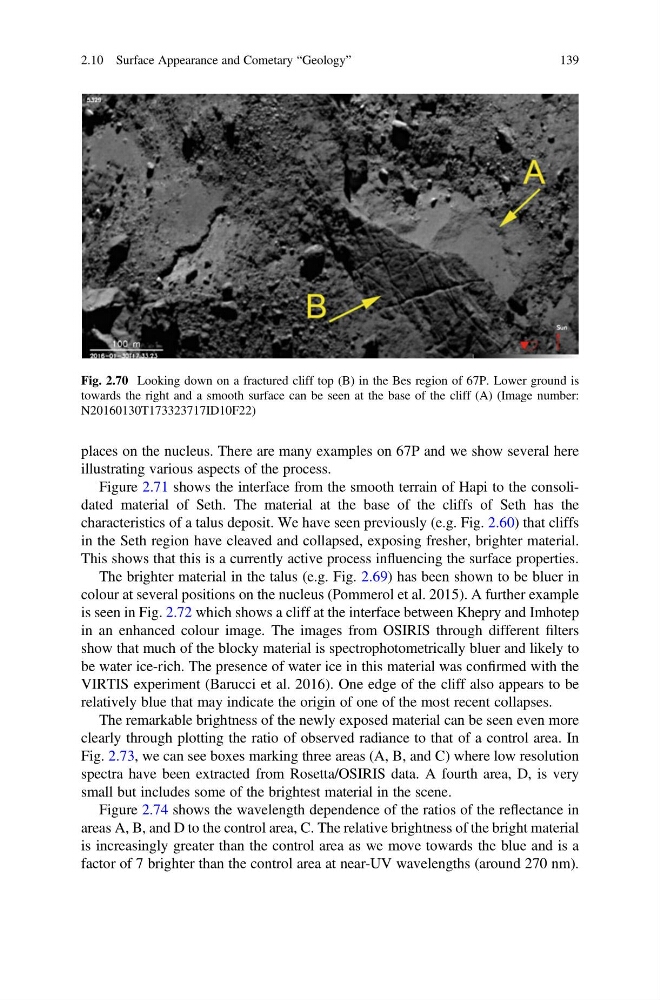
Fig. 2.70 Looking down on a fractured cliff top (B) in the Bes region of 67P. Lower ground is
towards the right and a smooth surface can be seen at the base of the cliff (A) (Image number:
N20160130T173323717ID10F22)
2.10 Surface Appearance and Cometary “Geology”
139
illustrating various aspects of the process.
Figure 2.71 shows the interface from the smooth terrain of Hapi to the consolidated material of Seth. The material at the base of the cliffs of Seth has the
characteristics of a talus deposit. We have seen previously (e.g. Fig. 2.60) that cliffs
in the Seth region have cleaved and collapsed, exposing fresher, brighter material.
This shows that this is a currently active process influencing the surface properties.
The brighter material in the talus (e.g. Fig. 2.69) has been shown to be bluer in
colour at several positions on the nucleus (Pommerol et al. 2015). A further example
is seen in Fig. 2.72 which shows a cliff at the interface between Khepry and Imhotep
in an enhanced colour image. The images from OSIRIS through different filters
show that much of the blocky material is spectrophotometrically bluer and likely to
be water ice-rich. The presence of water ice in this material was confirmed with the
VIRTIS experiment (Barucci et al. 2016). One edge of the cliff also appears to be
relatively blue that may indicate the origin of one of the most recent collapses.
The remarkable brightness of the newly exposed material can be seen even more
clearly through plotting the ratio of observed radiance to that of a control area. In
Fig. 2.73, we can see boxes marking three areas (A, B, and C) where low resolution
spectra have been extracted from Rosetta/OSIRIS data. A fourth area, D, is very
small but includes some of the brightest material in the scene.
Figure 2.74 shows the wavelength dependence of the ratios of the reflectance in
areas A, B, and D to the control area, C. The relative brightness of the bright material
is increasingly greater than the control area as we move towards the blue and is a
factor of 7 brighter than the control area at near-UV wavelengths (around 270 nm).
Fig. 2.70 Looking down on a fractured cliff top (B) in the Bes region of 67P. Lower ground is
towards the right and a smooth surface can be seen at the base of the cliff (A) (Image number:
N20160130T173323717ID10F22)
2.10 Surface Appearance and Cometary “Geology”
139