

plausible mechanism for crack production based on terrestrial studies is thermal
insolation weathering (Hall and Thorn 2014). Four of the fracture types noted by
El-Maarry et al. (2015b) were thought to be thermal in origin. The term insolation
weathering covers two processes—thermal fatigue and thermal shock. Thermal
fatigue is the process whereby the continuous heating and cooling cycle leads to
cracking whereas thermal shock describes fracturing from a large temporal temperature gradient. Production of fresh regolith by thermal fatigue fragmentation is now
thought to an important process for the rejuvenation of the surfaces of near-Earth
asteroids with decimetre-size rocks being broken on timescales of 10
3 years at 1 AU
(Delbo et al. 2014). In the case of comets, spatial temperature gradients can also be
high because of the low thermal inertia of the surface layer.
It is widely assumed that a decrease in temperature leads to contraction. However,
Britt and Opeil (2017) have performed experiments looking at the thermal conductivity, heat capacity and thermal expansion of five CM carbonaceous chondrites
(Murchison, Murray, Cold Bokkeveld, NWA 7309, Jbilet Winselwan) at low temperatures (5–300 K). The mineralogy of these meteorites is dominated by abundant
hydrous phyllosilicates, but they also contain anhydrous minerals such as olivine
and pyroxene found in chondrules. Although this material is probably of asteroidal
origin, it is interesting to note that the thermal expansion measurements for all these
CMs indicate a substantial increase in meteorite volume as the temperature decreases
from 230 to 210 K followed by linear contraction below 210 K. Such transitions are
unexpected and are not typical for anhydrous carbonaceous chondrites or ordinary
chondrites. Hence, using linear thermal contraction to initiate fractures is an assumption that may not be universally applicable.
An example of the magnitude of the temperature extremes on a surface layer is
shown in Fig. 2.66. The plot shows how the temperature changes with time for an
equatorial surface on an object rotating with a 12.4 h period. The surface is assumed
to move into shadow exactly at midday to illustrate the magnitude of the temperature
change with time that can be produced by such geometries. A heliocentric distance
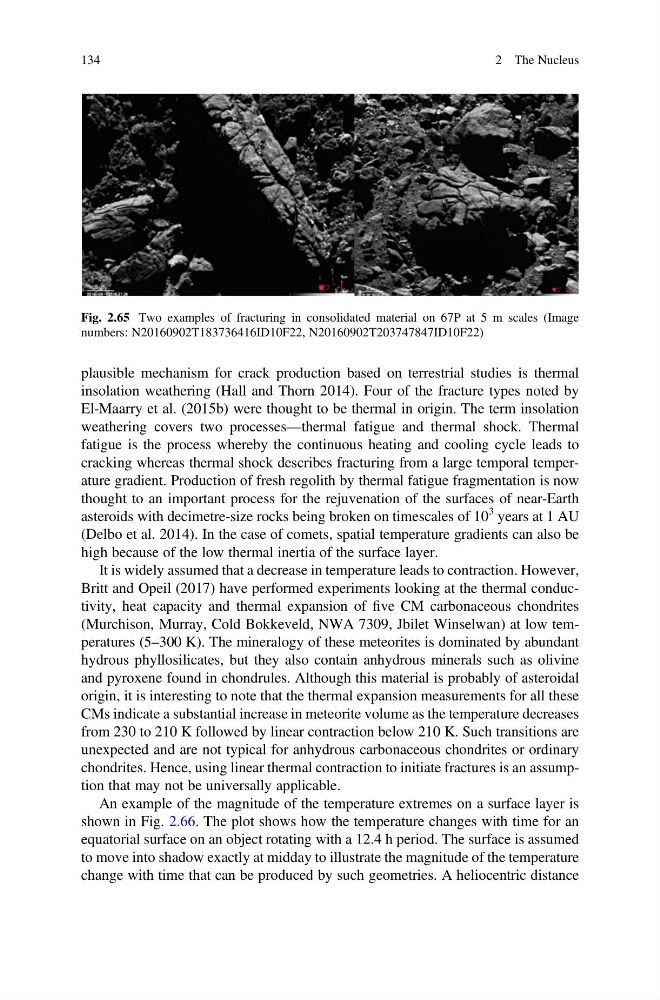
Fig. 2.65 Two examples of fracturing in consolidated material on 67P at 5 m scales (Image
numbers: N20160902T183736416ID10F22, N20160902T203747847ID10F22)
134
2 The Nucleus
insolation weathering (Hall and Thorn 2014). Four of the fracture types noted by
El-Maarry et al. (2015b) were thought to be thermal in origin. The term insolation
weathering covers two processes—thermal fatigue and thermal shock. Thermal
fatigue is the process whereby the continuous heating and cooling cycle leads to
cracking whereas thermal shock describes fracturing from a large temporal temperature gradient. Production of fresh regolith by thermal fatigue fragmentation is now
thought to an important process for the rejuvenation of the surfaces of near-Earth
asteroids with decimetre-size rocks being broken on timescales of 10
3 years at 1 AU
(Delbo et al. 2014). In the case of comets, spatial temperature gradients can also be
high because of the low thermal inertia of the surface layer.
It is widely assumed that a decrease in temperature leads to contraction. However,
Britt and Opeil (2017) have performed experiments looking at the thermal conductivity, heat capacity and thermal expansion of five CM carbonaceous chondrites
(Murchison, Murray, Cold Bokkeveld, NWA 7309, Jbilet Winselwan) at low temperatures (5–300 K). The mineralogy of these meteorites is dominated by abundant
hydrous phyllosilicates, but they also contain anhydrous minerals such as olivine
and pyroxene found in chondrules. Although this material is probably of asteroidal
origin, it is interesting to note that the thermal expansion measurements for all these
CMs indicate a substantial increase in meteorite volume as the temperature decreases
from 230 to 210 K followed by linear contraction below 210 K. Such transitions are
unexpected and are not typical for anhydrous carbonaceous chondrites or ordinary
chondrites. Hence, using linear thermal contraction to initiate fractures is an assumption that may not be universally applicable.
An example of the magnitude of the temperature extremes on a surface layer is
shown in Fig. 2.66. The plot shows how the temperature changes with time for an
equatorial surface on an object rotating with a 12.4 h period. The surface is assumed
to move into shadow exactly at midday to illustrate the magnitude of the temperature
change with time that can be produced by such geometries. A heliocentric distance
Fig. 2.65 Two examples of fracturing in consolidated material on 67P at 5 m scales (Image
numbers: N20160902T183736416ID10F22, N20160902T203747847ID10F22)
134
2 The Nucleus