

type of morphology is usually associated with stress perpendicular to the lineament
(e.g. Anderson faulting). But the source of this stress on 67P is not known.
2.10.5.2 Thermal Fractures
Close observation of 67P showed that the more consolidated material was often
heavily fractured (Thomas et al. 2015a; El-Maarry et al. 2015b) even down to the
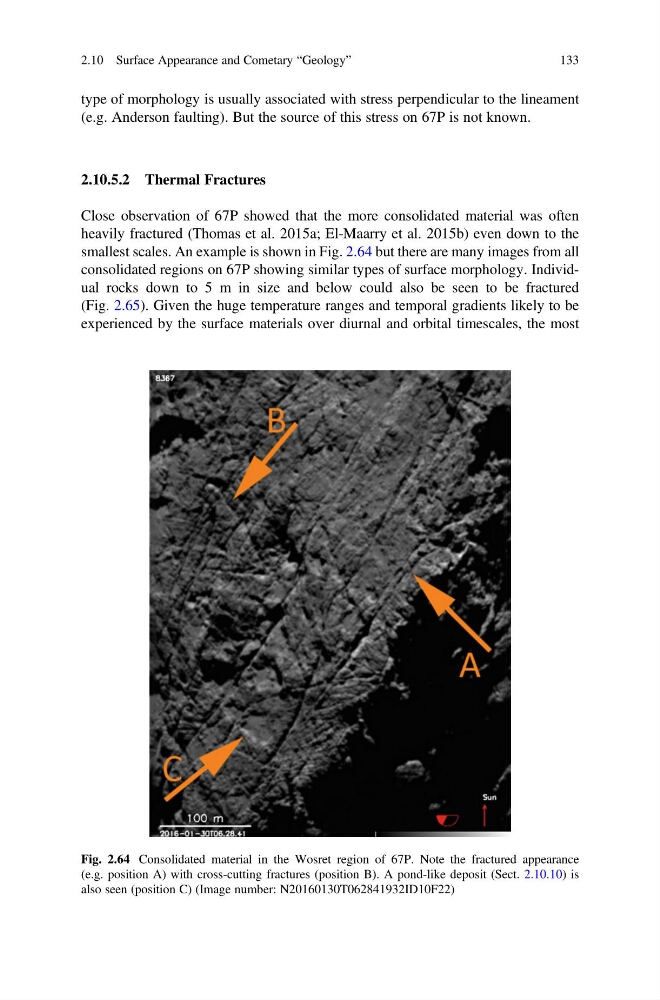
smallest scales. An example is shown in Fig. 2.64 but there are many images from all
consolidated regions on 67P showing similar types of surface morphology. Individual rocks down to 5 m in size and below could also be seen to be fractured
(Fig. 2.65). Given the huge temperature ranges and temporal gradients likely to be
experienced by the surface materials over diurnal and orbital timescales, the most
Fig. 2.64 Consolidated material in the Wosret region of 67P. Note the fractured appearance
(e.g. position A) with cross-cutting fractures (position B). A pond-like deposit (Sect. 2.10.10) is
also seen (position C) (Image number: N20160130T062841932ID10F22)
2.10 Surface Appearance and Cometary “Geology”
133
(e.g. Anderson faulting). But the source of this stress on 67P is not known.
2.10.5.2 Thermal Fractures
Close observation of 67P showed that the more consolidated material was often
heavily fractured (Thomas et al. 2015a; El-Maarry et al. 2015b) even down to the
smallest scales. An example is shown in Fig. 2.64 but there are many images from all
consolidated regions on 67P showing similar types of surface morphology. Individual rocks down to 5 m in size and below could also be seen to be fractured
(Fig. 2.65). Given the huge temperature ranges and temporal gradients likely to be
experienced by the surface materials over diurnal and orbital timescales, the most
Fig. 2.64 Consolidated material in the Wosret region of 67P. Note the fractured appearance
(e.g. position A) with cross-cutting fractures (position B). A pond-like deposit (Sect. 2.10.10) is
also seen (position C) (Image number: N20160130T062841932ID10F22)
2.10 Surface Appearance and Cometary “Geology”
133