

Hviid (pers. comm.) has performed a more detailed calculation specifically for
67P and estimated that the centripetal acceleration will overcome gravitational
acceleration when the spin period becomes less than ~3.7 h, in close agreement
with the more general solution given by Eq. (2.36). Under the assumption of nearzero tensile strength (Groussin et al. 2015a) splitting at this time would appear to be
inevitable.
The stresses in the neck region may also be enhanced by the asymmetric torques
from activity. The mass loss from the head is phase shifted with respect to the body
with the resultant reaction forces acting along vectors that are time variable. In
addition to modifying the rotational properties, these forces act to stress the neck
region and may also contribute to the observed fractures.
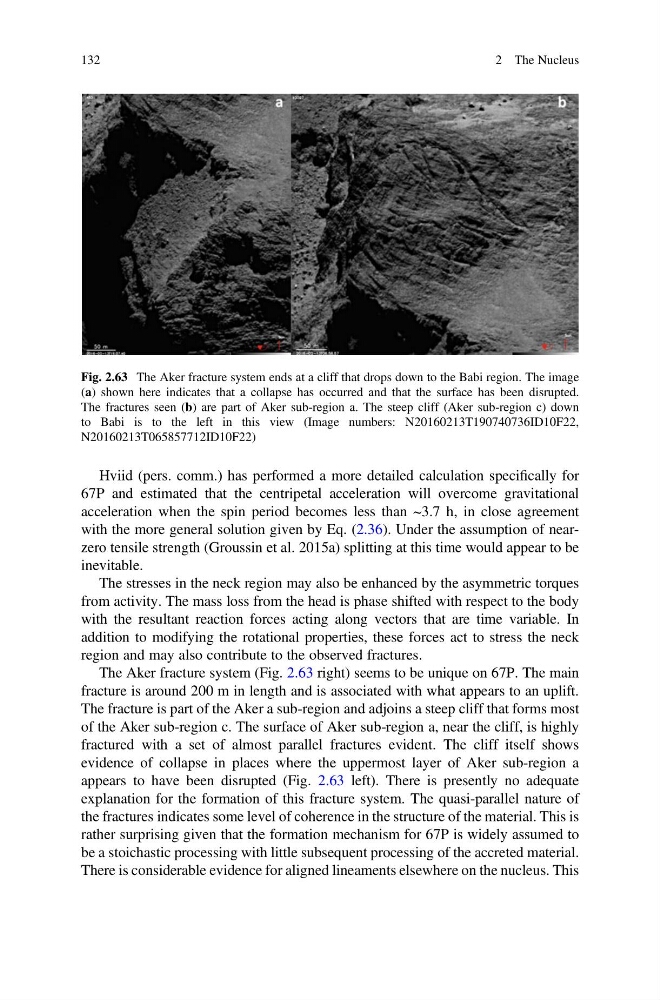
The Aker fracture system (Fig. 2.63 right) seems to be unique on 67P. The main
fracture is around 200 m in length and is associated with what appears to an uplift.
The fracture is part of the Aker a sub-region and adjoins a steep cliff that forms most
of the Aker sub-region c. The surface of Aker sub-region a, near the cliff, is highly
fractured with a set of almost parallel fractures evident. The cliff itself shows
evidence of collapse in places where the uppermost layer of Aker sub-region a
appears to have been disrupted (Fig. 2.63 left). There is presently no adequate
explanation for the formation of this fracture system. The quasi-parallel nature of
the fractures indicates some level of coherence in the structure of the material. This is
rather surprising given that the formation mechanism for 67P is widely assumed to
be a stoichastic processing with little subsequent processing of the accreted material.
There is considerable evidence for aligned lineaments elsewhere on the nucleus. This
Fig. 2.63 The Aker fracture system ends at a cliff that drops down to the Babi region. The image
(a) shown here indicates that a collapse has occurred and that the surface has been disrupted.
The fractures seen (b) are part of Aker sub-region a. The steep cliff (Aker sub-region c) down
to Babi is to the left in this view (Image numbers: N20160213T190740736ID10F22,
N20160213T065857712ID10F22)
132
2 The Nucleus
67P and estimated that the centripetal acceleration will overcome gravitational
acceleration when the spin period becomes less than ~3.7 h, in close agreement
with the more general solution given by Eq. (2.36). Under the assumption of nearzero tensile strength (Groussin et al. 2015a) splitting at this time would appear to be
inevitable.
The stresses in the neck region may also be enhanced by the asymmetric torques
from activity. The mass loss from the head is phase shifted with respect to the body
with the resultant reaction forces acting along vectors that are time variable. In
addition to modifying the rotational properties, these forces act to stress the neck
region and may also contribute to the observed fractures.
The Aker fracture system (Fig. 2.63 right) seems to be unique on 67P. The main
fracture is around 200 m in length and is associated with what appears to an uplift.
The fracture is part of the Aker a sub-region and adjoins a steep cliff that forms most
of the Aker sub-region c. The surface of Aker sub-region a, near the cliff, is highly
fractured with a set of almost parallel fractures evident. The cliff itself shows
evidence of collapse in places where the uppermost layer of Aker sub-region a
appears to have been disrupted (Fig. 2.63 left). There is presently no adequate
explanation for the formation of this fracture system. The quasi-parallel nature of
the fractures indicates some level of coherence in the structure of the material. This is
rather surprising given that the formation mechanism for 67P is widely assumed to
be a stoichastic processing with little subsequent processing of the accreted material.
There is considerable evidence for aligned lineaments elsewhere on the nucleus. This
Fig. 2.63 The Aker fracture system ends at a cliff that drops down to the Babi region. The image
(a) shown here indicates that a collapse has occurred and that the surface has been disrupted.
The fractures seen (b) are part of Aker sub-region a. The steep cliff (Aker sub-region c) down
to Babi is to the left in this view (Image numbers: N20160213T190740736ID10F22,
N20160213T065857712ID10F22)
132
2 The Nucleus