

2.10.5 Fracturing
The resolution on the nucleus obtained by the OSIRIS instrument on Rosetta has
been unique in that it has allowed the identification of fractures in consolidated
material. Following a detailed analysis, El-Maarry et al. (2015b) suggested six
different morphologies were present on the nucleus. Here we group these into two
main types.
2.10.5.1 Torque-Induced and Other Possible Tectonic Fractures
Previously, we have seen how the angular velocity of the nucleus of 67P increased
during the 2015 perihelion passage. This increased the centripetal acceleration and
increased the stress at the neck. The asymmetric and time-varying torque on the two
lobes of the nucleus as a result of the reaction forces arising from sublimation and
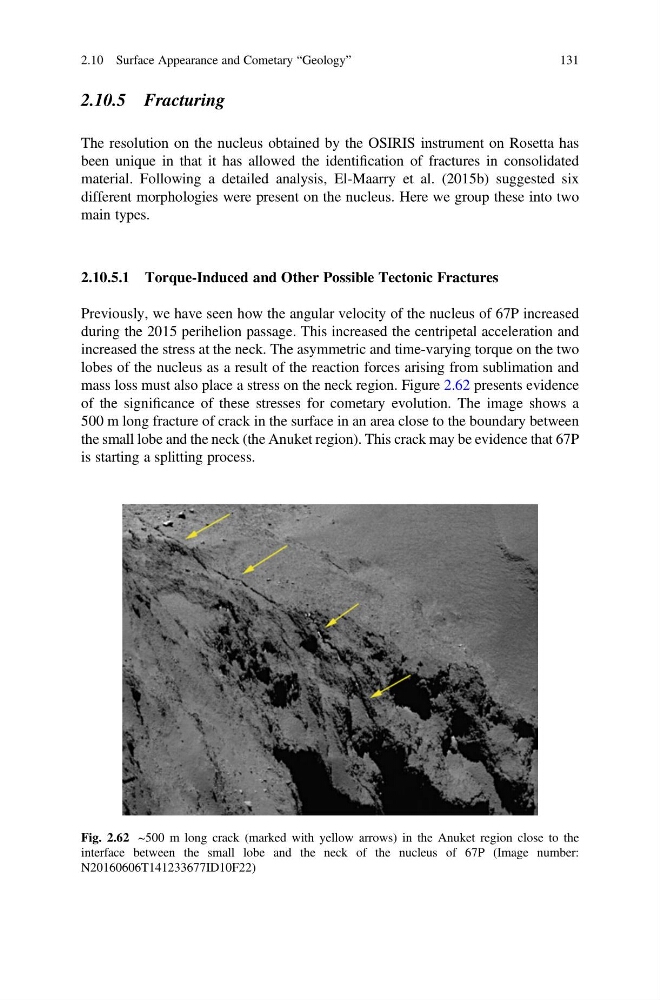
mass loss must also place a stress on the neck region. Figure 2.62 presents evidence
of the significance of these stresses for cometary evolution. The image shows a
500 m long fracture of crack in the surface in an area close to the boundary between
the small lobe and the neck (the Anuket region). This crack may be evidence that 67P
is starting a splitting process.
Fig. 2.62 ~500 m long crack (marked with yellow arrows) in the Anuket region close to the
interface between the small lobe and the neck of the nucleus of 67P (Image number:
N20160606T141233677ID10F22)
2.10 Surface Appearance and Cometary “Geology”
131
The resolution on the nucleus obtained by the OSIRIS instrument on Rosetta has
been unique in that it has allowed the identification of fractures in consolidated
material. Following a detailed analysis, El-Maarry et al. (2015b) suggested six
different morphologies were present on the nucleus. Here we group these into two
main types.
2.10.5.1 Torque-Induced and Other Possible Tectonic Fractures
Previously, we have seen how the angular velocity of the nucleus of 67P increased
during the 2015 perihelion passage. This increased the centripetal acceleration and
increased the stress at the neck. The asymmetric and time-varying torque on the two
lobes of the nucleus as a result of the reaction forces arising from sublimation and
mass loss must also place a stress on the neck region. Figure 2.62 presents evidence
of the significance of these stresses for cometary evolution. The image shows a
500 m long fracture of crack in the surface in an area close to the boundary between
the small lobe and the neck (the Anuket region). This crack may be evidence that 67P
is starting a splitting process.
Fig. 2.62 ~500 m long crack (marked with yellow arrows) in the Anuket region close to the
interface between the small lobe and the neck of the nucleus of 67P (Image number:
N20160606T141233677ID10F22)
2.10 Surface Appearance and Cometary “Geology”
131