

directly on the cliff. Consequently, the build-up of an ice-poor layer took longer than
had a flat surface been exposed.
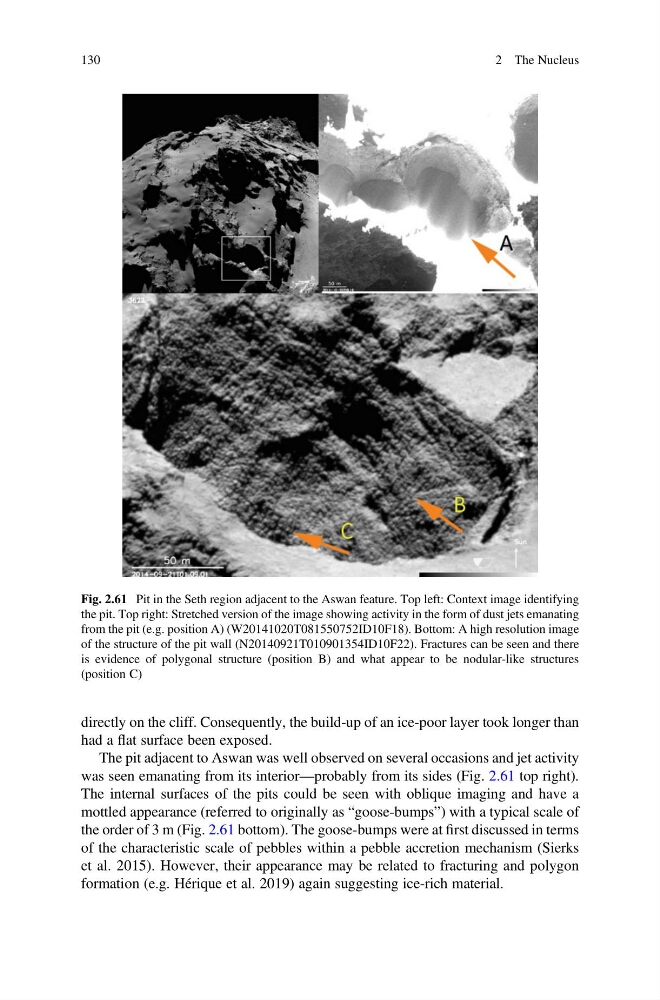
The pit adjacent to Aswan was well observed on several occasions and jet activity
was seen emanating from its interior—probably from its sides (Fig. 2.61 top right).
The internal surfaces of the pits could be seen with oblique imaging and have a
mottled appearance (referred to originally as “goose-bumps”) with a typical scale of
the order of 3 m (Fig. 2.61 bottom). The goose-bumps were at first discussed in terms
of the characteristic scale of pebbles within a pebble accretion mechanism (Sierks
et al. 2015). However, their appearance may be related to fracturing and polygon
formation (e.g. Hérique et al. 2019) again suggesting ice-rich material.
Fig. 2.61 Pit in the Seth region adjacent to the Aswan feature. Top left: Context image identifying
the pit. Top right: Stretched version of the image showing activity in the form of dust jets emanating
from the pit (e.g. position A) (W20141020T081550752ID10F18). Bottom: A high resolution image
of the structure of the pit wall (N20140921T010901354ID10F22). Fractures can be seen and there
is evidence of polygonal structure (position B) and what appear to be nodular-like structures
(position C)
130
2 The Nucleus
had a flat surface been exposed.
The pit adjacent to Aswan was well observed on several occasions and jet activity
was seen emanating from its interior—probably from its sides (Fig. 2.61 top right).
The internal surfaces of the pits could be seen with oblique imaging and have a
mottled appearance (referred to originally as “goose-bumps”) with a typical scale of
the order of 3 m (Fig. 2.61 bottom). The goose-bumps were at first discussed in terms
of the characteristic scale of pebbles within a pebble accretion mechanism (Sierks
et al. 2015). However, their appearance may be related to fracturing and polygon
formation (e.g. Hérique et al. 2019) again suggesting ice-rich material.
Fig. 2.61 Pit in the Seth region adjacent to the Aswan feature. Top left: Context image identifying
the pit. Top right: Stretched version of the image showing activity in the form of dust jets emanating
from the pit (e.g. position A) (W20141020T081550752ID10F18). Bottom: A high resolution image
of the structure of the pit wall (N20140921T010901354ID10F22). Fractures can be seen and there
is evidence of polygonal structure (position B) and what appear to be nodular-like structures
(position C)
130
2 The Nucleus