

possible origin are grouped into one unit irrespective of their spatial distribution. In a
geological mapping, structural elements such as major faults and fractures are
required to be present, surface deposits should be distinguished and morphological
features such as scarps, dunes, and layers need to be identified (e.g. Fig. 2.47).
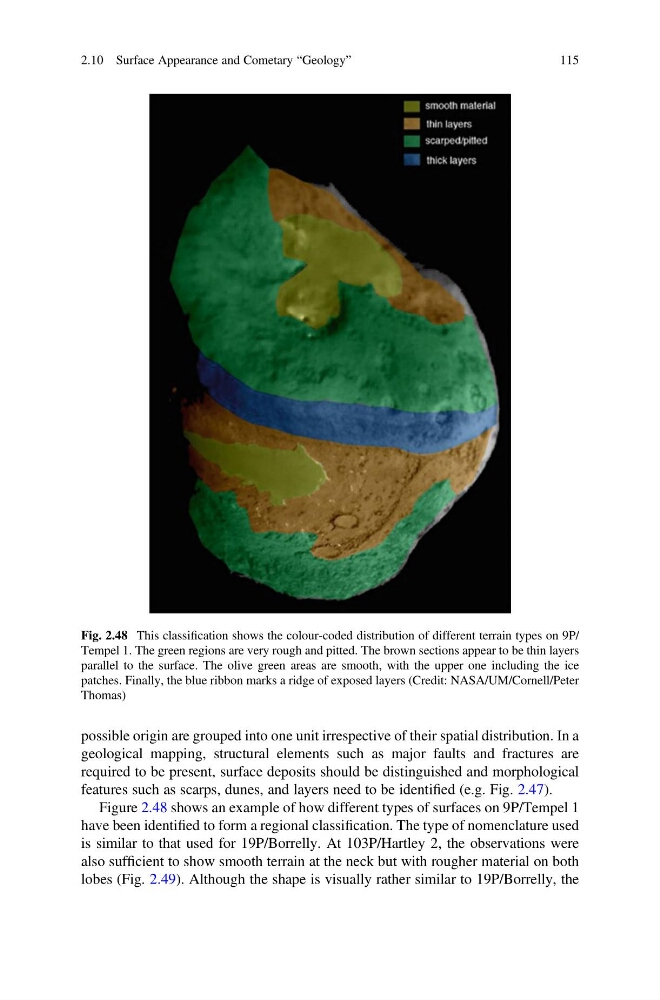
Figure 2.48 shows an example of how different types of surfaces on 9P/Tempel 1
have been identified to form a regional classification. The type of nomenclature used
is similar to that used for 19P/Borrelly. At 103P/Hartley 2, the observations were
also sufficient to show smooth terrain at the neck but with rougher material on both
lobes (Fig. 2.49). Although the shape is visually rather similar to 19P/Borrelly, the
Fig. 2.48 This classification shows the colour-coded distribution of different terrain types on 9P/
Tempel 1. The green regions are very rough and pitted. The brown sections appear to be thin layers
parallel to the surface. The olive green areas are smooth, with the upper one including the ice
patches. Finally, the blue ribbon marks a ridge of exposed layers (Credit: NASA/UM/Cornell/Peter
Thomas)
2.10 Surface Appearance and Cometary “Geology”
115
geological mapping, structural elements such as major faults and fractures are
required to be present, surface deposits should be distinguished and morphological
features such as scarps, dunes, and layers need to be identified (e.g. Fig. 2.47).
Figure 2.48 shows an example of how different types of surfaces on 9P/Tempel 1
have been identified to form a regional classification. The type of nomenclature used
is similar to that used for 19P/Borrelly. At 103P/Hartley 2, the observations were
also sufficient to show smooth terrain at the neck but with rougher material on both
lobes (Fig. 2.49). Although the shape is visually rather similar to 19P/Borrelly, the
Fig. 2.48 This classification shows the colour-coded distribution of different terrain types on 9P/
Tempel 1. The green regions are very rough and pitted. The brown sections appear to be thin layers
parallel to the surface. The olive green areas are smooth, with the upper one including the ice
patches. Finally, the blue ribbon marks a ridge of exposed layers (Credit: NASA/UM/Cornell/Peter
Thomas)
2.10 Surface Appearance and Cometary “Geology”
115