

2.10.1 Regional Classification
The range of topography on 1P/Halley was intriguing but said relatively little about
the local surface texture. As resolution on cometary nuclei has improved, it has
become apparent that surface texture varies such that globally surfaces are inhomogeneous in appearance. The observation of 19P/Borrelly (Fig. 2.47) hinted at this
and the nucleus was divided into regions with different surface textures. The
descriptions were rather crude and the interpretation of some of the features as
“mesas” can be challenged (cf. Britt et al. 2004; Thomas et al. 2013a) but these
data were important as they indicated that areas of different texture or structure were
present on individual nuclei that could, in turn, be interpreted in morphological
terms. The Deep Impact observations at 9P/Tempel 1 (Fig. 2.48) and subsequently at
103P/Hartley 2 (Fig. 2.49) provided considerably more evidence for surface textural
inhomogeneity (Thomas et al. 2013a, b). In the case of the latter, a smooth neckregion between two rougher lobes could be observed. The appearance of smooth
terrain at topographic/gravitational lows seems to be a recurring theme on nuclei and
has been seen on 103P/Hartley 2, 67P, and, arguably, 1P/Halley.
The only resolved nucleus that appears to be more uniform in texture is that of
81P/Wild 2 (Fig. 2.2). Here the surface is characterized by quasi-circular depressions
up to nearly 2 km across. These depressions covered the visible surface although two
different morphologies (pit halo and flat floor) could be identified (Brownlee et al.
2004).
In the case of 67P, the textural inhomogeneity is extreme although one needs to
be careful in that the more than 10-fold improvement in resolution has, almost
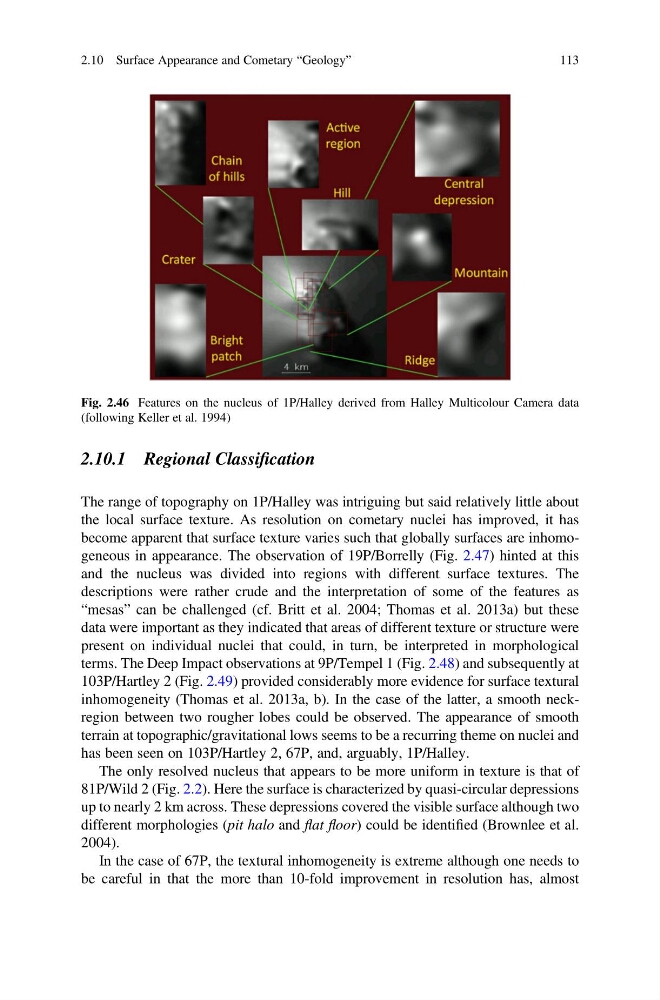
Fig. 2.46 Features on the nucleus of 1P/Halley derived from Halley Multicolour Camera data
(following Keller et al. 1994)
2.10 Surface Appearance and Cometary “Geology”
113
The range of topography on 1P/Halley was intriguing but said relatively little about
the local surface texture. As resolution on cometary nuclei has improved, it has
become apparent that surface texture varies such that globally surfaces are inhomogeneous in appearance. The observation of 19P/Borrelly (Fig. 2.47) hinted at this
and the nucleus was divided into regions with different surface textures. The
descriptions were rather crude and the interpretation of some of the features as
“mesas” can be challenged (cf. Britt et al. 2004; Thomas et al. 2013a) but these
data were important as they indicated that areas of different texture or structure were
present on individual nuclei that could, in turn, be interpreted in morphological
terms. The Deep Impact observations at 9P/Tempel 1 (Fig. 2.48) and subsequently at
103P/Hartley 2 (Fig. 2.49) provided considerably more evidence for surface textural
inhomogeneity (Thomas et al. 2013a, b). In the case of the latter, a smooth neckregion between two rougher lobes could be observed. The appearance of smooth
terrain at topographic/gravitational lows seems to be a recurring theme on nuclei and
has been seen on 103P/Hartley 2, 67P, and, arguably, 1P/Halley.
The only resolved nucleus that appears to be more uniform in texture is that of
81P/Wild 2 (Fig. 2.2). Here the surface is characterized by quasi-circular depressions
up to nearly 2 km across. These depressions covered the visible surface although two
different morphologies (pit halo and flat floor) could be identified (Brownlee et al.
2004).
In the case of 67P, the textural inhomogeneity is extreme although one needs to
be careful in that the more than 10-fold improvement in resolution has, almost
Fig. 2.46 Features on the nucleus of 1P/Halley derived from Halley Multicolour Camera data
(following Keller et al. 1994)
2.10 Surface Appearance and Cometary “Geology”
113