

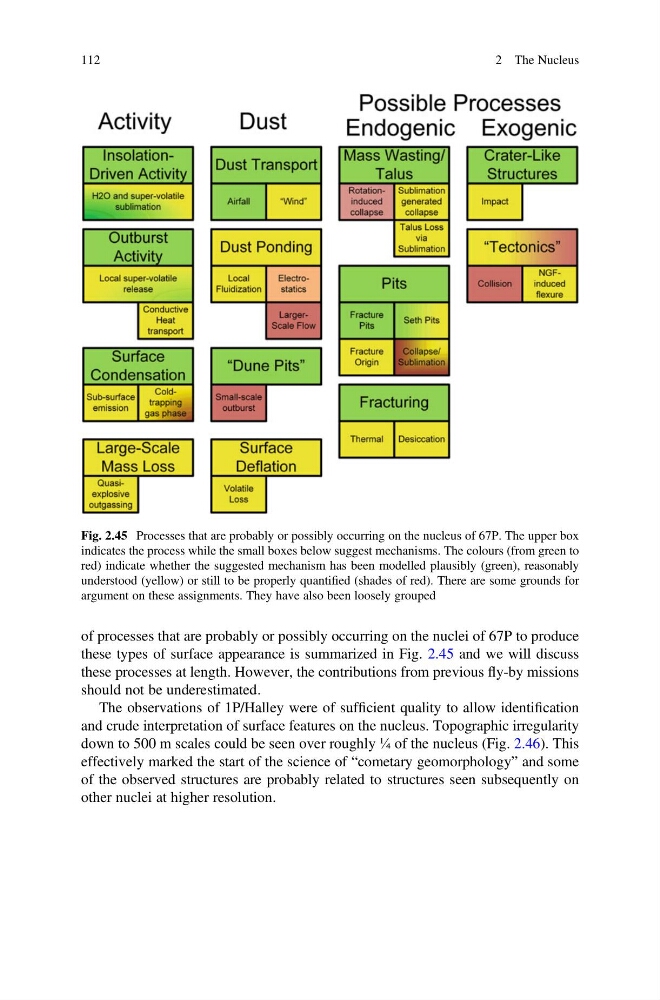
of processes that are probably or possibly occurring on the nuclei of 67P to produce
these types of surface appearance is summarized in Fig. 2.45 and we will discuss
these processes at length. However, the contributions from previous fly-by missions
should not be underestimated.
The observations of 1P/Halley were of sufficient quality to allow identification
and crude interpretation of surface features on the nucleus. Topographic irregularity
down to 500 m scales could be seen over roughly ¼ of the nucleus (Fig. 2.46). This
effectively marked the start of the science of “cometary geomorphology” and some
of the observed structures are probably related to structures seen subsequently on
other nuclei at higher resolution.
Fig. 2.45 Processes that are probably or possibly occurring on the nucleus of 67P. The upper box
indicates the process while the small boxes below suggest mechanisms. The colours (from green to
red) indicate whether the suggested mechanism has been modelled plausibly (green), reasonably
understood (yellow) or still to be properly quantified (shades of red). There are some grounds for
argument on these assignments. They have also been loosely grouped
112
2 The Nucleus
these types of surface appearance is summarized in Fig. 2.45 and we will discuss
these processes at length. However, the contributions from previous fly-by missions
should not be underestimated.
The observations of 1P/Halley were of sufficient quality to allow identification
and crude interpretation of surface features on the nucleus. Topographic irregularity
down to 500 m scales could be seen over roughly ¼ of the nucleus (Fig. 2.46). This
effectively marked the start of the science of “cometary geomorphology” and some
of the observed structures are probably related to structures seen subsequently on
other nuclei at higher resolution.
Fig. 2.45 Processes that are probably or possibly occurring on the nucleus of 67P. The upper box
indicates the process while the small boxes below suggest mechanisms. The colours (from green to
red) indicate whether the suggested mechanism has been modelled plausibly (green), reasonably
understood (yellow) or still to be properly quantified (shades of red). There are some grounds for
argument on these assignments. They have also been loosely grouped
112
2 The Nucleus