

surface is at 300 K, the unilluminated cliff will be at 252 K and thus well above the
free sublimation temperature of water ice. On the other hand, realistic cases have
shown this effect to be small on global scales (Marschall 2017; Marschall et al.
2017). Nonetheless, locally there may still be need to take such effects into account
for specific geometries (Höfner et al. 2017).
2.10 Surface Appearance and Cometary “Geology”
Arguably, it is in the field of cometary geomorphology that the Rosetta mission has
made the biggest contribution to cometary research. The rendezvous and nearnucleus mapping allowed ultra-high (<1 m px
À1 ) imaging of the surface. An
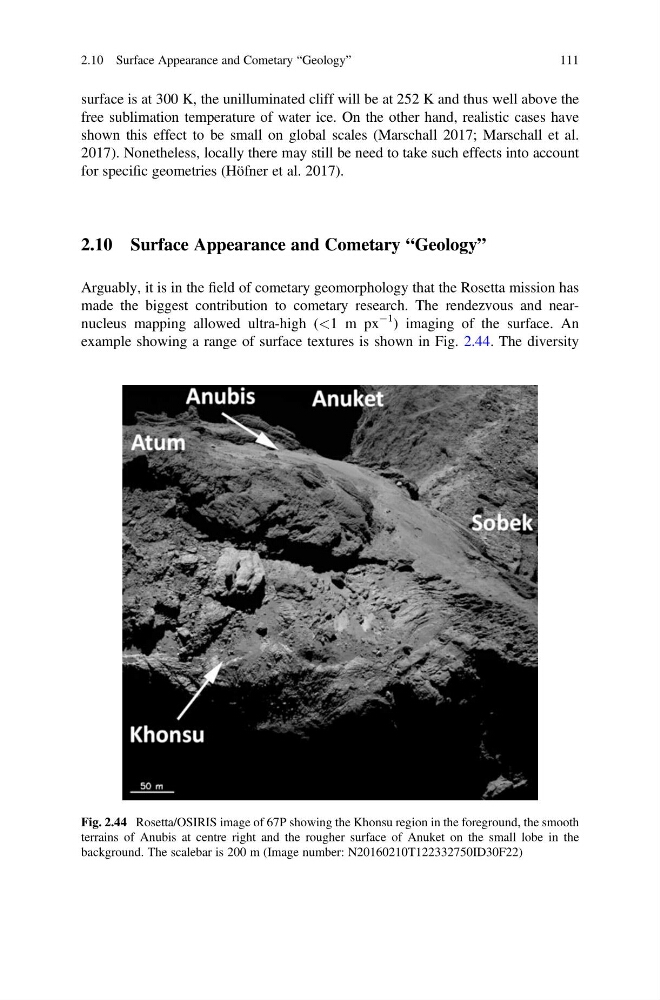
example showing a range of surface textures is shown in Fig. 2.44. The diversity
Fig. 2.44 Rosetta/OSIRIS image of 67P showing the Khonsu region in the foreground, the smooth
terrains of Anubis at centre right and the rougher surface of Anuket on the small lobe in the
background. The scalebar is 200 m (Image number: N20160210T122332750ID30F22)
2.10 Surface Appearance and Cometary “Geology”
111
free sublimation temperature of water ice. On the other hand, realistic cases have
shown this effect to be small on global scales (Marschall 2017; Marschall et al.
2017). Nonetheless, locally there may still be need to take such effects into account
for specific geometries (Höfner et al. 2017).
2.10 Surface Appearance and Cometary “Geology”
Arguably, it is in the field of cometary geomorphology that the Rosetta mission has
made the biggest contribution to cometary research. The rendezvous and nearnucleus mapping allowed ultra-high (<1 m px
À1 ) imaging of the surface. An
example showing a range of surface textures is shown in Fig. 2.44. The diversity
Fig. 2.44 Rosetta/OSIRIS image of 67P showing the Khonsu region in the foreground, the smooth
terrains of Anubis at centre right and the rougher surface of Anuket on the small lobe in the
background. The scalebar is 200 m (Image number: N20160210T122332750ID30F22)
2.10 Surface Appearance and Cometary “Geology”
111