

Thermal emission is “beamed” into the sunward direction so that, at low phase
angles, higher flux levels are observed at an elevated apparent colour temperature.
This effect is referred to as thermal-infrared beaming and is accounted for by an
additional parameter, η th , the infrared beaming parameter (Lebofsky et al. 1986),
entering in the radiative loss term in the energy balance equation leading to an
equation
F th ¼
2
3
η th ε S ⨀ 1 À A H
ð
Þ
r
2
N
Δ
2 r 2
h
ð2:127Þ
for the thermal flux at zero phase angle geometry. This constitutes the refined
standard thermal model (STM) for asteroids. Lagerros (1998) attempted to provide
a physical explanation of this quantity by studying regular-shaped and stochastic
surface roughness. The implementation of this type of approach on local scales for
resolved observations would be challenging as there would be a need to define the
small scale roughness within the measurement footprint.
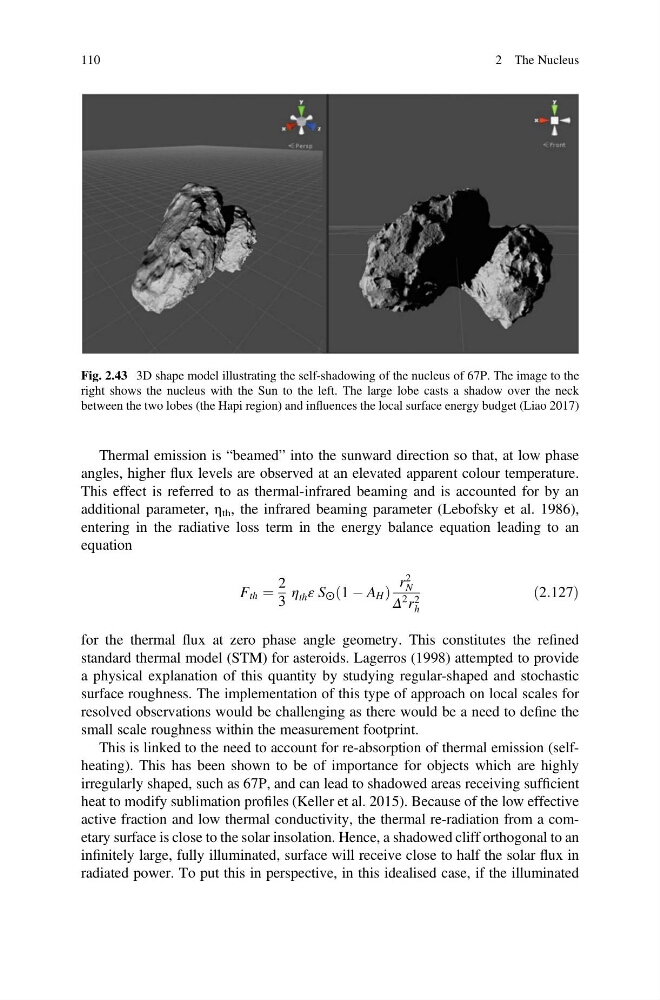
This is linked to the need to account for re-absorption of thermal emission (selfheating). This has been shown to be of importance for objects which are highly
irregularly shaped, such as 67P, and can lead to shadowed areas receiving sufficient
heat to modify sublimation profiles (Keller et al. 2015). Because of the low effective
active fraction and low thermal conductivity, the thermal re-radiation from a cometary surface is close to the solar insolation. Hence, a shadowed cliff orthogonal to an
infinitely large, fully illuminated, surface will receive close to half the solar flux in
radiated power. To put this in perspective, in this idealised case, if the illuminated
Fig. 2.43 3D shape model illustrating the self-shadowing of the nucleus of 67P. The image to the
right shows the nucleus with the Sun to the left. The large lobe casts a shadow over the neck
between the two lobes (the Hapi region) and influences the local surface energy budget (Liao 2017)
110
2 The Nucleus
angles, higher flux levels are observed at an elevated apparent colour temperature.
This effect is referred to as thermal-infrared beaming and is accounted for by an
additional parameter, η th , the infrared beaming parameter (Lebofsky et al. 1986),
entering in the radiative loss term in the energy balance equation leading to an
equation
F th ¼
2
3
η th ε S ⨀ 1 À A H
ð
Þ
r
2
N
Δ
2 r 2
h
ð2:127Þ
for the thermal flux at zero phase angle geometry. This constitutes the refined
standard thermal model (STM) for asteroids. Lagerros (1998) attempted to provide
a physical explanation of this quantity by studying regular-shaped and stochastic
surface roughness. The implementation of this type of approach on local scales for
resolved observations would be challenging as there would be a need to define the
small scale roughness within the measurement footprint.
This is linked to the need to account for re-absorption of thermal emission (selfheating). This has been shown to be of importance for objects which are highly
irregularly shaped, such as 67P, and can lead to shadowed areas receiving sufficient
heat to modify sublimation profiles (Keller et al. 2015). Because of the low effective
active fraction and low thermal conductivity, the thermal re-radiation from a cometary surface is close to the solar insolation. Hence, a shadowed cliff orthogonal to an
infinitely large, fully illuminated, surface will receive close to half the solar flux in
radiated power. To put this in perspective, in this idealised case, if the illuminated
Fig. 2.43 3D shape model illustrating the self-shadowing of the nucleus of 67P. The image to the
right shows the nucleus with the Sun to the left. The large lobe casts a shadow over the neck
between the two lobes (the Hapi region) and influences the local surface energy budget (Liao 2017)
110
2 The Nucleus