

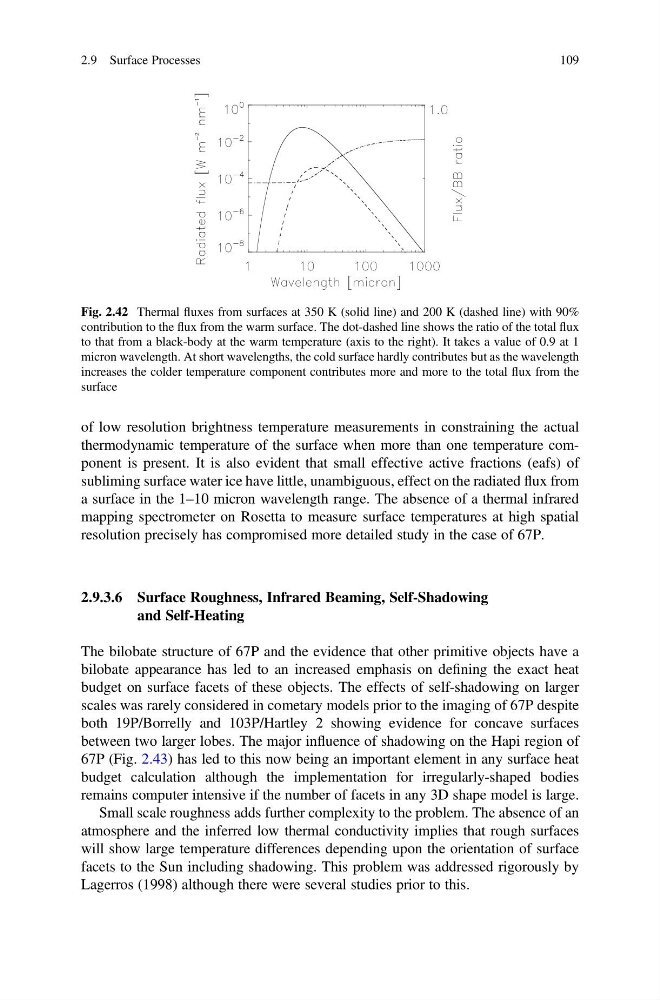
of low resolution brightness temperature measurements in constraining the actual
thermodynamic temperature of the surface when more than one temperature component is present. It is also evident that small effective active fractions (eafs) of
subliming surface water ice have little, unambiguous, effect on the radiated flux from
a surface in the 1–10 micron wavelength range. The absence of a thermal infrared
mapping spectrometer on Rosetta to measure surface temperatures at high spatial
resolution precisely has compromised more detailed study in the case of 67P.
2.9.3.6 Surface Roughness, Infrared Beaming, Self-Shadowing
and Self-Heating
The bilobate structure of 67P and the evidence that other primitive objects have a
bilobate appearance has led to an increased emphasis on defining the exact heat
budget on surface facets of these objects. The effects of self-shadowing on larger
scales was rarely considered in cometary models prior to the imaging of 67P despite
both 19P/Borrelly and 103P/Hartley 2 showing evidence for concave surfaces
between two larger lobes. The major influence of shadowing on the Hapi region of
67P (Fig. 2.43) has led to this now being an important element in any surface heat
budget calculation although the implementation for irregularly-shaped bodies
remains computer intensive if the number of facets in any 3D shape model is large.
Small scale roughness adds further complexity to the problem. The absence of an
atmosphere and the inferred low thermal conductivity implies that rough surfaces
will show large temperature differences depending upon the orientation of surface
facets to the Sun including shadowing. This problem was addressed rigorously by
Lagerros (1998) although there were several studies prior to this.
Fig. 2.42 Thermal fluxes from surfaces at 350 K (solid line) and 200 K (dashed line) with 90%
contribution to the flux from the warm surface. The dot-dashed line shows the ratio of the total flux
to that from a black-body at the warm temperature (axis to the right). It takes a value of 0.9 at 1
micron wavelength. At short wavelengths, the cold surface hardly contributes but as the wavelength
increases the colder temperature component contributes more and more to the total flux from the
surface
2.9 Surface Processes
109
thermodynamic temperature of the surface when more than one temperature component is present. It is also evident that small effective active fractions (eafs) of
subliming surface water ice have little, unambiguous, effect on the radiated flux from
a surface in the 1–10 micron wavelength range. The absence of a thermal infrared
mapping spectrometer on Rosetta to measure surface temperatures at high spatial
resolution precisely has compromised more detailed study in the case of 67P.
2.9.3.6 Surface Roughness, Infrared Beaming, Self-Shadowing
and Self-Heating
The bilobate structure of 67P and the evidence that other primitive objects have a
bilobate appearance has led to an increased emphasis on defining the exact heat
budget on surface facets of these objects. The effects of self-shadowing on larger
scales was rarely considered in cometary models prior to the imaging of 67P despite
both 19P/Borrelly and 103P/Hartley 2 showing evidence for concave surfaces
between two larger lobes. The major influence of shadowing on the Hapi region of
67P (Fig. 2.43) has led to this now being an important element in any surface heat
budget calculation although the implementation for irregularly-shaped bodies
remains computer intensive if the number of facets in any 3D shape model is large.
Small scale roughness adds further complexity to the problem. The absence of an
atmosphere and the inferred low thermal conductivity implies that rough surfaces
will show large temperature differences depending upon the orientation of surface
facets to the Sun including shadowing. This problem was addressed rigorously by
Lagerros (1998) although there were several studies prior to this.
Fig. 2.42 Thermal fluxes from surfaces at 350 K (solid line) and 200 K (dashed line) with 90%
contribution to the flux from the warm surface. The dot-dashed line shows the ratio of the total flux
to that from a black-body at the warm temperature (axis to the right). It takes a value of 0.9 at 1
micron wavelength. At short wavelengths, the cold surface hardly contributes but as the wavelength
increases the colder temperature component contributes more and more to the total flux from the
surface
2.9 Surface Processes
109