

τ diff ¼
L
2
d t
¼
r
2
N
d t
ð2:122Þ
where L is a length scale that we can assume to be the radius of the nucleus, r N , we
can estimate that the nucleus may need to be in a stable state for ~5 million years to
equilibrate. This implies that, even for objects that have completed many revolutions
in the inner Solar System, the internal temperature may be a residual from when the
comet was in an earlier, and perhaps its original, reservoir and may be different from
comet to comet. This produces uncertainty in the boundary conditions for thermal
calculations because the internal temperature should be specified for short-term
calculations. The value assumed influences the temperature gradients within a few
skin depths of the surface and this, in turn, can influence the energy input to
potentially important sub-surface super-volatile reservoirs.
This is illustrated in Fig. 2.39 which compares identical simple thermal models in
which two different internal temperatures, 40 K and 100 K, have been chosen. The
resulting temperature structure at midday and midnight are shown for the two cases.
As might be expected, the temperature structure, 15 cm and below, is almost
independent of local time. However, the different internal temperatures influence
the temperature right up to the surface, especially on the nightside. This can
influence the loss of CO 2 on the nightside, for example, as the diurnal thermal
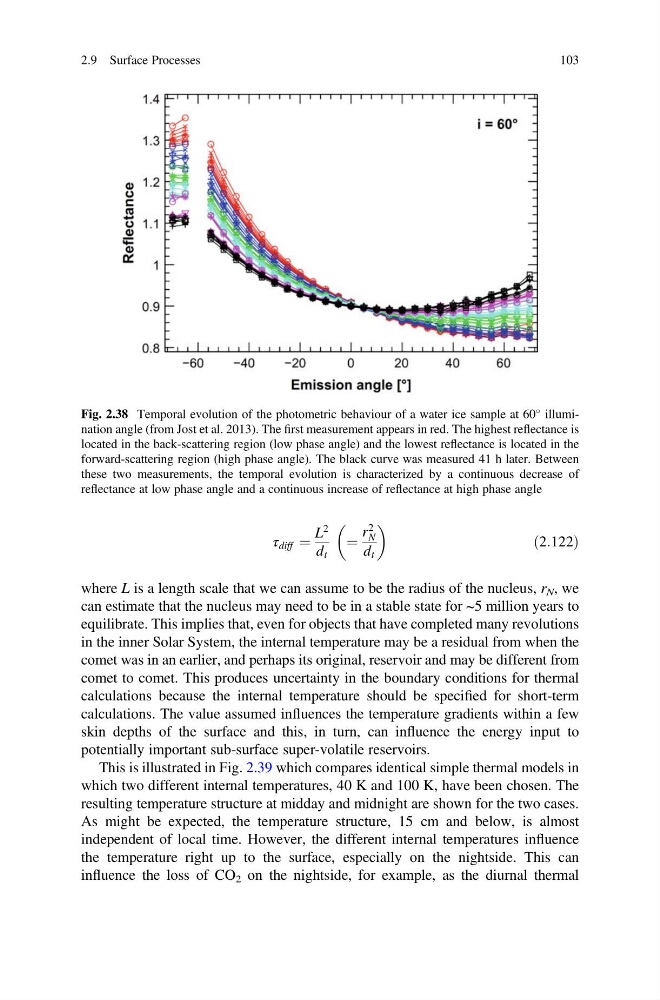
Fig. 2.38 Temporal evolution of the photometric behaviour of a water ice sample at 60
illumination angle (from Jost et al. 2013). The first measurement appears in red. The highest reflectance is
located in the back-scattering region (low phase angle) and the lowest reflectance is located in the
forward-scattering region (high phase angle). The black curve was measured 41 h later. Between
these two measurements, the temporal evolution is characterized by a continuous decrease of
reflectance at low phase angle and a continuous increase of reflectance at high phase angle
2.9 Surface Processes
103
L
2
d t
¼
r
2
N
d t
ð2:122Þ
where L is a length scale that we can assume to be the radius of the nucleus, r N , we
can estimate that the nucleus may need to be in a stable state for ~5 million years to
equilibrate. This implies that, even for objects that have completed many revolutions
in the inner Solar System, the internal temperature may be a residual from when the
comet was in an earlier, and perhaps its original, reservoir and may be different from
comet to comet. This produces uncertainty in the boundary conditions for thermal
calculations because the internal temperature should be specified for short-term
calculations. The value assumed influences the temperature gradients within a few
skin depths of the surface and this, in turn, can influence the energy input to
potentially important sub-surface super-volatile reservoirs.
This is illustrated in Fig. 2.39 which compares identical simple thermal models in
which two different internal temperatures, 40 K and 100 K, have been chosen. The
resulting temperature structure at midday and midnight are shown for the two cases.
As might be expected, the temperature structure, 15 cm and below, is almost
independent of local time. However, the different internal temperatures influence
the temperature right up to the surface, especially on the nightside. This can
influence the loss of CO 2 on the nightside, for example, as the diurnal thermal
Fig. 2.38 Temporal evolution of the photometric behaviour of a water ice sample at 60
illumination angle (from Jost et al. 2013). The first measurement appears in red. The highest reflectance is
located in the back-scattering region (low phase angle) and the lowest reflectance is located in the
forward-scattering region (high phase angle). The black curve was measured 41 h later. Between
these two measurements, the temporal evolution is characterized by a continuous decrease of
reflectance at low phase angle and a continuous increase of reflectance at high phase angle
2.9 Surface Processes
103