

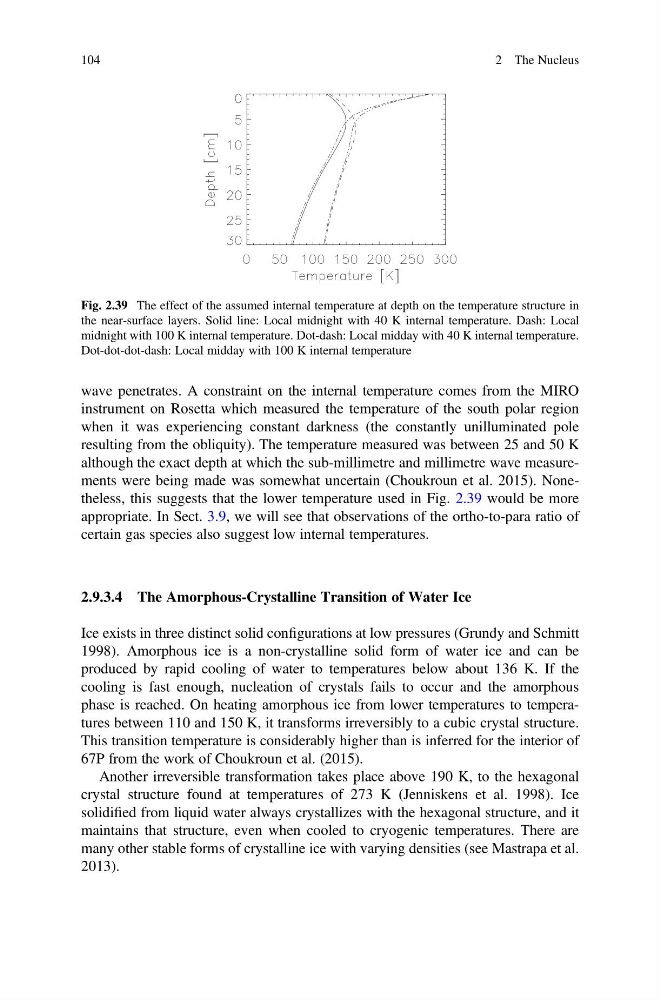
wave penetrates. A constraint on the internal temperature comes from the MIRO
instrument on Rosetta which measured the temperature of the south polar region
when it was experiencing constant darkness (the constantly unilluminated pole
resulting from the obliquity). The temperature measured was between 25 and 50 K
although the exact depth at which the sub-millimetre and millimetre wave measurements were being made was somewhat uncertain (Choukroun et al. 2015). Nonetheless, this suggests that the lower temperature used in Fig. 2.39 would be more
appropriate. In Sect. 3.9, we will see that observations of the ortho-to-para ratio of
certain gas species also suggest low internal temperatures.
2.9.3.4 The Amorphous-Crystalline Transition of Water Ice
Ice exists in three distinct solid configurations at low pressures (Grundy and Schmitt
1998). Amorphous ice is a non-crystalline solid form of water ice and can be
produced by rapid cooling of water to temperatures below about 136 K. If the
cooling is fast enough, nucleation of crystals fails to occur and the amorphous
phase is reached. On heating amorphous ice from lower temperatures to temperatures between 110 and 150 K, it transforms irreversibly to a cubic crystal structure.
This transition temperature is considerably higher than is inferred for the interior of
67P from the work of Choukroun et al. (2015).
Another irreversible transformation takes place above 190 K, to the hexagonal
crystal structure found at temperatures of 273 K (Jenniskens et al. 1998). Ice
solidified from liquid water always crystallizes with the hexagonal structure, and it
maintains that structure, even when cooled to cryogenic temperatures. There are
many other stable forms of crystalline ice with varying densities (see Mastrapa et al.
2013).
Fig. 2.39 The effect of the assumed internal temperature at depth on the temperature structure in
the near-surface layers. Solid line: Local midnight with 40 K internal temperature. Dash: Local
midnight with 100 K internal temperature. Dot-dash: Local midday with 40 K internal temperature.
Dot-dot-dot-dash: Local midday with 100 K internal temperature
104
2 The Nucleus
instrument on Rosetta which measured the temperature of the south polar region
when it was experiencing constant darkness (the constantly unilluminated pole
resulting from the obliquity). The temperature measured was between 25 and 50 K
although the exact depth at which the sub-millimetre and millimetre wave measurements were being made was somewhat uncertain (Choukroun et al. 2015). Nonetheless, this suggests that the lower temperature used in Fig. 2.39 would be more
appropriate. In Sect. 3.9, we will see that observations of the ortho-to-para ratio of
certain gas species also suggest low internal temperatures.
2.9.3.4 The Amorphous-Crystalline Transition of Water Ice
Ice exists in three distinct solid configurations at low pressures (Grundy and Schmitt
1998). Amorphous ice is a non-crystalline solid form of water ice and can be
produced by rapid cooling of water to temperatures below about 136 K. If the
cooling is fast enough, nucleation of crystals fails to occur and the amorphous
phase is reached. On heating amorphous ice from lower temperatures to temperatures between 110 and 150 K, it transforms irreversibly to a cubic crystal structure.
This transition temperature is considerably higher than is inferred for the interior of
67P from the work of Choukroun et al. (2015).
Another irreversible transformation takes place above 190 K, to the hexagonal
crystal structure found at temperatures of 273 K (Jenniskens et al. 1998). Ice
solidified from liquid water always crystallizes with the hexagonal structure, and it
maintains that structure, even when cooled to cryogenic temperatures. There are
many other stable forms of crystalline ice with varying densities (see Mastrapa et al.
2013).
Fig. 2.39 The effect of the assumed internal temperature at depth on the temperature structure in
the near-surface layers. Solid line: Local midnight with 40 K internal temperature. Dash: Local
midnight with 100 K internal temperature. Dot-dash: Local midday with 40 K internal temperature.
Dot-dot-dot-dash: Local midday with 100 K internal temperature
104
2 The Nucleus